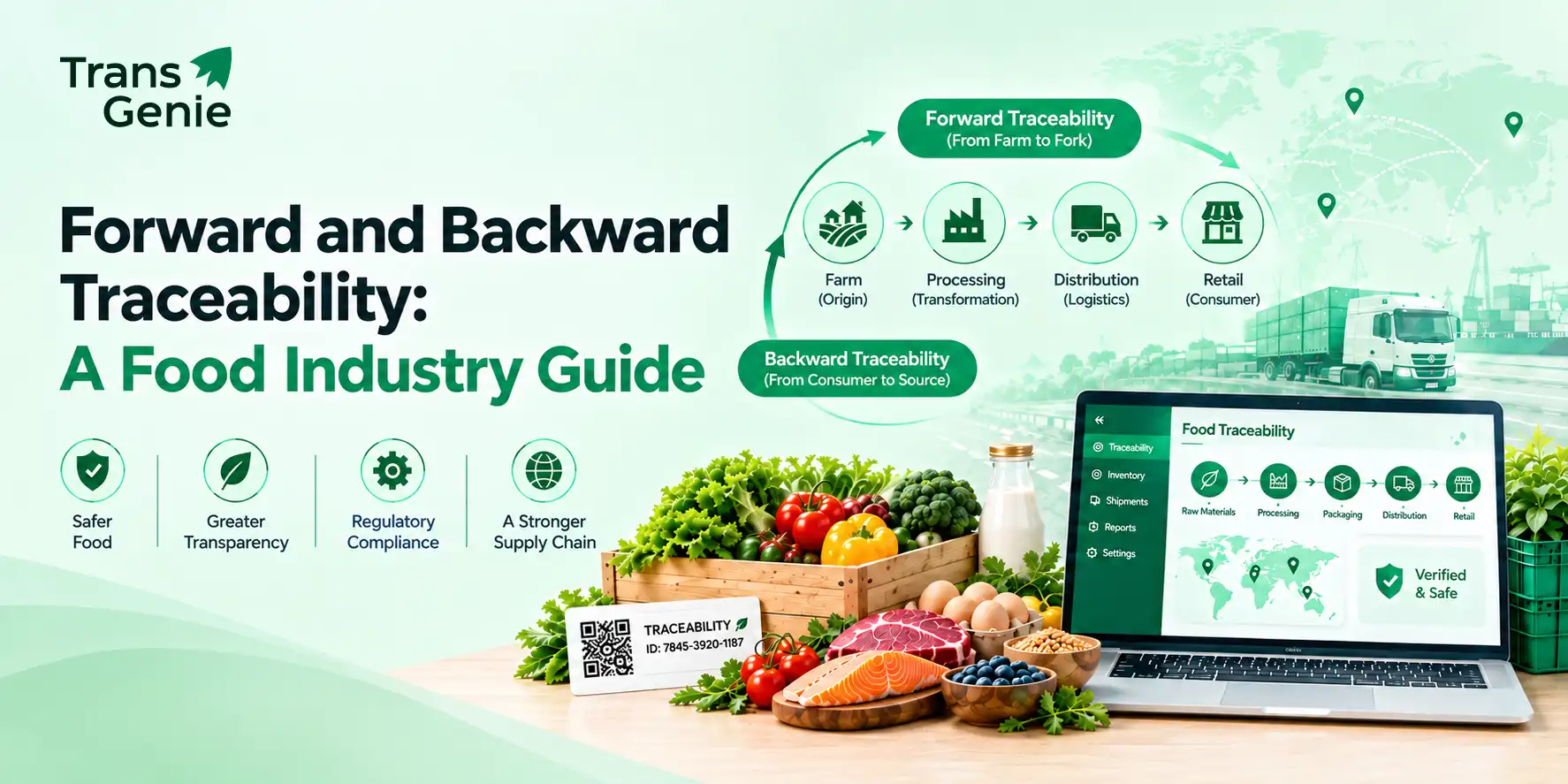
Traceability has two directions, and both answer a different question.
Backward traceability tells you where a product came from - the ingredients, lots, suppliers, and other records behind it.
Whereas forward traceability tells you where a product went - the batches it became part of and the customers or locations that received it.
Most food operations are good at one and weaker at the other. The problem is, you may not notice the gap until a recall, supplier withdrawal, or customer complaint forces your team to trace a product quickly.
This guide explains both directions with a practical lot-code example. We'll also look at what food regulations actually require, where traceability records commonly break, and why internal traceability - the link between receiving and shipping - matters just as much.
Backward traceability takes you from a finished product back to its ingredients and sources. Forward traceability takes you from an ingredient or production lot to the products and customers it reached.
The Two Directions, Defined
Forward and backward traceability are connected, but they are not the same thing. The easiest way to understand the difference is to look at where you start and where you need to go.
Backward traceability starts with a product you have - or a product already with a customer - and works its way back through the supply chain.
For example, if a customer reports an issue with a finished sauce jar, your team should be able to identify the inputs behind it, such as:
- The production batch
- The ingredient lots used in that batch
- The suppliers behind those lots
- The relevant receiving records and dates
In simple terms, you start with the finished product and work backward to its sources. Backward traceability is used when something has gone wrong with a product you have in your facility or one already with your customer, and you need to find out where it came from.
This is also called tracing in many food-supply-chain contexts.
Forward traceability works in the opposite direction. i.e., it starts with something upstream and works downstream.
Suppose one of your suppliers tells you that an ingredient lot needs to be withdrawn. Your team now needs to find every production batch that used that lot and where those finished products were shipped.
That means following the lot from:
The goal is to understand the reach of the affected lot so your team can act on the right products and locations.
This is also commonly referred to as tracking.
They Are Not Interchangeable & Why You Need Both
Knowing where a product came from is only half the picture.
The two directions are used at different times, by different people, and often under very different pressure.
- Backward traceability is usually an investigation. You have a product in front of you, and the question is: Where did this come from?
- Whereas forward traceability is usually more urgent. The product may have already left your facility, and the question becomes: Where did it go?
A system that handles one direction well but struggles with the other may seem perfectly adequate for years. The gap often becomes visible only when you need to trace an affected lot quickly.
At TransGenie, we look at both directions as part of the same traceability chain. Your records should let your team move upstream and downstream without having to piece together information from separate spreadsheets, systems, or manual records.
Think of it this way:
- Backward = source → product
- Forward = product → destination
| Backward Traceability | Forward Traceability | |
|---|---|---|
| Starts with | A finished product, batch, or lot | An ingredient, material, or lot |
| Moves | Upstream | Downstream |
| Main question | Where did this come from? | Where did it go? |
| Helps you find | Ingredients, source lots, suppliers, receiving records | Production batches, shipments, customers, destinations |
| Usually needed when | Investigating a product issue | Containing an affected ingredient or lot |
A Forward and Backward Traceability Example
Definitions only get you so far. Let's use a simple food manufacturing example to see how forward and backward traceability work in practice.
A sauce manufacturer receives three ingredients during the week of 8 September:
| Input | Lot Code | Supplier | Received |
|---|---|---|---|
| Tomato paste | TP-2609-A | Valley Processing | 9 Sep |
| Salt | SLT-4471 | Northern Minerals | 3 Sep |
| Rapeseed oil | OIL-2288 | Delta Oils | 5 Sep |
On 12 September, the plant uses these ingredients to produce 4,800 jars under batch B-260912-02.
The jars are then shipped to three customers:
| Customer | Quantity Shipped | Date |
|---|---|---|
| Retailer A | 2,000 jars | 13 Sep |
| Distributor B | 1,600 jars | 14 Sep |
| Export customer C | 1,200 jars | 16 Sep |
Backward Trace: A Customer Complains
A consumer returns a jar to Retailer A. The jar has the batch code B-260912-02.
Your team can start with that batch and trace it backward:
The backward trace identifies:
- Tomato paste: TP-2609-A - Valley Processing
- Salt: SLT-4471 - Northern Minerals
- Rapeseed oil: OIL-2288 - Delta Oils
- The relevant receiving dates for each lot
That answers the question: “Where did this product come from?”
When these records are connected, your team can follow the trail without searching through multiple disconnected records.
Forward Trace: A Supplier Calls
Now let's reverse the situation.
Valley Processing tells you that tomato paste lot TP-2609-A is subject to a supplier withdrawal.
Your team now needs to find everything that may have been affected. The trace starts with the ingredient lot:
In this example, the lot was used in:
- B-260912-02 on 12 September
- B-260914-01 on 14 September
Your team then needs to identify every customer who received products from those batches.
Why Forward Tracing Can Be More Complex
Notice the difference.
- A backward trace usually starts with a finished product and works back through a defined set of inputs.
- A forward trace can spread across several production batches and customers. One ingredient lot may be used in multiple batches, and each batch may be shipped to different customers.
That means one supplier lot can lead to many branches that need to be checked.
This is why having connected lot and batch records matters. Your team should be able to start with either end of the chain and follow the relationships without losing the trail.
Track and Trace is the Same Thing in Different Words
If you've been reading food traceability or software vendor content, then you might have probably come across the term track and trace more often than the terms forward and backward traceability.
They refer to the same two directions:
- Tracking = forward: Following a product from its source toward the customer or consumer.
- Tracing = backward: Starting with a product and working back to its sources.
You may see different terminology depending on who is talking about traceability. Standards bodies and academic literature often use forward and backward traceability, while buyers, logistics teams, and software vendors commonly use track and trace. Regulators may use either term, sometimes within the same document.
You'll also come across terms such as “food track and trace” and “supply chain track and trace.” The difference is mainly about the scope of the supply chain being discussed.
The terminology is less important than what your traceability system can actually do.
A useful system should let your team trace both directions at the lot level - from a finished product back to its sources and from an ingredient or lot forward to the products and customers it reached.
That is what turns track and trace from a record-keeping exercise into a traceability system you can actually use when something goes wrong.
The Third Direction Nobody Names
Between forward and backward traceability sits the internal traceability - and this is often where the supply chain breaks.
Backward traceability starts at your receiving point and works upstream.
Forward traceability starts at your shipping point and works downstream. Everything that happens in between - decanting, mixing, cooking, packing, relabelling, and rework - falls under internal traceability.
This middle part is easy to miss. But if these movements are not recorded, you may have the receiving and shipping records but still not be able to connect them.
A Small Gap Can Break the Chain
Let's go back to our earlier example.
After receiving tomato paste lot TP-2609-A, the plant decants it into a day tank. The tank still contains a small amount of the previous lot.
If that transfer is not recorded, the traceability chain can break right there.
You may be able to show:
What you received → What you shipped
But you may not be able to prove:
Which input lot went into which shipment.
That is the problem with gaps in internal traceability. They can remain hidden until someone actually tests the trace.
Commingling Makes it More Complicated
The challenge becomes even greater when products from several sources are combined at the same point in the process.
Think about:
- Eggs from several farms entering one grading centre
- Milk from several farms entering one silo
- Grain from different fields entering one storage bin
- Produce from different growers entering the same wash line
If the source information is not captured before those products are combined, the output may be easy to identify while the individual sources behind it are not.
At that point, backward traceability is no longer simply slow. The missing link may make it impossible to identify the exact source.
This is why a problem linked to one farm or supplier can sometimes affect a much larger volume of production than expected.
Check out our guide on how egg traceability contains a Salmonella recall and get to know this type of situation in more detail.
Forward and Backward Traceability in the Food Industry
Food supply chains have some traceability challenges that are less common in other industries. These challenges affect backward and forward traceability in different ways.
Backward Traceability in the Food Industry
The upstream end of a food supply chain often starts with farms, growers, fishing vessels, and other suppliers that may not work with the same lot-code systems as a manufacturer.
A farm may deliver a load. A fishing vessel may land a catch. A grower may harvest from a particular field or block. That source information still needs to be captured and connected to the product as it moves through the supply chain.
Three challenges make backward traceability particularly important in food:
Eggs from several houses may enter the same grading line. Milk from several farms may go into one silo. Grain from different fields may enter the same bin.
If the source information isn't captured before the products are combined, the link back to the individual sources can be lost forever.
Not every supplier will have the same systems or processes as your operation.
Some suppliers may work with you for only part of the year or may not have a traceability system of their own. Your process still needs a practical way to capture the information you need from them.
An ingredient may have its own supply chain behind it.
For example, a sauce may contain tomato paste that was manufactured using tomatoes from another supplier or source. This raises an important question: How far upstream do you need to trace?
You can manage the records within your own operation, but further upstream, you may depend on your suppliers' traceability programmes and records.
Forward Traceability in the Food Industry
On the downstream side, speed becomes a major factor.
Perishable food items can move quickly through wholesalers, distributors, foodservice operators, retail locations, and other channels. By the time an issue is identified, some of the product may already have moved to another location - or reached the consumer.
Every handoff also creates another point where lot information can be lost.
For example, a distributor may receive 1,600 jars but record only the quantity. If the batch number B-260912-02 isn't recorded with that shipment, your team may know how much was sent but not which batch reached that customer.
That makes a forward trace much harder.
Where Regulatory Requirements Come In
The level of traceability information required also depends on the product and the regulation that applies.
For foods covered by the FDA Food Traceability List, the FDA's traceability rule specifies key data elements that must be maintained at defined critical tracking events.
So, for these products, recording only a quantity or a customer name isn't enough. The required traceability information needs to stay connected across the relevant receiving, processing, and shipping events.
What the Law Requires in Each Direction
For many food businesses, traceability requirements follow a simple principle: one step forward and one step back.
In other words, you should be able to identify:
- Who supplied the product or ingredient to you - one step back
- Who you supplied your product to - one step forward
How Different Regulations Approach Traceability
| Regulation / Standard | Backward | Forward | Key point |
|---|---|---|---|
| EU Regulation 178/2002, Article 18 | Identify your supplier | Identify the businesses you supplied | One step back and one step forward |
| Canada's SFCR | One step back | One step forward | Records must be kept for two years and be accessible in Canada |
| Codex CXG 60-2006 | One step back | One step forward | Uses traceability as one tool within a wider food-safety system |
| FDA Food Traceability Rule | More detailed records for covered foods | More detailed records for covered foods | Applies to foods on the FDA Food Traceability List and requires specific KDEs at defined CTEs |
Under Regulation (EC) No 178/2002, Article 18, food businesses must be able to identify the person or business that supplied them and the businesses they supplied. These are the backward and forward steps respectively.
Canada's Safe Food for Canadians Regulations follow the same basic approach, with records retained for two years and accessible in Canada.
The Codex CXG 60-2006 guidance also uses the one-step-forward, one-step-back principle. It also makes an important point: traceability is a tool that supports food safety; it does not, by itself, guarantee that food is safe.
What About the FDA Food Traceability Rule?
The FDA Food Traceability Rule goes further for foods included on the FDA Food Traceability List.
The rule requires specific Key Data Elements (KDEs) to be recorded at defined Critical Tracking Events (CTEs). Covered businesses must also be able to provide the required records to FDA in a sortable electronic spreadsheet within 24 hours of a request.
The enforcement date is July 20, 2028, at the earliest, following the Congressional directive that FDA not enforce the rule before that date. The underlying requirements in 21 CFR Part 1, Subpart S remain in place.
This is where the difference between meeting a basic requirement and having useful end-to-end traceability becomes important.
With one step forward and one step back, information may still sit with different companies and in different systems. When you need to trace a product across several stages, your team may have to contact one party, wait for its records, and then follow the trail to the next.
That can take much longer than using a connected traceability system.
Basic food traceability requirements don't always give you full supply chain visibility. If your team needs answers quickly, your records need to be connected so you can follow a lot in either direction.
Where Each Direction Breaks
Forward, backward, and internal traceability can fail in different ways. That’s why it’s important to test all three.
| Direction | Common failure | What happens |
|---|---|---|
| Backward | Supplier sends product without a lot code or changes the code format | You know the supplier, but not the specific lot. You may have to treat the whole delivery as affected. |
| Backward | Products from different sources are mixed at intake | Several sources become one, making it difficult or impossible to trace the product back to the right source. |
| Internal | A production or material movement isn't recorded | You have receiving & shipping records, but can't connect the input to the finished product. |
| Forward | Customer records are kept in another system | Sales knows who bought the product, while production knows which batch was made. Connecting the two takes time. |
| Forward | The lot isn't recorded when the product is shipped | You know a customer received 400 cases, but not which batch they came from. |
| Both | Different teams use different lot-code terms | The supplier's lot code may be recorded at receiving, while production uses a different code, making the records harder to connect. |
The key takeaway:
A traceability gap doesn't always mean that records are missing. Sometimes the records are there, but they aren't just connected.
That is why testing both directions matters. You need to know whether your team can move from source to customer and from finished product back to source without losing the trail.
How to Test Both Directions
A simple traceability test can tell you a lot about how well your records actually work. You don't need to wait for an audit to find the gaps.
Pick a finished product from about three months ago at random.
Without giving the team advance notice, ask them to find:
- Every input lot used
- The suppliers behind those lots
- The dates those lots were received
This shows how easily your team can trace a finished product back to its sources.
Now test the other way. Pick one inbound delivery from the same period. Ask your team to find:
- Every production batch that used that lot
- Every customer who received those products
- The quantities and shipment dates
This shows how far your team can follow an input lot through production and distribution.
Track Three Things
For both tests, record:
- Time taken - How many hours did the trace take?
- People involved - How many people had to stop their normal work to find the records?
- Unclosed links - How many parts of the trace could not be connected?
The third number is especially important. A traceability chain can look complete until you reach one missing handoff. If that link cannot be closed, you may not be able to follow the product any further.
In many operations, the forward trace can take longer because one ingredient lot may be used in several batches and shipped to multiple customers. That makes it particularly important to test both directions separately.
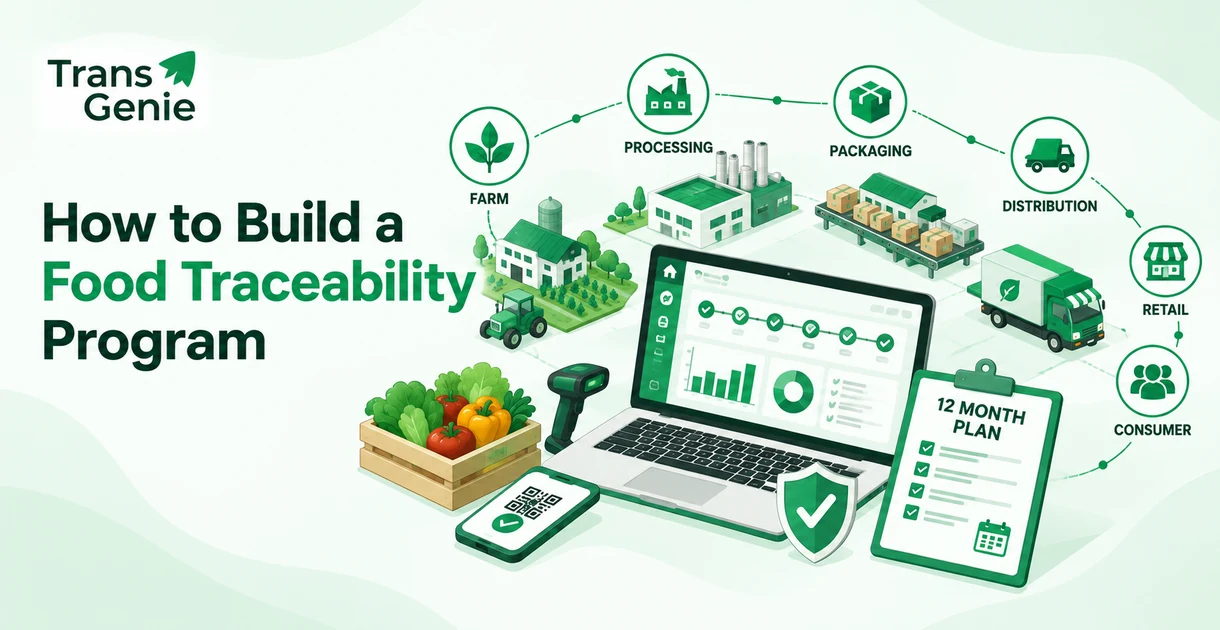
If you find gaps, our guide to building a food traceability programme can help you work through what to improve.
What Good Traceability Looks Like
A traceability system that handles both directions well should have four characteristics.
Clear Lot Identity
Every lot should have a clear identity created at a defined point in your process and assigned to someone responsible for it.
It shouldn't depend only on the code a supplier happens to use. Our guide to traceability codes explains how lot codes are created and used.
Every Transformation is Recorded
If a product is mixed, processed, repacked, relabelled, or changed in any way, that step needs to be recorded.
This is what connects your receiving records to your finished products and shipments. Without these internal links, the trace can break in the middle.
Lot Relationships Stay Connected
Your system should record how lots relate to each other - not just store a list of lot numbers.
For example:
- 1 input lot → 3 production batches
- 3 input lots → 1 finished batch
Your team should be able to follow these relationships in either direction.
Both Directions are Tested
Don't test backward traceability and assume forward traceability will work too.
Test them separately and without warning. A system may work perfectly when tracing a finished product back to its source but struggle when you need to find every customer affected by one ingredient lot.
What This Means When Choosing Traceability Software
If you're evaluating food traceability software, look beyond whether it can store lot numbers.
The system should be able to connect lots through the transformations that happen in your operation and let your team trace those relationships in both directions.
For businesses managing multiple sites or supply-chain tiers, supply chain traceability can extend that visibility beyond your own facilities and connect the records across the wider chain.
Yokesh Sankar