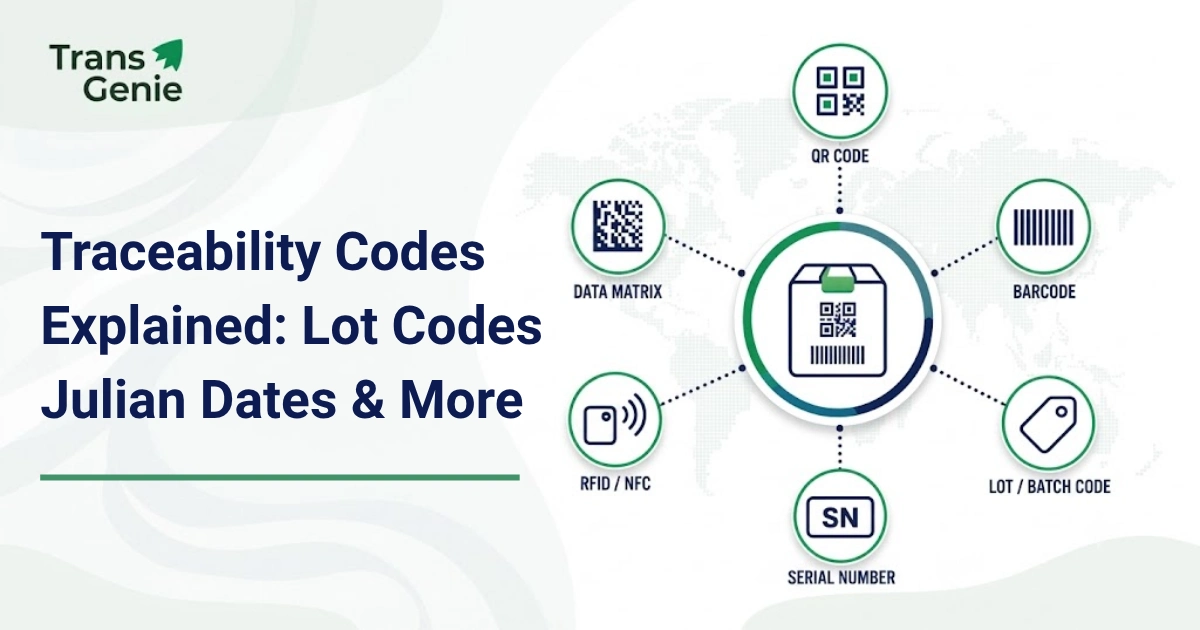
Ever looked at a sealed product package and wondered what all those numbers, letters, and the QR code mean? Actually, those are traceability codes and can reveal useful details about the product. But figuring them out isn't always straightforward. The catch is that traceability coding systems vary from product to product, and even country to country.
A traceability code used on one product may follow completely different rules than the QR code used on another.
In this guide, we’ll break down in detail about traceability codes, why they matter, and how lot codes differ from other food traceability codes
Any case in your warehouse could carry any of these five codes
00 95420123456788Say what it is
NOT AN IDENTIFIERBB 03 2027Says when
NOT AN IDENTIFIERDay 062 of the yearSays roughly when
NOT A LOT CODELinks to a web pageSays “visit us”
NOT MACHINE-READABLE DATAL24219ASay which units
IT’S THE TRACEABILITY CODEWhat Makes a Code a “Traceability Code”
Not every code on a food package supports traceability. Some codes will simply describe the product, nothing else. Only certain traceability codes help in identifying the specific batch or a group of products.
Say, for example, a best-before date shows you when the product should be used, while a GTIN tells you what type of product it is. These details are useful for food traceability, but neither one tells you which production run a particular product came from.
Meanwhile, a traceability code adds that missing link. It connects the product to a specific batch, production run, lot, or defined group, allowing businesses to distinguish one group from another and follow its movement through the supply chain.
This becomes essential specifically during recalls, complaints, and audits. If an issue is found, businesses need to quickly identify which products are affected and which are not. Only a clear traceability code helps draw the line, making it much easier to locate the right products without unnecessarily involving unaffected batches.
What Are Lot Traceability Codes & Why It Matters
A lot code is a unique identifier assigned to a batch of food produced, packed, or handled under defined conditions. It’s most likely the “fingerprint” of the batch.
When a food safety issue actually occurs, knowing exactly which products are affected can make all the difference. The product lot code helps businesses trace products back to the specific batch, making it easier to identify affected products and act quickly.
Without clear lot-code tracking, recalls can become much broader and hard to manage. On the other hand, with the codes, tracking becomes narrow, reduces disruption, and gets the right products off the market faster.
Batch vs Serial Codes: What’s the Difference?
A batch or lot identification code tells you which group of products was made together. On the other hand, a serial number/code identifies one specific unit. They serve different purposes, and most food businesses only need the first.
Batch/Lot
One code covering a group of products that was made under similar conditions. This is a common approach for food traceability.
For most food products, batch-level tracing is more than enough to pinpoint the affected products during a recall. Unit-level serialization can add complexity and cost without providing any extra value.
Lot Code Format & Requirements
A lot code and batch code both generally serve the same purpose, which is identifying the group of products made, processed, or packed under similar conditions. The name may vary, but what matters most is whether the code can separate one production group from another.
When something goes off track, traceability codes should help businesses identify the affected group without unnecessary product recalls.
No Universal Lot Code Format
In general, there’s no single format that every producer must follow. It can be in different formats. Lot codes can combine dates, shift numbers, line numbers, plant codes, batch numbers, or internal references.
- PLT03Plant code (plant 3)
- 260619Date (19th June 2026)
- SH2Shift number (second shift)
- B14Internal batch reference
What matters is not how the traceability code looks, but whether it reliably identifies the intended production group.
The EU “L” Rule
Under EU food labeling rules, a lot marking will normally be preceded by “L”. But the indication “L” isn’t mandatory when the lot marking is clearly distinguishable from other information on the label. The marking must be legit, visible, and permanent.
- LThe required lot marking prefix under the EU labelling law
- 26Year (2026)
- 06Month (June)
- 19Day
How Big Should a Lot Be?
A lot should be small enough to track easily. If everything made in a full day is given under one product lot code. It may be broad, especially when different batches or production conditions are involved.
The exact lot size depends on the product and the rules that apply. The simple idea is that one lot should represent a clearly identifiable group of products.
Julian Dates: Why They’re Not Lot Identifiers?
A Julian date is a three-digit code that shows the day of the year when a product is processed or packed. For example, 001 indicates January 1, and 365 indicates December 31 for a non-leap year. For a leap year, December 31 is represented as 366.
It tells you when something was produced, but not necessarily which production run it came from. A single day can include multiple shifts, lines, or production runs. So, using only the Julian date may group too many products. To make it more useful for traceability, producers combine the Julian date with a shift, line, or run number.
- 177June 26th (for a non-leap year)
- L3Production line 3
- S2Second shift
In short, a Julian date is useful for knowing when a product was made, but a lot of code is what helps you know exactly which production group it came from.
Have a Look at Best-Before & Use-By Dates
The best-before and use-by dates are also not the traceability codes, they denote other things. A use-by date is a safety deadline for perishable foods, while a best-before date indicates the food product’s quality. Neither of these dates tells you which production run, line, or batch a product came from.
Examples:Best Before: 05 SEP 2026 - Shows quality, not the batch
Use-By: 05 SEP 2026 - Shows safety, not the batch
In the EU, one of these dates is required on most foods. However, in the US, date labels are generally voluntary, except for infant formula where a use-by date is mandatory.
If a product has a best-before or use-by date, that date can be used as its lot code.
Under EU rules, a separate lot mark may not be required if the date shows at least the date and month. But that doesn’t make the date a lot code. It only tells you when the product was made or for how long it should be used.
GTIN, SSCC, & GLN: What These Traceability Codes Actually Do?
The GTIN, SSCC, and GLN are the GS1 identification codes used to identify products, locations, or shipments across the supply chain. Similarly, these codes also don’t serve a traceability purpose to the fullest, and none of them replace a lot code.
| Code | What It Identifies | Traceability Role |
|---|---|---|
| GTIN | The product or SKU | Tells you what the product is |
| SSCC | A specific pallet, carton, or shipping unit | Tells you which logistics unit is being moved |
| GLN | A company or supply-chain location | Tells you who or where |
As you can clearly see the roles, none of these tells you which production lot the product came from, which is the actual job of the lot code.
- (10)the GS1 Application Identifier
- LOT4487BThe producer’s own internal lot value
The key here is to use these traceability codes together. A GTIN tells you what the product is; for example, a case of 1kg pasta. The lot code tells you which production run it came from. Together, they give you product identity and lot identity, which is what makes them useful for traceability.
The Role of QR Codes in Traceability
Most of the retail QR codes simply take you to a landing page, promotional website, or loyalty program. They don’t actually carry the traceability data that warehouse or recall systems use.
However, a GS1 Digital Link is quite different from the regular one. Its QR code can connect a product identifier with data such as lot number, serial number, or expiry date in a standard format that a system can read.
Sunrise 2027 means every product must have a QR code by 2027.
GS1’s own implementation guideline calls it Ambition 2027, not a legal deadline. The goal is for retail scanners to be able to read 2D barcodes by the end of 2027. It doesn’t require every product to carry a QR code, and traditional barcodes will continue to coexist with 2D codes.
At the end of the day, a QR code helps traceability only when it carries information that systems can actually use to identify and track the product or lot.
Where ISO Fits in Traceability
ISO standards can help in structuring a traceability system, but they don’t prescribe a specific lot-code format.
ISO 22005 is the dedicated food traceability standard. It requires organizations to define what a lot means for their operations and identify it consistently. It tells you how to structure traceability, not what your product lot code should look like.
ISO certification is required for food safety compliance.
ISO certification is not a legal food safety requirement, but ISO’s own guidance confirms the certification is voluntary. ISO itself does not certify organizations; only independent certification bodies do that. In practice, certification is usually required by buyers or customers as a commercial condition, rather than by food law.
ISO 22005 can support a strong traceability system, but it doesn’t replace schemes like BRCGS, FSSC 22000, or SQF when a customer specifically requires one.
A Brief on FSMA 204’s Traceability Lot Code
Under FDA’s FSMA 204 rule, a traceability lot code is a unique identifier, which is usually in letters and numbers that identifies a specific food in a company’s records. The lot is created when food is initially packed, first received land-based, or transformed.
Assigned One
The lot code is assigned at any one of the three points and then stays alongside the product as it moves through the supply chain. Downstream businesses don’t create a new traceability lot code at every handoff; they continue referring to the same lot.
No Fixed Format
FDA doesn’t prescribe a particular format, and the traceability code doesn’t have to appear on the food label or packaging. The thing is that the next business can access it, and the required records are kept. This can be shared through a bill of lading, shipping notice, email, and QR code.
- FFRN-1029384A source reference, which FDA gives as one acceptable option.
- 240619Date component
- BInternal batch differentiator
Despite the QR-code hype, it’s just one way to share the code, not a requirement. FSMA 204 enforcement can’t begin before July 20, 2028, so that date is the earliest enforcement point rather than a fixed compliance deadline written into the original rule.
What Does the EU Law Actually Require
The EU food law requires businesses to track food one step back and one step forward, like who supplied it and who received it. Along with it, the food must also be properly labelled or identified so it can be traced.
However, the EU does not require one specific traceability code, format, or technology. Businesses can use lot traceability codes, GTINs, or their own internal systems to meet the requirement.
Meanwhile, some rules are more specific, such as lot marking and date marking. Individual rules also require geolocation of the land for certain commodities under the deforestation regulation.
Also, if you’ve heard about Digital Product Passports (DPPs) from a packaging supplier, note that the food itself is excluded from the DPP rules. Packaging can be a different matter.
How to Create an Effective Lot Code System
A “coding scheme” is simply the way you decide to build your traceability codes. For example, your code might include the year, production, day, and line number. There’s no single format you have to use. Start with these six simple questions.
The requirements can differ depending on the product and where you actually sell it.
Retailers and buyers may have their own coding requirements beyond the law.
Your code should let you identify the smallest group of products you can actually trace.
Make sure the two different lots can never end up with the same code.
Decide whether it needs to appear on the product, case, paperwork, records, or all of them.
Everyone assigning lot codes should follow the same rules every time.
A quick comparison helps you show what each code is actually used for. Here’s the simple breakdown of what they identify and whether they’re legally required.
| Code Type | What It Identifies | Required |
|---|---|---|
| Lot/Batch Code | A group of products made together | In some EU & US cases |
| Serial Number | One individual product | Rare for food items |
| GTIN | A product type | No, mainly commercial |
| SSCC | A pallet or carton | No, mainly commercial |
| GLN | A company or location | No, mainly commercial |
| Julian Date | A calendar day | No, not enough by itself |
| Best-Before / Use-By | Product’s date limit | Usually required |
| Marketing QR Code | Marketing or production information | No |
| GS1 Digital Link | Product, lot, serial, or date | No, but increasingly requested |
Winding Up
To conclude, traceability becomes much easier when you clearly understand what each code actually does in real time. A date tells you when, GTIN tells you what product, a QR code tells you where to find more information, and so on. But only a lot identification code tells you which specific lot is affected, making it the key piece of information during recalls, audits, and buyer checks.
The rules can differ between the US and individual buyers, but the goals stay the same. Which is, if something went off track, your code quickly shows what is affected and what isn’t. With this, you can build your system around that goal and choose the right code that simplifies the work. Moreover, by having TransGenie’s traceability software by your side, you can build a simpler, more reliable traceability system around that goal.
Yokesh Sankar