Those exporting seafood to the European Union have probably heard about the EU CATCH system already. For others, especially exporters who are still getting familiar with the new process, CATCH can seem a little confusing at first.
Since January 10, 2026, CATCH has been made mandatory for EU operators importing fishery products. It is the European Commission’s digital system used to manage catch certificates under the EU IUU Regulation, and it works through TRACES NT.
But here is the part seafood exporters need to understand:
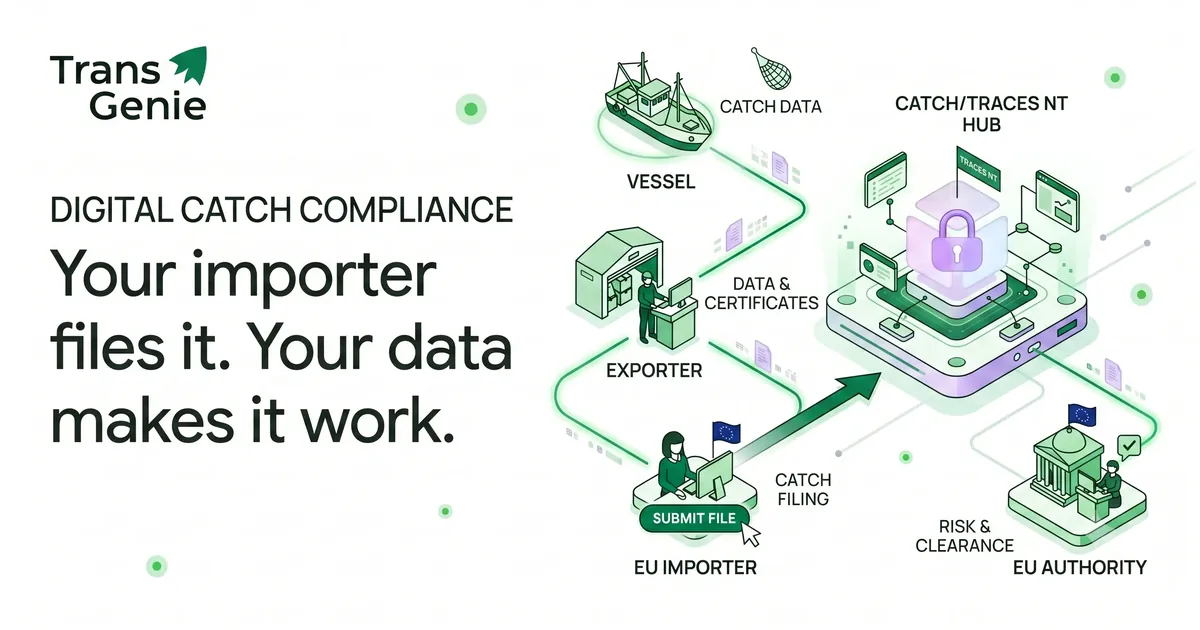
You are not the one filing the CATCH declaration. Your EU importer usually does that. However, the details come from you.
This includes your vessel records, fishing licence, species, catch dates, catch areas, gear, transhipment details, weights, container numbers, and other shipment records, all of which feed into the process.
So, even when your importer handles the filing, your data can show whether it goes through smoothly or comes back with questions.
In this guide, we’ll break down the EU CATCH system, who is responsible for each step, and what goes into an EU CATCH certificate. We’ll also cover the key points, how to fix errors and what exporters should need to know for seafood export compliance, from registration and corrections to important 2026 deadlines.
What Is the EU CATCH System?
The EU CATCH system is the European Commission’s digital system for managing catch certificates under the EU IUU Regulation. It works within TRACES NT, so CATCH is not a separate portal. If you are looking for the EU TRACES NT seafood importer/exporter roles, your access and permissions will depend on what you do in the supply chain.
This system helps move catch certification from paper-based processes to a digital workflow. It allows the relevant operators and authorities to create, submit, validate, check, and manage catch certificates and related documents.
CATCH is a module of TRACES NT and is not a standalone portal.
You may see TRACES NT CATCH used when looking for the system online. That is because CATCH works within TRACES NT, the European Commission's platform for managing official certificates and documents related to trade and animal, food and feed controls.
To use the system, users need an EU Login account and the respective TRACES NT role and permissions.
What Does CATCH Actually Do?
At its core, CATCH brings together the information needed to show that imported fishery products come from legal fishing activities. This makes digital catch certificates an important part of EU export compliance for seafood businesses supplying the European market.
It includes information such as:
This means an EU catch certificate is more than just another shipment document for your shipment. The information behind it needs to match the records of the exporter, vessel, processor, importer, and relevant authorities.
What CATCH Does Not Cover
CATCH applies to fishery products covered by the EU IUU Regulation and their catch certification requirements. Hence, it is important to note that not every seafood product automatically needs a catch certificate. For example, certain aquaculture products and freshwater products fall outside the catch certification scheme.
So, before preparing a certificate, first check whether your product is actually within the scope of the EU IUU requirements.
If you aren't sure whether your seafood products fall under these rules, read our guide to the EU IUU Regulation and its scope →
When Did CATCH Become Mandatory, and Who Needs to Use It?
If you are exporting seafood to the EU, the first thing you may want to know is: "Do I actually need to use CATCH?"
For this, the answer depends on your role in the shipment.
Understanding the EU catch certificate requirements for seafood exports starts with knowing who files the certificate and what information each party needs to provide.
The EU CATCH system became mandatory on 10 January 2026 for EU operators who are involved in importing fishery products covered by the catch certification rules. For most of the imports, the EU importer or their representative submits the required information through CATCH. They generally do this at least three working days before the expected arrival of the shipment.
What About Seafood Exporters Outside the EU?
For those seafood exporters outside the EU, using CATCH is generally considered voluntary. However, you still need to provide the right information for your importer to complete the process.
Your vessel, licence, catch, species, area, gear, weight, transhipment, and shipment records should be precise and consistent, so your importer can use them to complete the EU catch certificate correctly.
This removes the repeated "who files or who provides information" explanation and gives the H3 a clear purpose: what the exporter actually needs to do.
Who Does What: Flag State, Exporter, Processor and Importer?
The EU catch certificate can involve several parties, and each one has a different role. Understanding the TRACES NT seafood importer and exporter roles makes the process much easier to follow.
Flag State Authority
The flag State authority is the party that checks and validates the catch information. If a certificate needs to be replaced after validation, the existing certificate is cancelled and a new one is created through the appropriate process.
For you as an exporter, this means the catch details should be ready for your authority to verify.
Third-Country Exporter
This is where most of your work comes in. The information your importer needs does not start in CATCH. It actually comes from your own records.
You may need to input vessel and licence details, species, catch dates and areas, fishing gear, catch quantities, transhipment details, transport information, and container and seal numbers.
If you have the relevant CATCH access, you can also create or submit a certificate for validation and add next operators for the next stage of the shipment.
Master or Licence Holder
The vessel master, fishing licence holder, or an authorised representative may sign the relevant certificate information. This makes it essential to check the catch details before the certificate reaches the signing stage.
Processing-Country Authority
If the fish or other seafood is processed in another country before entering the EU, you may need to provide a processing statement. In that case, the relevant processing-country authority checks and endorses the statement where required.
EU Importer
The EU importer or their designated representative handles the import submission through CATCH. They also need to provide the required transport and supporting information.
If they are working from a paper certificate that has not been entered into CATCH, then the importer or representative must transfer the information into the system. This is one reason for exporters to give their importers clear and accurate records. Even a simple typing error can create a mismatch later.
EU Member State Authority
Once the importer submits the information, the relevant Member State competent authority checks the declaration and decides whether to authorise or refuse the import.
In simple terms: the exporter provides the source information, the relevant authority validates it, the importer handles the EU submission, and the Member State authority makes the import decision.
| Party | Main responsibility |
|---|---|
| Flag State authority | Checks and validates the catch information |
| Third-country exporter | Provides vessel, catch, product, transport and shipment details |
| Master/licence holder | Signs the relevant certificate information |
| Processing-country authority | Endorses the processing statement when required |
| EU importer | Submits the import documentation through CATCH |
| EU Member State authority | Reviews the submission and authorises or refuses the import |
How to Register and Get Started With CATCH
If you need to use CATCH yourself, then the process starts with an EU Login account. You will then connect your account to your company in TRACES NT and request the role that matches your work. If you need CATCH access, these steps will help you understand how to comply with EU CATCH system requirements and get the right role in TRACES NT.
Begin by creating or using your EU Login account and set up the required two-factor authentication. You can then use the same account to access TRACES NT and its CATCH functions.
Your company needs to be registered as an Operator in TRACES NT. If your company is already registered, then you can directly request access to it. If not, you can create a new Operator profile and select the activity that matches your role.
Your role determines what you can do in CATCH. For a third-country exporter, the relevant activity is CATCH fishery products (CFFP) – Exporter.
Separate activities are available for masters and fishing licence holders or their authorised representatives.
Once your company and user details are submitted, the relevant administrator or authority needs to validate them. Soon after approval, you can use the CATCH functions available for your role.
Soon after validation approval, you can access and use the CATCH functions available for your verified role.
If your EU importer is handling the filing, you may not need CATCH access at all. It is worth confirming your role before going through the registration process.
What Information Goes Into an EU Catch Certificate?
Knowing who handles CATCH is only part of the process. The next question is what information do you actually need for the certificate? Here is a step-by-step EU catch certificate workflow, starting with the details that come from the vessel and exporter.
The answer is scattered across the different sections of the catch certificate. Most of this information comes from records you already maintain for your vessels, catches, shipments, and processing activities.
Box 1: Validating Authority
Box 1 is useful in identifying the authority responsible for validating the catch certificate. This is directly linked to the flag State of the fishing vessel.
Box 2: Vessel Details
This section is helpful in identifying the fishing vessel. For a third-country vessel, the identification order is important:
- IMO number → RFMO Unique Vessel Identifier (UVI) → flag State registration number
It is vital to keep these details consistent with your vessel and licence records. Note that the CFR should not be used here as a catch certificate field. CFR refers to an EU fleet register number.
Box 3: Catch and Product Details
This is one of the most important sections for exporters as it brings together several pieces of catch information.
You need to provide details such as:
- Species and product information
- Catch dates
- Catch areas
- Fishing gear
- Catch and product weights
The species must use the FAO/ASFIS scientific name and FAO 3-alpha code. Hence, a commercial name on its own is not enough.
Apart from this, the catch area also needs the required level of detail. Depending on the catch, this can include the EEZ, High Seas and/or RFMO area, rather than only a broad FAO fishing zone.
For gear, the certificate requires the relevant FAO category and specific gear type. The weights also need attention, as the certificate uses different weight concepts. Your records should show how each figure relates to the actual catch and product.
Box 4: Conservation and Management Measures
This section includes the relevant conservation and management measures linked to the catch. The information should be consistent with the fishing activity and the records available to the flag State authority.
Box 5: Master or Licence Holder
The certificate can be signed by the vessel master, fishing licence holder, or an authorised representative, where applicable.
Before it gets signed, you should ensure the catch details match the respective vessel and fishing records.
Boxes 6 and 7: Transhipment Details
If the catch was transhipped at sea or in port, then the relevant details must also be recorded in the appropriate section.
This is why transhipment should be recorded as an event in your traceability records and not treated as a separate document that is only checked when preparing the certificate.
Boxes 8 and 9: Exporter and Validation
These sections connect the certificate to the exporter and the flag State validation. The details should also match the exporter information and the certificate submitted for validation.
Box 10: Transport Details
Transport information is an important part of the revised certificate. The section should not simply be left blank. Depending on the shipment, it includes information such as container and seal numbers.
For exporters, this information means your logistics records should connect clearly to the shipment and catch records.
Box 11: Importer Declaration
This section covers the importer declaration and includes two important weight figures: Net weight and net fishery product weight.
These figures should be consistent with the product and shipment information already recorded.
Important Note: Box 12 is not a separate data-entry section like the boxes above. So, it does not require the same level of detail here.
Box 13: Refusal Information
Box 13 is all about recording the legal basis for a refusal when the competent authority refuses an import.
This gives the authority a specific place to record why the consignment was refused under the applicable rules.
The key takeaway: Every box does not come from the same person. Some information starts with the vessel, some with the exporter or processor, and some is completed by the importer or authority. The more connected your source records are, the easier it is to prepare and check the certificate.
How to Fix Mistakes in CATCH
Mistakes can occur when information passes between exporters, importers, and authorities. While this is unavoidable, what you need to do depends on when you spot the error.
Found an Error?
Inaccuracies spotted in vessel, catch, or shipment details
If you find a mistake just before the certificate is submitted for validation, then you can use the REPLACE option to correct it.
If the certificate has already been submitted, you need to use the AMENDMENT process to make necessary changes.
The certificate can be moved to "To be amended" status. With this, the required correction must be made through CATCH.
Yes. A QR code on the certificate can be used to verify the certificate, which is useful for authorities and other parties that need to check it without having direct access to CATCH.
CATCH Transition Periods: Which Deadline Applies to You?
Not all CATCH requirements started at the same time. Some are already in place, while others come into effect later. If you are exporting seafood to the EU, these dates are worth keeping on your radar.
If your catch certificate was validated before 10 January 2026, it can continue to be used during the transition period, subject to the applicable rules, until 10 January 2028.
This is particularly helpful if you still have older paper certificates connected to ongoing shipments.
The revised catch certificate and processing statement templates have been mandatory since 10 January 2026.
So, for new shipments covered by the current requirements, make sure you are working with the latest templates rather than following the older versions.
There is a later deadline for the revised Simplified Catch Certificate. With that, the new template becomes mandatory from 10 January 2027.
If you use simplified catch certificates, this is a date worth preparing for now rather than waiting until the deadline.
The Commission has also offered additional flexibility around some of the new CATCH fields until 30 November 2026 for certain affected countries and trading arrangements.
However, this should not be treated as a delay to CATCH itself. The system is already mandatory for EU importers. So, it is better to think of the extension as a temporary implementation flexibility while businesses and authorities adjust to the new data requirements.
For exporters, the safest approach is to work with the current requirements now rather than relying on the transition period. That gives your team and your EU importer the time to find out any missing data before it becomes a shipment problem.
What's Still Difficult With CATCH in 2026?
If you have already started working with CATCH, you may have noticed that digital presence does not automatically make the process simple. There are some practical issues still being worked out, especially when CATCH has to work with the systems you already use.
Three Practical Challenges Converging into Core Risk
Technical Limits
- Timeouts
- Missing reference data
- File-size limits
System Disconnects
- CATCH & Inventory
- Processing & Logistics
- Customs & Traceability
Responsibility Gaps
- Who prepares?
- Who submits?
- Who corrects?
Data Consistency
The document specifically identifies these practical challenges. When data across systems, files, and partners fails to synchronize, compliance risk multiplies.
When working with CATCH, it is obvious for you to come across system timeouts, missing reference data, or file-size limits. The 2 MB limit for certain uploads can also be a concern when you need to share supporting documents.
That is why it is better to check your files and information before the shipment is close to departure, rather than finding out a problem at the last minute.
CATCH handles the catch certification process, but it does not replace your inventory, processing, logistics, customs, or traceability systems.
So, you may still need to enter the same vessel, catch, product, or shipment details between different systems. If those records are not kept in sync, small differences can quickly turn into bigger questions.
If you usually work with a freight forwarder or another representative to handle import documentation, CATCH may not always fit into your usual process.
Before the shipment moves, make sure everyone knows who is preparing the information, who is submitting it, and who will respond if something needs to be corrected.
What This Means for Exporters
Industry groups like CLECAT and Europêche have already raised concerns about some of these practical challenges.
So, you do not need to wait for every issue with CATCH to be resolved. The best thing you can control is your own data. Keep your records clean, organised, share the required information early, and give your importer enough time to deal with any CATCH issues before the shipment arrives.
How to Prepare Your Data Before Using CATCH
If you want the CATCH process to go smoothly, start with your data and not with the CATCH screen.
Most of the details required for the certificate already exist somewhere in your business. The goal is to bring it together, check it, and make sure the information matches before it reaches the importer or authority.
Start With Your Master Data
Begin with the information that stays relatively consistent across shipments. This includes
- Species and FAO codes
- Scientific names
- Fishing gear and gear types
- Catch areas
- Vessel identifiers
- Fishing licences
- Flag State details
Keeping these details in one place helps prevent your team from using different names, codes, or identifiers for the same vessel or species.
Keep Your Vessel and Licence Records Ready
Your vessel records should clearly show the correct identifiers and licence details. For third-country vessels, pay attention to the IMO number, RFMO UVI, and flag State registration number. Make sure to link the relevant licence and licence-holder information to the vessel record as well.
So, when your importer needs the details for an EU catch certificate, you don't have to search through old documents or emails to find them.
Make Your Weights Easy to Reconcile
Weights can become one of the trickier parts of the certificate, as different stages of the supply chain can record different quantities.
Your records should make it easy to see how the catch quantity, product quantity, net weight, and net fishery product weight relate to each other. If someone asks why two figures are different, you should be able to trace the difference back to the relevant catch or processing record.
Keep Catch and Transhipment Records Connected
Do not treat catch, transhipment, processing, and shipment records as separate pieces of information. They should connect back to the same vessel, catch event, batch, and shipment.
This makes it much easier to answer a question from your importer or authority without going through multiple spreadsheets and documents.
The goal is simple: when your importer asks for information for CATCH, you should be able to find the right data quickly, check it against your records, and share it with confidence.
Where Do Your Traceability Records Fit Into CATCH?
CATCH involves several people and organisations, but the data behind the certificate often starts with your own records. This is where fish traceability for the EU market becomes important.
Your traceability records can provide much of the information your importer needs to complete the CATCH process.
What Information Comes From You?
The exact responsibility can vary by shipment, but your records may provide information such as:
| Your records | Used for |
|---|---|
| Vessel and licence details | Vessel identification |
| Species and FAO codes | Product and catch details |
| Catch dates and areas | Catch information |
| Gear details | Fishing method |
| Catch quantities | Certificate weights |
| Transhipment records | Transhipment details |
| Processing records | Processing information |
| Container and seal numbers | Transport details |
| Shipment records | Export and transport information |
Keeping these details together makes it easier to give your importer the right information when they need it.
The Re-Keying Problem
The re-keying problem is one issue the exporters should pay close attention to. Until the end of the transition period, some certificates may still be provided as paper documents and then entered into CATCH by the EU importer or their representative.
That opens up the possibility for errors to happen. For instance, a vessel number can be typed incorrectly. A weight can be entered differently. A container number can be missed.
The original information may be correct, but the CATCH submission can still end up with a mismatch. This is why giving your importer a clear and structured data set is a much-needed process. This helps reduce the amount of information they have to interpret or re-enter.
Keep the Certificate, Processing Statement & Import Declaration Aligned
Your catch certificate may also need to be connected with a processing statement and the importer declaration.
While these documents serve different purposes, the information across them still needs to make sense. i.e., the relevant catch, product, and weight information should be traceable back to the same source records.
If your team can connect these records, it becomes much easier to spot a mismatch before the shipment reaches the EU.
Be Ready When an Amendment Is Requested
Whenever your importer or authority asks for an AMENDMENT, you should not have to start searching through old emails and spreadsheets.
With connected records, you can trace the issue back to the vessel, catch event, batch, processing record, or shipment and quickly find out what needs to be corrected. That can turn a correction that takes days into something your team can deal with much faster.
What is Not Your Responsibility?
Besides what you do, it is also important to know where your responsibility ends. If your EU importer is handling the import filing, you are not responsible for submitting the import declaration or making the Member State's decision.
Your role is to enter the accurate source information your importer and relevant authorities need.
So, CATCH handles the filing and verification process, but your traceability records provide much of the information that makes that process work.
What Should Seafood Exporters Do Now?
If you export seafood to the EU, you do not need to manage every part of CATCH yourself. But you should make sure the information your importer needs is accurate, complete, and easy to find.
Here are the main things to check before your next shipment:
- 01
Confirm whether your product needs a catch certificate
Check that your seafood falls within the scope of the EU IUU Regulation.
- 02
Know who will handle the CATCH filing
Ensure whether your EU importer, their representative, or your team will submit the required details.
- 03
Check your vessel and licence records
Make sure identifiers, licence details, & flag State information are up to date.
- 04
Standardise your catch data
Check your species codes, scientific names, catch areas, dates, & fishing gear details.
- 05
Keep your weights consistent
Ensure your catch, product, & shipment records explain how the different weight figures relate to each other.
- 06
Record transhipment and shipment details
Keep transhipment events, container numbers, seal numbers, & other transport details linked to the relevant shipment.
- 07
Give your importer the information early
Never wait until the shipment is about to arrive. Giving your importer the required time to check and enter the information can help avoid last-minute issues.
- 08
Keep your source records ready
If a correction or AMENDMENT is requested, you should be able to quickly trace the information back to the original vessel, catch, batch, or shipment record.
So, you do not have to control every step of CATCH. You just need to make sure the data coming from your side is right and ready when your importer needs it.
EU CATCH System: What Exporters Need to Remember
Moving to digital catch certification means keeping your vessel, catch, processing, and shipment records accurate and organised is more important than ever.
When your importer has the right information from the start, it becomes easier to complete the certificate, avoid mismatches, and respond faster if something needs to be corrected.
Most importantly, do not treat CATCH as just an importer's responsibility. Your role is to make sure the data your importer and the relevant authorities rely on is complete, accurate, and easy to verify.
Yokesh Sankar