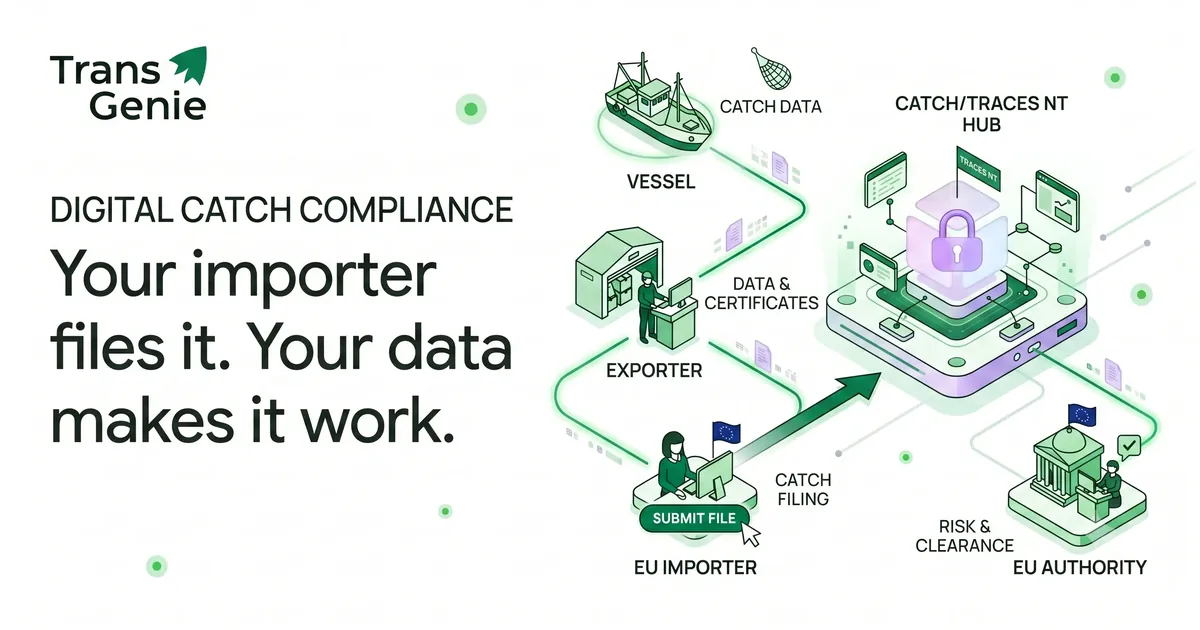
EU catch system explained: Guide for Seafood Exporters
Learn how the EU CATCH system works for seafood exporters, including catch certificate requirements, roles, registration, corrections, and 2026 deadlines
Read the guideOur fish traceability platform gives seafood businesses one connected view of their supply chain - from catch and landing to processing, storage, and final shipment. We bring scattered records and disconnected operations together so your team can trace every product with confidence.




Fish can pass through many stages before reaching its final destination. When catch, processing, batch, storage, and shipment records are kept in different systems, it becomes hard to see the full product journey.
"FAO's June 2026 State of World Fisheries and Aquaculture report states that global fisheries and aquaculture production reached 235 million tonnes in 2024, including 195 million tonnes of aquatic animals, while trade in aquatic animal products reached $184 billion."
Catch, vessel, farm, landing, or supplier information are not always connected to the finished product.
Processing activities, batch transformations, quantities, and product movements can become difficult to follow.
Teams often rely on spreadsheets, paper records, or separate systems to manage product movement.
Once the fish batch leaves a processing or storage facility, tracking its next destination can become complex.
Finding the right records for audits, customer requests, or trace-back exercises can take time and effort.
Information from suppliers, processors, warehouses, logistics partners, and buyers may remain isolated instead of forming one traceable chain.
TransGenie Solution:
At TransGenie, we connect these data points into a digital traceability flow and offer your team a clearer picture of each product's journey without forcing them to work across disconnected records.
Fish traceability software is a digital system that records and connects a fish product’s journey from its source to its final destination. It links information collected across catching, landing, processing, storage, distribution, and shipment. Thus giving businesses a clear record of where each product came from and where it went. Digital fish traceability connects origin, product, processing, storage, and movement records in one system, making it easier to follow a fish product across its supply chain.
Explore the 4 key pillars of connected traceability data:

At TransGenie, we turn these records into one connected fish traceability system built around your business needs.
At TransGenie, we connect the key stages of fish supply chain traceability into one digital flow, from catch and landing through processing, storage, distribution, and shipment. Our team collects the data your business needs at each stage and links it to the relevant product, batch, and shipment records.
Our team record catch and landing details, including species, location, vessel or farm, supplier, date, and especially quantity.
We connect all the processing activities to the original catch and maintain the relationship between source and resulting batches.
Our traceability software solution will track where each batch is stored, transferred, and handled as it moves between facilities.
Our team of experts link products with distributors, warehouses, buyers, and other supply chain partners as they change hands.
Our team will connect shipment records with the relevant batches, quantities, destinations, and movement details.
We bring these records together so your team can trace a product back to its origin or forward to its destination from one connected system.
See how TransGenie connects product, lot, compliance, and supply-chain records in one place. No pressurejust a focused walkthrough.
At TransGenie, we build fish traceability platform solutions around your operations, data, and existing systems. Our team can tailor the platform for accurate fish product tracking across each stage of the supply chain.
Helps assign unique identities to fish lots, batches, and products for consistent recordkeeping.
Used to collect data through apps, QR codes, barcodes, RFID, and connected devices.
Helps connect related records across suppliers, facilities, products, and transactions.
Move from a product to its source or identify products connected to a specific source.
Helps control what suppliers, processors, distributors, and other users can manage.
Helpful in triggering alerts for missing data, exceptions, or predefined events.
Used to organize the records required for audits and applicable traceability requirements.
Connect with ERP, WMS, inventory, logistics, and other systems already used by your business.
Answer a few questions to identify gaps in your current fish traceability process and see where your business stands.
We design our seafood traceability systems to help fish businesses organize the records needed across changing food safety, fisheries, and import requirements.
| Requirement | How We Support It |
|---|---|
| FSMA 204 | Organize relevant traceability events and Key Data Elements |
| NOAA SIMP | Structure applicable harvest, landing, processing, and import records |
| EU Traceability | Support digital, lot-level traceability across applicable fishery and aquaculture products |
| Your Business Requirements | Configure workflows around your products, markets, and supply chain |
Fish traceability records key information about catches as they move through processing, trade, and distribution. For exporters, keeping these details accurate can be important for meeting documentation. Clear records also make it easier to verify the origin and movement of seafood products. Learn more about the EU Catch System and what seafood exporters need to know.
Learn how the EU CATCH system works for seafood exporters, including catch certificate requirements, roles, registration, corrections, and 2026 deadlines
Read the guideNo two seafood supply chains work the same way. So, we don't build and deliver the same traceability workflow for every seafood business. TransGenie ensures we adapt the system to match the records, handoffs, and operations that matter to your business.
Whether you want to manage one facility or coordinate data across multiple partners, we shape the platform around your actual supply chain - not a generic seafood workflow
We help seafood businesses move beyond simply recording data. Our seafood traceability software systems make that data useful when your team needs to verify a catch, investigate a batch, answer a buyer, or act on a shipment.
With our fish traceability software, you can search connected records instead of checking multiple files to understand a product’s history.
It is possible to identify the source, affected lots, and downstream movements when a product needs to be investigated with our software.
Our fish traceability software helps replace scattered spreadsheets and paper-based processes with structured digital records.
With our software, it is possible to share reliable origin and movement information with customers, retailers, as well as supply chain partners.
With the TransGenie fish traceability system, you can keep relevant traceability records organized and accessible when your team needs them.
It is possible to extend the same traceability approach as you add products, facilities, suppliers, or distribution partners.
Thus, at TransGenie, we help businesses turn traceability from a manual recordkeeping task into a connected part of your day-to-day operations.
Your traceability data shouldn't be spread across different systems. We integrate our fish traceability platform with the tools your team is already using to keep product, inventory, processing, and logistics data connected.
Overall, our team maps the systems and data flows first, then builds the integrations needed for your specific seafood operation.
At TransGenie, we start with your actual seafood workflows and build the traceability system around them. Our team takes the project from supply chain mapping through deployment and ongoing improvements.
The development cost of fish traceability software depends on how much of your seafood supply chain you want to connect. At TransGenie , we connect your requirements around traceability workflows, integrations, users, facilities, and compliance needs before estimating the project.
Tell us about your operations, integrations, and tracking needs to get a project estimate tailored to your business.
Check out the projects we delivered that show how our team approaches complex data, tracking, and supply chain requirements to build connected digital platforms.
 CASE STUDY 01
We built a blockchain-based platform connecting farmers and buyers, with traceability embedded into the food supply chain at every step. The project focused on improving transparency across entire food production and trade.
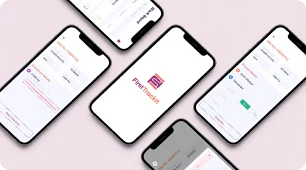 CASE STUDY 02
We developed a production tracking platform that gives users real-time order updates, unique identification, inventory visibility, and exception alerts - all capabilities relevant to businesses managing complex product movements.
At TransGenie, we combine traceability expertise with practical supply chain technology to build systems that fit the way seafood businesses actually operate.
Our team knows that fish traceability is more than tracking products. So, we connect the records that show how each product moves through the supply chain.
We configure TransGenie for your products, facilities, partners, workflows, and markets. Our solution thus adapts to your business needs and requirements.
Our platform brings traceability data together with the systems you already use. Thus allowing your internal team to access all that data under a single roof.
As you add products, locations, suppliers, or distribution partners, we can extend your traceability environment without rebuilding it from scratch.
Our work across food traceability and production tracking ensures practical experience in handling complex product data, supply-chain events, and connected operations.
For fisheries and fishing businesses, we connect catch, vessel, landing, species, quantity, and destination records. Thus ensuring the product history starts with a clear origin.
For processors, we link source lots with sorting, processing, repacking, and new batch records, keeping the relationship between the original catch and finished products.
For suppliers and distributors, we connect product, order, warehouse, transfer, and delivery records across different partners and facilities.
We help seafood distributors maintain a clear record of incoming lots, storage locations, transfers, and outgoing shipments across your distribution network.
For importers and exporters, we organize product, origin, shipment, and supporting records across international transactions and market-specific requirements.
For aquaculture businesses, we connect the farm, harvest, batch, processing, and distribution data to create a digital record of each product's journey.
Our team connects product, batch, supplier, purchasing, and inventory data with your existing ERP or inventory software to keep core records connected.
We integrate processing, production, storage, and facility data. Thus, the traceability record stays connected as the products move through your operations.
We bring shipment, carrier, destination, and delivery data into the traceability workflow. This gives your team the relevant movement information in one place.
We connect scanning technologies with your traceability workflows and thus your team will be able to capture and retrieve product information without relying on manual entry.
Our team can connect relevant sensor and monitoring data with product or batch records. This helps track the temperature, location, or handling conditions.
We build custom API integrations when your business relies on proprietary, legacy, or industry-specific systems that aren't supported by standard connectors.
We research your products, facilities, partners, markets, and traceability requirements to define what the system needs to handle.
Our team now identifies where traceability data originates, how it changes hands, and which systems need to exchange it.
We turn those requirements into the system architecture, user flows, dashboards, and traceability workflows your teams will use.
We build the platform and connect it with your ERP, warehouse, logistics, scanning, or other business systems as required.
Our team tests the system against actual product movements, batch changes, and trace-back scenarios before deployment.
We help your team move into production and continue refining the platform as your operations, partners, and traceability requirements evolve.