If you export seafood to the European Union, several important seafood traceability requirements and fisheries-control changes took effect on 10 January 2026.
However, EU seafood traceability is not one single requirement. The changes have brought three separate sets of requirements. They do not apply to the same products or businesses. i.e., One mainly deals with wild-capture products, while the next one covers both fishery and aquaculture products, and the third mainly applies to fishing operations and operators covered by the EU fisheries-control system.
A lot of published articles treat EU seafood traceability 2026 as one set of requirements. But these rules do not all apply in the same way. This eventually makes it difficult for exporters to understand which requirements apply to them and what they actually need to prepare for.
However, our guide separates the three areas, explains which requirements may apply to your business, and outlines the data you need to manage for each in detail.
The Three EU Seafood Traceability Regimes - And Which One Applies to You
The revised EU fisheries control framework comes from Regulation (EU) 2023/2842, which updated the EU's fisheries control rules. Two further regulations - Commission Delegated Regulation (EU) 2025/1766 and Commission Implementing Regulation (EU) 2025/2196 - provide more details on how some of these requirements apply from 10 January 2026.
For seafood exporters, the key thing to understand is that these requirements do not all apply to the same products or businesses.
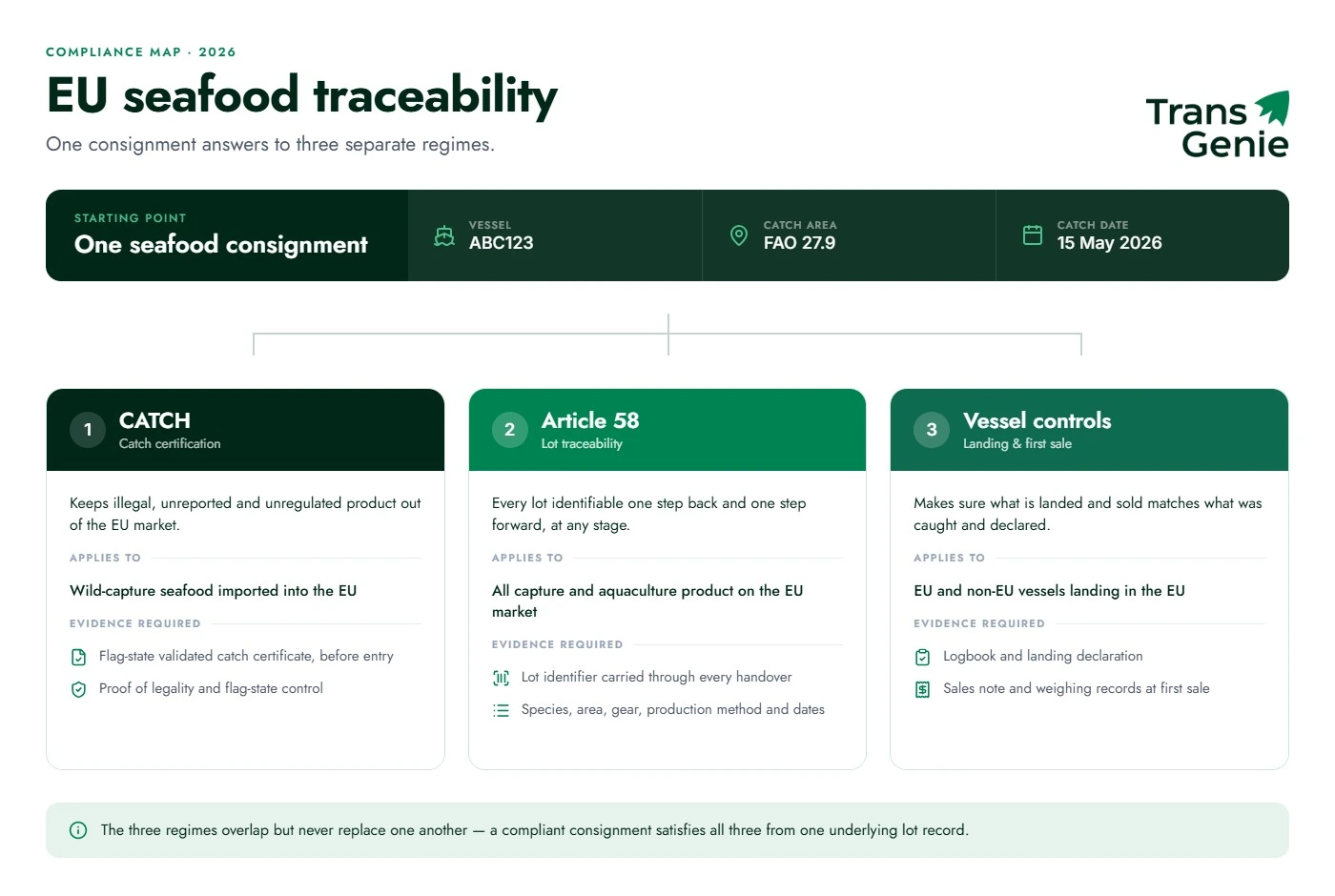
Regime 1: The IUU Catch Certificate and CATCH - Wild-Capture Products
The EU catch certification scheme applies to relevant wild-capture seafood products. Its purpose is to help prevent illegally, unreported, and unregulated caught seafood from entering the EU market.
From 10 January 2026, CATCH is used as the EU's digital system for managing the catch certification process.
The main thing to understand here is that this regime applies to wild-capture products and not farmed seafood. So, if you export farmed shrimp, tilapia, pangasius, or salmon, the CATCH and catch certificate requirements do not apply to those farmed volumes.
However, that does not mean EU seafood traceability requirements do not apply. Farmed products may still fall under the Article 58 requirements, which we will explain below. For a step-by-step look at how CATCH works, see our separate practical guide to the EU CATCH system.
Regime 2: Article 58 Lot Traceability - Fishery and Aquaculture Products
Article 58 has a wider scope because it not only covers fishery products, but also aquaculture products. It requires traceability information to be recorded for every lot and made available digitally as the product moves through the supply chain.
According to DG MARE guidance to the Market Advisory Council, from 10 January 2026, these requirements apply to fresh and frozen fishery and aquaculture products that fall under Chapter 3 of the Combined Nomenclature.
This means the rules can apply to both wild-capture and farmed seafood, including marine and inland products. This is an important difference from CATCH. Article 58 traceability is not limited to products that require a catch certificate.
For those who export farmed seafood, such as shrimp, tilapia, pangasius, or salmon, Article 58 may still apply, although the catch certificate regime does not. For products within scope, aquaculture supply chain traceability is also part of meeting EU traceability requirements.
Regime 3: Vessel and First-Sale Controls - Mainly Relevant to Fishing Operations
The third set of requirements covers areas such as vessel monitoring, electronic catch recording, and first-sale documentation.
The European Commission mentions the wider changes as part of a move towards a fully digitalised recording and reporting system of catches. This eventually covered the requirements related to vessel monitoring devices, digital inspection reports, and other fisheries-control processes.
These requirements mainly apply to fishing operations and other businesses covered by the EU fisheries-control system.
If you are a non-EU seafood exporter, then it is to note that these requirements may not affect your day-to-day operations in the same way as Article 58 or the catch certification requirements. However, if you operate EU-flagged vessels, then these controls can form a significant part of your compliance responsibilities.
The most important thing to understand is to identify which of these three areas applies to your product and your role in the supply chain. That will help you focus on the right EU seafood traceability requirements instead of treating every 2026 change as one single obligation.
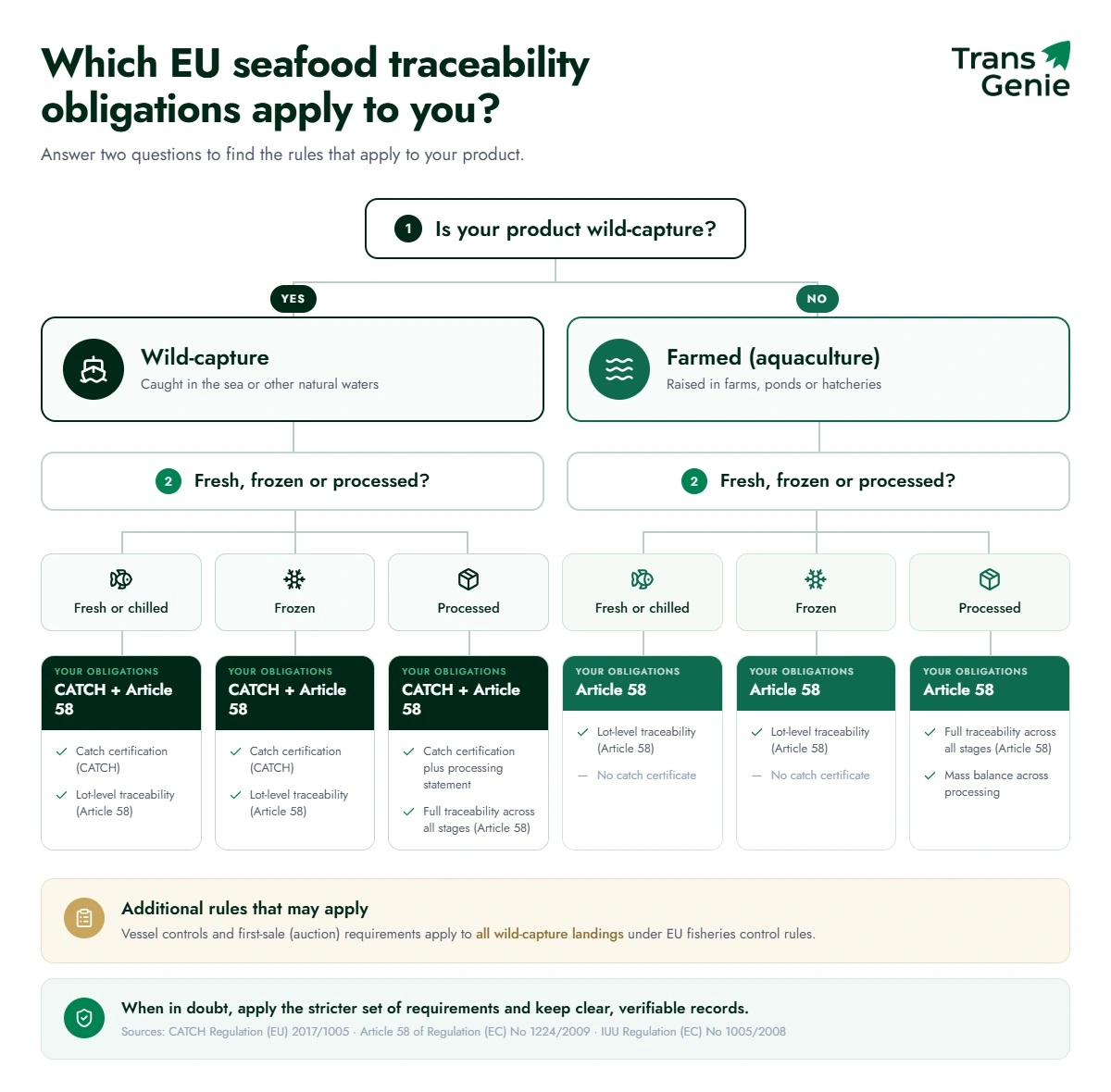
Quick Decision Table: Which Requirements Apply to You?
The requirements that apply depend on your product and your role in the supply chain.
| Your situation | Catch certificate / CATCH | Article 58 lot traceability | Vessel & first-sale controls |
|---|---|---|---|
| Non-EU exporter, wild-capture, fresh or frozen | Yes | Yes | No |
| Non-EU exporter, aquaculture, fresh or frozen | No | Yes | No |
| Non-EU exporter, processed product (CN 1604/1605) | Yes, where wild-capture | Not until 10 Jan 2029 | No |
| EU importer | Yes - you key the data | Yes | No |
| EU-flagged vessel operator | Where exporting | Yes | Yes |
| EU processor buying imported raw material | Via processing statements | Yes | No |
What the 10 January 2026 Changes Mean for Seafood Exporters
A number of changes took effect on 10 January 2026 under the revised EU fisheries-control framework. The changes were intended to affect catch certification, lot-level traceability, and how certain fisheries information is recorded and shared.
| Change from 10 January 2026 | What it means for you |
|---|---|
| CATCH becomes mandatory for EU importers and Member State authorities | Your EU buyer may need to enter your certificate data into the system |
| Article 58 lot traceability applies to fresh and frozen CN Chapter 3 products | Nine data elements must be maintained for each lot and made available digitally |
| New catch certificate content | This includes IMO numbers, gear specifications, more detailed catch areas, and revised weight classifications |
| Processing statements required for land-processed products | This applies regardless of where the processing took place |
| Traceability records must be digital and interoperable | Keeping scanned documents or PDFs alone is not enough |
| Transitional acceptance of pre-2026 templates | The transition runs until 10 January 2028 |
From Paper Records to Digital by Default
The older framework allowed paper records to be the main way of managing traceability information. However, under the revised framework, the focus has shifted towards digital records, with paper processes being gradually phased out.
The key question is not simply whether you can produce a document when someone asks for it. Rather, your traceability information also needs to be available in a digital format that can be shared and verified. As DG MARE explains, the information should be "digitalised using international or global standards which ensure interoperability and verifiability."
In practical terms, a scanned certificate stored in a shared folder is digital, but that does not necessarily make the underlying details easy to share, connect, or verify across systems.
The New Data Elements Exporters Need to Capture
The revised catch certificate requires some information that many exporters may not have needed to capture in the past. According to SFPA guidance, the new requirements include:
- IMO numbers
- Fishing gear specifications
- More detailed catch areas, including FAO area, EEZ, High Seas, and RFMO areas instead of one broad zone
- Revised weight classifications
These are not just additional fields to complete when preparing export documents. Rather, these are the information that needs to be available even before that stage.
For example, if you do not have the IMO number in your records, you cannot add it when preparing the catch certificate at the point of export. The same applies to catch-area details, gear information, and other source data.
That is why these changes are important to capture the right data early, and not when preparing the right documents later.
Article 58 in Detail: What You Need to Track for Each Lot
Article 58 sets out the lot-level traceability information you need to record, retain, and make available for covered seafood products.
What Counts as a "Lot"?
A lot is nothing but a batch of fishery or aquaculture products. It is vital for the products to be placed into lots before they enter the market.
This is where lot-level traceability begins. The lot is the unit used to track the product through the supply chain, and the traceability information required under Article 58 is linked to it.
That is why clear lot identification is important. If lot boundaries are unclear during packing or processing, it becomes complex to trace the product and provide the required information later.
The Nine Mandatory Data Elements
For fresh and frozen products, the minimum traceability information for each lot includes:
| # | Required information | What it identifies |
|---|---|---|
| 1 | Lot identification number | The individual lot |
| 2 | Unique fishing trip identification number | Links the lot to a specific fishing trip or landing |
| 3 | FAO alpha-3 code and scientific name of the species | Identifies the species clearly |
| 4 | Geographical catch area(s) or production area(s) | Where the product came from |
| 5 | Fishing gear type | How the fish was caught |
| 6 | Catch or harvest date(s) | When it was caught or harvested |
| 7 | Quantities - kg net weight or number of individuals | How much product is in the lot |
| 8 | Imported product: IMO number and catch certificate number(s) | Vessel identification and certificate details |
| 9 | Aquaculture product: aquaculture production unit number | Identifies the farm or production unit |
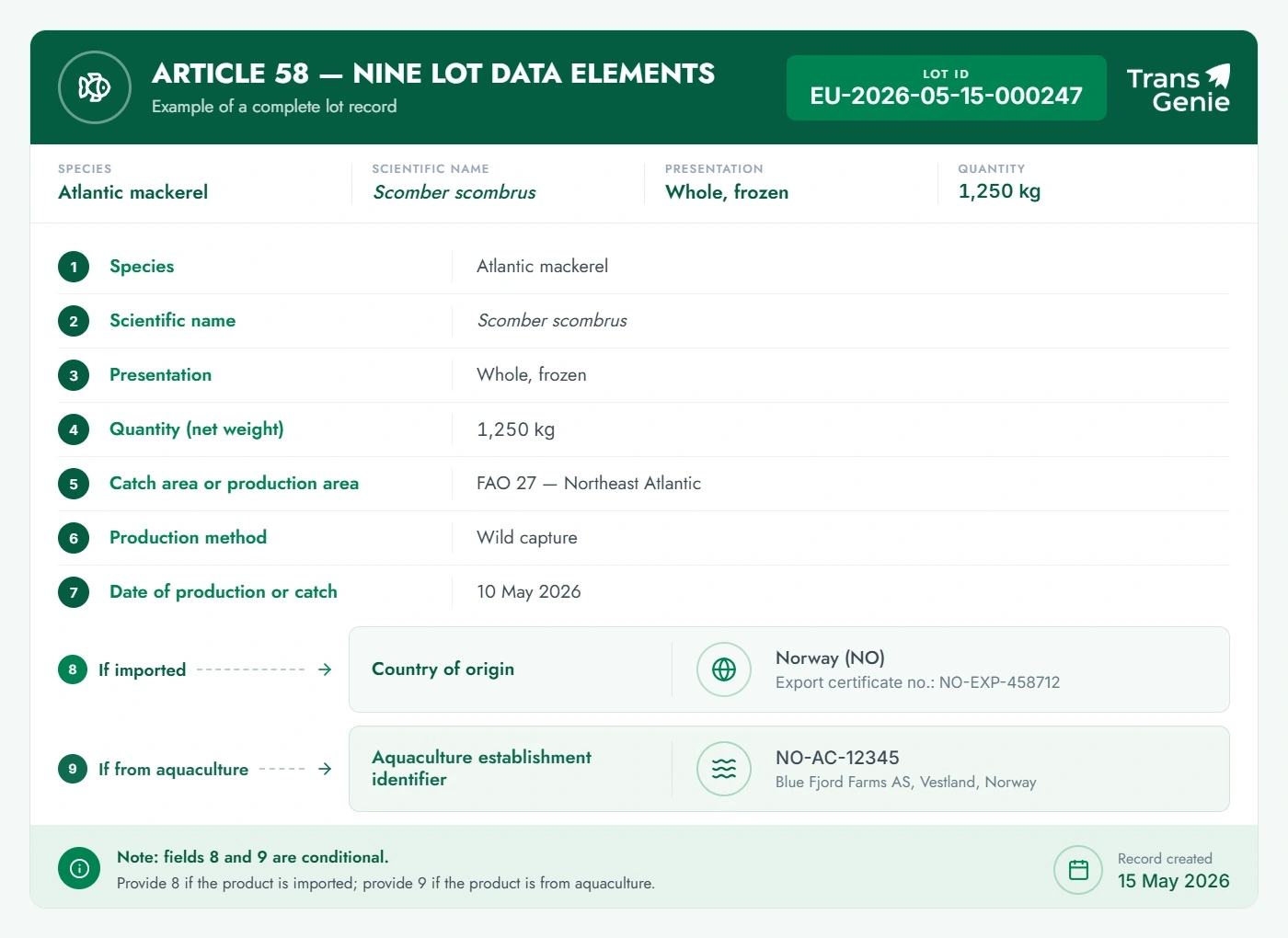
It is important to note that the same information does not apply to every product in exactly the same way. The requirements vary based on the product itself. For instance, those imported wild-capture products require vessel and catch certificate information, while aquaculture products require information about the aquaculture production unit.
Hence, your traceability system needs to handle both types of information where relevant.
What Does "Made Available Digitally" Mean - And What it Does Not Yet Mean
It means the required traceability information must be available in a digital format that can be received and verified by another party. The system should use standards that support interoperability.
However, this does not mean there is one EU portal where exporters upload every seafood lot. Article 58 traceability and CATCH are separate systems that solve different problems. CATCH is part of the catch certification process, while Article 58 covers lot-level traceability.
So, entering information into CATCH does not automatically meet the separate Article 58 traceability requirements.
How Long Must Records Be Kept?
According to DG MARE guidance, the minimum traceability information required under Article 58(5) must be recorded for at least three years.
For exporters, this means keeping three years of lot-level records and being able to retrieve them whenever needed.
So, it is not only about storing the records. Your team also needs to be able to figure out the right records when a buyer or authority requests them.
What Happens When Lots Are Mixed, Split, or Merged?
Article 56a sets out the rules for what happens when lots are split or combined. This is an important part for traceability because lot information can easily be lost when products are being processed, repacked, split, or combined.
The rules clearly distinguish between handling before and after the product enters the market.
- Before market entry, lots can be split. There is also limited scope to combine small quantities of the same species from the same vessel.
- But after market entry, lots can be merged only if the required Article 58(5) information remains available for each lot that makes up the new lot. The information must also show how the new lot was made up, including the original lots and the quantity contributed by each.
In simple terms, combining lots should not remove their traceability history.
For example, if Lot A and Lot B are combined into a new lot, you should still be able to identify:
- the original Lot A
- the original Lot B
- the traceability information for both lots
- the quantity from each lot included in the new lot
This is an important requirement when designing your traceability process. In simpler words, a new lot should not replace the history of the products that went into it. The connection to the original lots and their information must remain available.
CATCH in Detail: Who Registers, Who Validates, and Who Enters the Data
Understanding who uses CATCH, how the roles are divided, and where exporters fit into the process can help avoid delays and missing information.
What is CATCH: A TRACES NT Module, Not a Standalone Portal
CATCH is an EU-wide, real-time IT system used to manage procedures linked to the catch certification scheme. It is part of TRACES NT, the European Commission's existing platform for sanitary and phytosanitary certification.
This is important because CATCH does not have a separate login. Users first create an EU Login account and then request the relevant role in TRACES NT, such as Operator or Authority. When your EU buyer says they are not yet set up to use CATCH, then the issue may be their TRACES NT roles and permissions rather than CATCH itself.
Who Must Use CATCH?
From 10 January 2026:
- EU importers and EU Member State competent authorities must use CATCH.
- Non-EU operators and non-EU authorities can use the system voluntarily.
For third-country exporters, this is an important distinction. You are generally not required to use CATCH, but your EU importer is. This in turn means your product and certificate information may need to be entered into the system by your EU buyer. If the information is incomplete or difficult to understand, it can create extra work and delays during the import process.
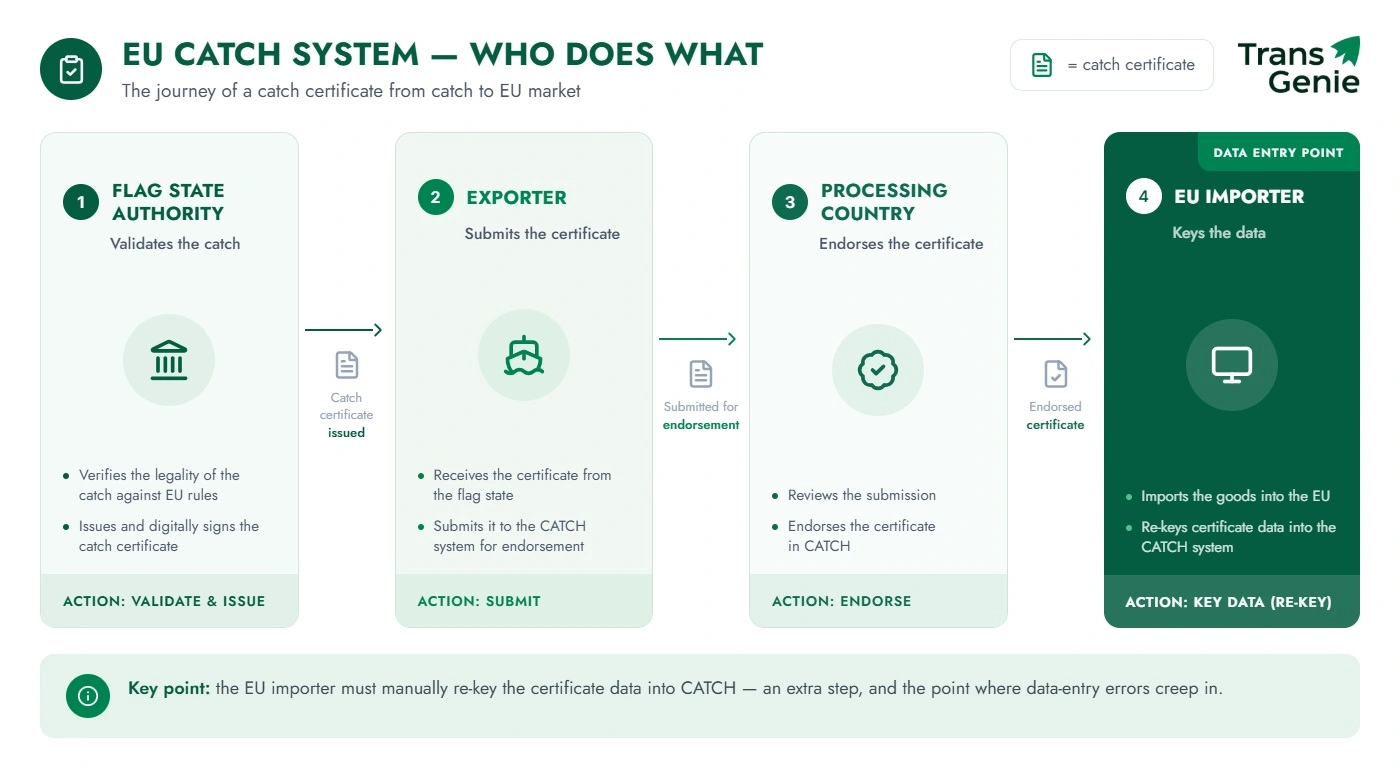
Who Does What?
| Party | Main role in CATCH |
|---|---|
| Flag State authority | Validates catch certificates and must be notified to the Commission under Article 20(1) |
| Exporter | Submits certificates for validation and completes the “next operator” section when the product is transferred |
| Processing country authority | Endorses processing statements, which are now required for all land-processed fishery products |
| EU importer | Enters certificate data, starts the importer declaration, and receives authorisation notifications |
Why Paper Certificates Can Still Slow Down the Process
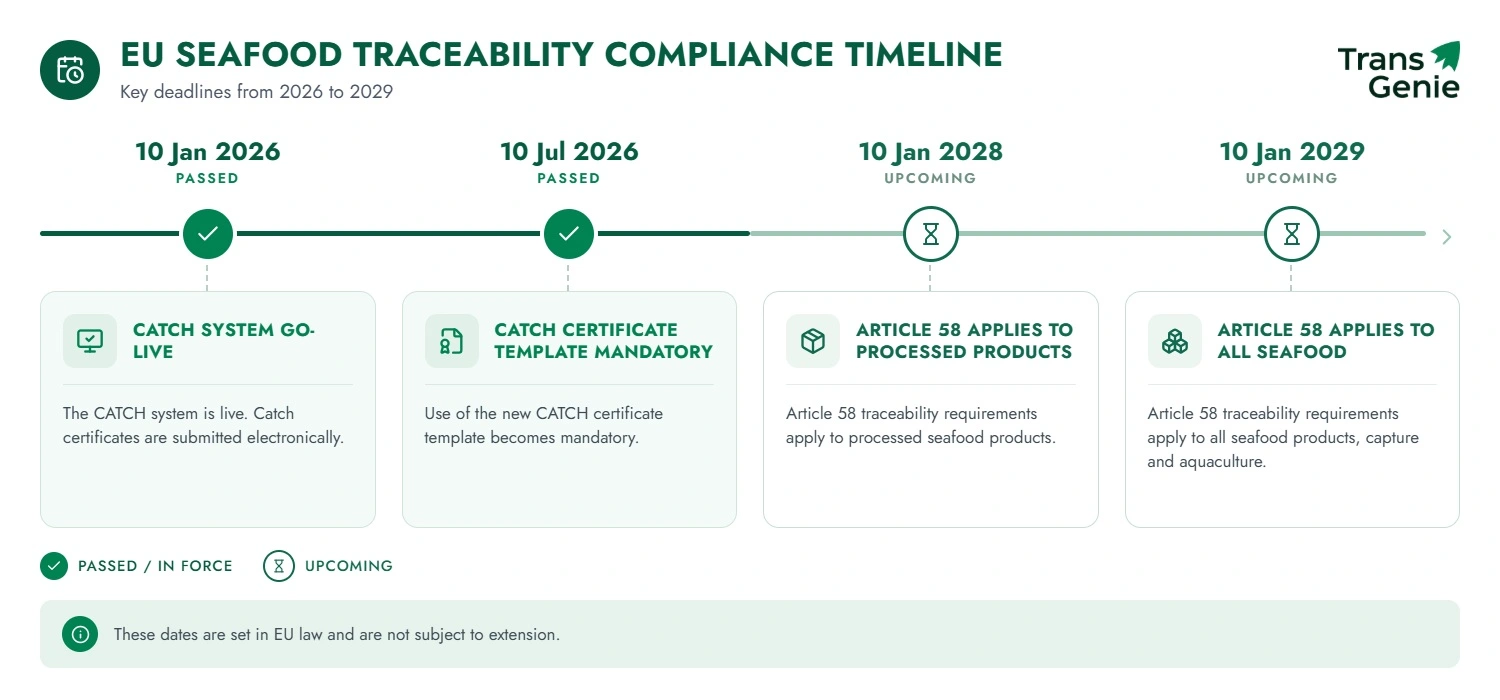
There is a 24-month transition period from the start of mandatory CATCH use. During this period, both the pre-2026 and new certificate templates are accepted. Those older templates remain valid until 10 January 2028. After that, the new template becomes mandatory.
During the transition, paper certificates can still be used if a scanned copy is uploaded into CATCH. However, this can still mean information from the certificate needs to be entered into the system. So, while paper is still allowed during the transition, it can add extra manual work to the process.
Check Whether Your Flag State Authority is Notified
Flag State competent authorities must be notified to the European Commission under Article 20(1). This means that if a Flag State has not completed this notification, its authorities cannot access CATCH.
As per the official guidance, this means it will not be possible to create a catch certificate for vessels flying that flag. This is particularly important if you source seafood from vessels operating under different flags.
Before the season or before sourcing from a new fleet, it is mandatory to check whether the competent authority for each Flag State has been notified to the Commission and can access CATCH.
The issue may not be with your own records or processes. However, a missing notification from a Flag State can eventually affect whether the catch certificate can be created at all.
Before your next sourcing season, you shall check whether all the Flag States you source from are on the Commission's list of notified authorities. This can help prevent problems with your shipments later.
What it Looked Like in Practice: The First Six Months
CATCH became mandatory on 10 January 2026. After which, a six-month grace period for the new data fields ran until 10 July 2026.
The first six months showed some of the practical challenges businesses faced when using the system.
What Happened at the Border
Gaps between CATCH and national customs control systems caused delays at some major ports.
Fresh and chilled seafood was affected the most of all. For these products, even a delay of a few hours can affect the entire product quality. Whereas frozen products can generally tolerate delays more easily.
The Technical Problems
There are three different technical issues reported during this period:
- Server timeouts and slow performance. Operators handling consignments from multiple vessels reported waiting several minutes for pages to refresh.
- A 2 MB file-size limit. This was not always enough for longer certificates and supporting documents.
- Certificate search problems. In some cases, the system could not find a certificate but still flagged it as a duplicate. As a result, operators were unable to continue or create a new one.
The Re-Keying Problem
Another major issue was the amount of manual data entry required. Many third-country authorities continued to issue paper certificates. This meant EU importers had to manually enter large amounts of certificate data into CATCH.
The same information also did not automatically carry forward between linked steps. This includes the catch certificate, processing statement, and importer declaration. As a result, some data had to be entered more than once at different stages.
So, each time the information is entered manually, there is a risk of errors or mismatches occurring between the information provided by the exporter and the information declared in the system.
What Industry Reported After Six Months
Within the first two weeks, industry bodies, including Seafood Europe, had reported dozens of operational challenges.
Six months later, some importers were still reporting problems with the system in practice. The biggest concerns were around fresh and chilled products, indirect imports, re-exports of processed products, and species that the system did not clearly cover.
For exporters, the key takeaway is that the challenges are often concentrated around entering and transferring data between different systems and parties. This makes it even more important to provide your EU buyer with complete, accurate, and well-structured data.
The easier the information is to check and enter, the less likely manual data handling will create delays or mismatches.
EU Seafood Traceability: Important Dates Ahead
10 July 2026 - The Grace Period for New Data Fields Ended
This date has already passed. The six-month grace period for the new catch certificate data fields ended on 10 July 2026. Hence, the temporary tolerance for these new fields no longer applies.
10 January 2028 - Old Templates End and the New Template Becomes Mandatory
This marks the end of the 24-month transition period. From this date, pre-2026 catch certificate templates will no longer be accepted. The revised template will become the only valid format.
This is also when the paper-and-scan approach will no longer be a practical way to manage the process.
10 January 2029 - Article 58 Extends to Processed Products and Algae
According to DG MARE, Article 58 lot-level traceability requirements will extend to processed fishery and aquaculture products and algae from this date.
For those of you exporting products under CN 1604/1605, this is when the Article 58 requirements will start applying to those products.
However, the information needed to meet those requirements starts much earlier in the supply chain. That means exporters should consider how they capture and manage the required data in their operations before the 2029 deadline arrives.
Seven Traceability Problems This Creates for Exporters
These are some of the common data and traceability gaps that can create compliance problems for seafood exporters.
1. Free-Text Species Names That Fail Validation
Requirement 3 requires the FAO alpha-3 code along with the scientific name of the species.
If your records only say "white shrimp" or use a local market name, then it means someone has to identify and map it to the correct species when preparing the certification data. This can be difficult when multiple species share the same common name, especially when the information is needed quickly.
2. Catch Areas Recorded Only as Broad Zones
The new catch certificate requires more detailed catch-area information. This includes the FAO area, EEZ, High Seas, and RFMO areas.
If your records hold only one broad catch zone, it may not be possible to add the required level of detail later. These details need to be captured when the catch takes place, rather than reconstructed later during documentation.
3. Lot Identity Lost When Lots Are Split or Merged
Article 56a requires a merged lot to retain the full traceability information for every original lot that went into it.
If a system creates a new lot number when lots are merged but does not keep the link to the original lots, the required traceability information can be lost. The problem may only become clear when a buyer or authority asks for the lot history.
4. Quantities That Do Not Match
Requirement 7 requires quantities to be recorded as net weight in kilograms or the number of individuals.
Problems can occur when catch, processing, and shipment quantities are recorded in different systems using different units or conversion methods. The numbers may not match, and the difference can become a problem when the shipment is checked or questioned.
5. Farm and Vessel Records Kept in Separate Systems
The Article 58 requirements differ depending on the type of product. For wild-capture products, the required information can include the IMO number and catch certificate reference. For aquaculture products, it includes the aquaculture production unit number.
Exporters dealing with both types of products may keep farm and vessel records in separate systems. If those systems cannot offer a consistent lot record, gaps can appear in the traceability information. This is one of the areas where farm traceability software can help manage traceability data on the aquaculture side.
6. Records Take Days to Find When Information Is Needed Quickly
Keeping records for three years is only useful if you can find them when needed. Records stored across emails, spreadsheets, and filing cabinets may technically be retained, but retrieving the right information can take too long when a buyer or authority needs it quickly.
7. Documentation Work Increases as Shipment Volume Grows
Manual data entry and re-keying often increases the documentation work with the number of shipments.
As shipment volumes increase, your team has more information to enter and check. Without structured data that can move easily between systems and parties, this can mean more compliance work and a higher risk of errors.
The Common Thread
None of these seven problems starts with the document itself. In most cases, the issue begins earlier with data being missed, unclear, disconnected, or difficult to retrieve. Also, fixing it at the documentation stage can take time and create repeated compliance work.
The better approach is to capture and maintain the right traceability data throughout the supply chain. With this, the information is already available when you need to prepare documents or respond to a request.
What Good EU Seafood Traceability Looks Like
An EU seafood traceability is termed to be good if does just more than just storing records. The right information needs to be captured early, kept connected, and easy to retrieve when needed. This is where seafood traceability software can help move beyond simply storing documents.
Capture Data at the Source and Validate It Early
Each Article 58 data element should be captured where the information is most accurate - at the vessel or the farm unit.
For example, the species should be recorded using the correct FAO code at landing, the catch area should be captured at the level of detail required, and the IMO number should be linked to the correct vessel record.
The information should also be checked when it first enters your system. When something is missing, you can directly ask the person who has access to the original information before it becomes a problem later.
One Data Model for Different Markets
The EU is not the only market introducing stronger traceability requirements. Building a separate EU-specific data structure for every market can mean changing your system again when new requirements are introduced.
A better approach is to maintain one lot-level traceability model and use it to meet the different data and reporting requirements of each market.
This, in turn, also helps prepare for the 2029 extension of Article 58 requirements without needing to rebuild your traceability process later. Our blockchain food traceability case study shows how a connected traceability model can work when managing live product volumes.
Test How Quickly You Can Retrieve the Information
You can test your current traceability process without buying new software.
Choose a lot you shipped four months ago and ask your team to provide:
- All nine Article 58 data elements
- The full history of any lots that were merged into it
- The catch certificate reference
Then see how long it takes. If your team can find the information within minutes, then it means your records are likely well connected. If it takes a day, the information may be stored but difficult to retrieve quickly.
That matters when a buyer or authority requests traceability information. The information may need to be provided quickly, so simply keeping records is not enough.
If you are building your traceability process from the beginning, our seafood traceability guide covers the basic principles behind the approach discussed in this article.

Yokesh Sankar