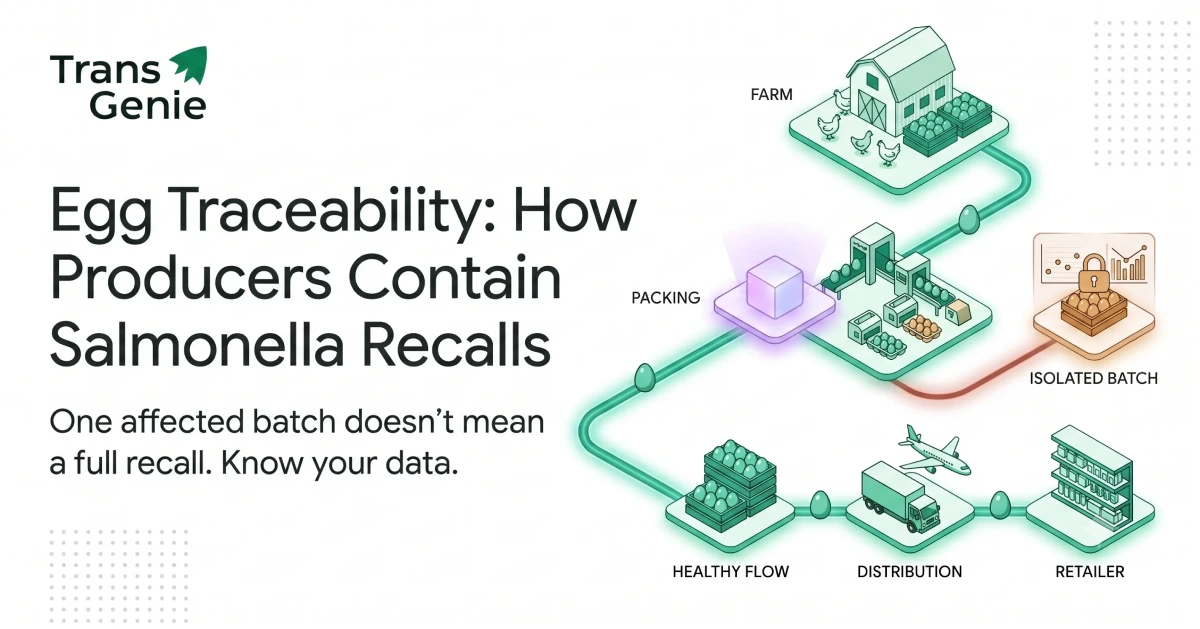
Four shell egg Salmonella outbreaks have hit U.S. producers in the past two years, but not all four looked the same. The scale of each recall depended heavily on how quickly the source could be identified and how clearly the affected eggs could be traced.
This article looks at those four major outbreaks, what happened, how the recalls unfolded, and why the ability to trace affected eggs quickly can make such a major difference when a Salmonella problem occurs.
The Story Starts With Four Major Outbreaks in the U.S
If you run QA at an egg operation, you might have heard about the four names in this piece. They show what can happen when contaminated eggs enter the market. From Milo’s Poultry Farms in 2024 to August Egg Company, Country Eggs, and Midwest Poultry Services in 2025 and 2026, each case shows a different challenge in identifying affected eggs and controlling the recall.
The main thing isn't about stopping Salmonella. Traceability software can’t stop Salmonella from showing up in your flock. The major part comes once the issue is found, which is how quickly you can find the affected eggs and where they’re produced. The quicker you give those answers to the FDA, the easier it is to limit the recall instead of pulling back everything.
When the Same Salmonella Leads to Two Different Recalls
Here, we compare two major Salmonella recalls for two major farms involving real U.S. egg producers, occurring about 18 months apart.
Milo’s Poultry Farms
QA testing matched the Salmonella outbreak strain to both the poultry house and the packing facility. Once contamination reached the packing facility, the producer could no longer confidently limit the problem to a single flock. Any eggs that passed through that specific facility could be affected.
- The recall covered “all eggs, all types, and sizes”, including duck eggs from an associated brand.
- 93 illnesses across 12 states with 34 hospitalizations
- FDA cited gaps in Salmonella prevention, visitor controls, and rodent monitoring.
Midwest Poultry Services
The producer himself found possible contamination at two major farms through its own testing. After investigating the problem thoroughly, it confirmed that the Salmonella presence was linked to the major outbreak.
- The recall covered eggs from two specific plant codes.
- It was limited to a 28-day production period.
- The company said it was not aware of illness from its eggs when the recall was issued.
- FDA says these recalled eggs do not explain the entire outbreak, so the investigation is ongoing.
That’s all the major differences between these two cases. One producer had to recall “all of them”, whereas the other could point to a specific 28-day window and two locations.
Four Outbreaks in Two Years & the Clock Kept Running
The bar below indicates the time between the first reported illness and the public recall. That’s actually a long gap, especially when you consider what can happen during those days. The eggs might have moved from farms to packing facilities, to trucks, into stores, or even into people’s houses while the investigation is still underway.
Take a peek at these four timelines once again. Here, the fastest recall took more than three months, and the slowest took almost 8 months. This time period matters because the longer the investigation runs, the more the product can move through the supply chain even before the recall begins.
Besides the recall timeline, what actually matters is the number of products caught up in it. A producer can’t always control how quickly an investigation should move. What can be controllable is precision in identifying the affected eggs when the time comes.
To resolve the recall with less disruption, you need a traceability engine that can pinpoint exactly which eggs are affected and which aren’t.
What Really Takes 169 Days to Resolve a Recall
A recall investigation usually takes time before it reaches your operation. For your quick understanding, someone gets sick, the tests are carried out, the CDC connects the cases, and the investigation finally begins. The thing is, you can't control any of that.
Your part starts only when the FDA asks for the records, and this is where traceability plays a vital role. As of FSMA 204, the covered records must be provided as an electronic, sortable spreadsheet within 24 hours of an FDA request. The quicker you show which eggs were affected, where they came from, and where they went, the faster you can reduce the recall.
FDA’s 2026 exercise shows another issue: “having records doesn’t mean you can find the answer quickly”. Roughly 80% of companies had lot codes somewhere in their records, but only 40% could follow those codes through the entire supply chain. Moreover, just 27% could provide complete information about where the product came from.
This is the real problem that took more than 169 days to resolve a recall. The records can exist and still not give you a clear answer when you need one.
The Biology Already Tells You What to Trace
Different types of Salmonella can contaminate eggs in different ways, which is why knowing only the farm isn’t always enough. Here’s a brief outlook on Salmonella types.
S.Enteritidis
- This type of Salmonella can infect the hen’s ovaries and reproductive system, which means it can get inside the egg before the shell even forms.
- Other Salmonella types are commonly found in bird feces, but this kind is often found in traceable eggs, making up to 90% of cases.
- Just because S.Enteritidis can be inside the hen, the issue can often be traced to one flock, one house, and one production period, rather than the whole farm.
S.Typhimurium & Others
- These Salmonella types are usually found outside the egg and are picked up from droppings, dust, or a contaminated environment.
- A study found that these Salmonella typers were found in the reproductive tract of only 3 out of 14 birds at most, and it was never found inside the eggs.
- For these types, the major source might be the environment, equipment, or a particular production line, rather than one specific flock.
The rules treat each poultry house as a separate flock. However, when eggs from different houses are mixed at the packing centre, you can’t tell which eggs came from which house.
The Hidden Cost of Commingling at the Packing Center
When eggs from different poultry houses are combined at the packing centre and given the same lot code, a single test can affect everything that is packed under that code. Even if the problem comes from just one house, you may not separate the affected eggs from the rest.
$3.0M-$72.7M
Estimated cost to producers when the source of the recall can’t be identified quickly and accurately. It’s an expert estimate from the “Journal of Food Protection”, not a made-up cost.
$575M
FDA estimates that FSMA 204 could save more than 500 million every year by helping companies avoid unnecessary recalls, compared with the $780M saved by preventing illness.
To put simply, FDA sees traceability as more than a way to protect consumers. It can also help producers avoid recalling products that were never affected. The goal is not to avoid every recall, but to make sure the recall is no bigger than the actual problem.
Where 21 CFR 118 & FSMA 204 Leave a Traceability Gap
The egg producers have kept Salmonella records under 21CFR 118 since 2010. What is covered in these records is Salmonella prevention plans, environmental testing, egg testing after a positive result, refrigeration, and recordkeeping.
The key difference is what each rule tracks. 21 CFR 118 focuses on the source of eggs, including the flock and poultry houses. Whereas FSMA 204 focuses on the eggs after packing, using lot codes to track where each batch was shipped. In a Salmonella recall, Part 118 can help FDA identify the poultry house linked to the contamination, while FSMA 204 can help trace the affected lot through the supply chain and identify where those eggs were distributed.
If the lot code doesn’t keep the house information attached to the eggs, those records don't connect. And this is the actual gap: having the records isn’t enough if they can’t tell you where the affected eggs went
What FSMA 204 Actually Means for the Packing Line
FSMA 204 can sound complicated on paper, but the packing is where it really matters. Here’s what the rule means for your lots, records, and daily operations.
Shell Eggs Are Covered
Raw and unpasteurized shell eggs are on the food traceability list, so they fall under FSMA 204. Fully pasteurized egg products are treated differently.
Packing Creates the Lot Code
The lot code is created when the eggs are first packed. The rule requires key information to stay connected to that lot, including where they came from, harvesting details, and where they were cooled
FDA Gives You 24 Hours
If the FDA asks you for covered records, you must provide them as an electronic, sortable spreadsheet within 24 hrs. So, having the information somewhere in your system ain’t enough.
Delayed Enforcement
A Nov 25 law prevents FDA from enforcing FSMA before July 20, 2028. That doesn’t mean that the underlying requirements have disappeared. Enforcement being delayed and compliance being delayed are completely different.
The Exemption Trap
FDA estimates that about 98% of the shell egg products are exempt because they have fewer than 3000 hens. But the number can be misleading. It counts the producers, not the number of eggs they produce.
The First 24 Hours: What to Do When FDA Calls
The first few hours of a Salmonella recall can shape teh entire response. Here’s what to do in the next 24 hours.
Confirm the Ask
Get the FDA’s request in writing
Pull the Lot Code
Find the affected lots quickly
Build the Spreadsheet
Keep the key details in one file
Alert Your Partners
Notify those who received the eggs
Log Every Diversion
Record every movement
Close the Loop
Document the final outcome
What Europe Marks on the Egg & What It Leaves Off
The Salmonella issue isn’t just locked to the US. In 2024, the European Union reported nearly 80,000 confirmed Salmonella cases, with eggs linked to more outbreaks and hospitalizations than any other food category.
Every egg sold in the EU has a producer code stamped on the shell. This shows how the hens were raised, the country, and the producer or the farm number. This means the egg can be linked back to where it was actually produced without opening the package.
However, the stamp doesn't show when the egg was laid, which house it came from, or which flock produced it. Such kind of information stays on the package at the farm. When the eggs cross the EU border, the producer code must also be added before they leave the farm. This helps in preventing eggs from different sources that are impossible to separate.
Beyond the Audit: Building for Recall Containment
When a Salmonella issue is detected, traceability helps you quickly isolate affected eggs and limit the recall. These steps connect the eggs to their source and movement, making it much easier to identify what needs to be pulled.
Assign Lot Codes
Create a lot code at the poultry house. If eggs from multiple houses share the same code, separating them during the recall becomes much harder than you think.
Record House Details
Ensure you keep the lay date and house ID with the pack record. This helps narrow the recall to the affected houses and production dates.
Track Diversions
Record where eggs go after a positive test in the same lot record. This makes it easier to see which products were moved or diverted.
Test Retrieval
Don’t just store the data elsewhere. Alongside, test how quickly you can retrieve it. By following this, you can be able to pull the affected lot records within 24 hours.
Consider Treatment
Full pasteurization with a 5-log Salmonella reduction can remove the eggs from the food traceability list. For some, treatment can reduce the need for complex controls.
Align Partners
Ensure that the suppliers, packers, and receivers use compatible records and data formats. This can make the recall requests faster and reduce manual back-and-forth.
Even Traceability Has Its Limits
As said earlier, traceability is not a Salmonella prevention system. It becomes important only after a problem is found, helping you understand how much product can be affected and where it went.
It Can’t Prevent Salmonella
Records can track a problem after it happens, but they can’t stop Salmonella from entering or spreading through a flock.
It Can’t Control CDC Timelines
Traceability doesn’t speed up illness reporting, lab testing, PulseNet matching, or epidemiological interviews. Those steps follow their own timelines.
It Can’t Fix a Bad Data
A traceability system can be useful only if the records behind it are maintained. Missing house IDs, or gaps in shipment records can still make a recall harder to contain.
Bottom Line
You can’t always control when a Salmonella issue will happen, just like those four major incidents. But you can control how prepared your operation is when there’s an outbreak. The decisions you make now about how you record, connect, and retrieve your data will shape how confidently you can respond later.
Good traceability isn’t only about creating more records for the sake of compliance. Actually, it's about building a system that your team can rely on when the pressure is real, you need quick answers, and every hour matters.
See how quickly you can trace and retrieve your own lot data before a real recall happens.
Book a Demo Now →
Yokesh Sankar