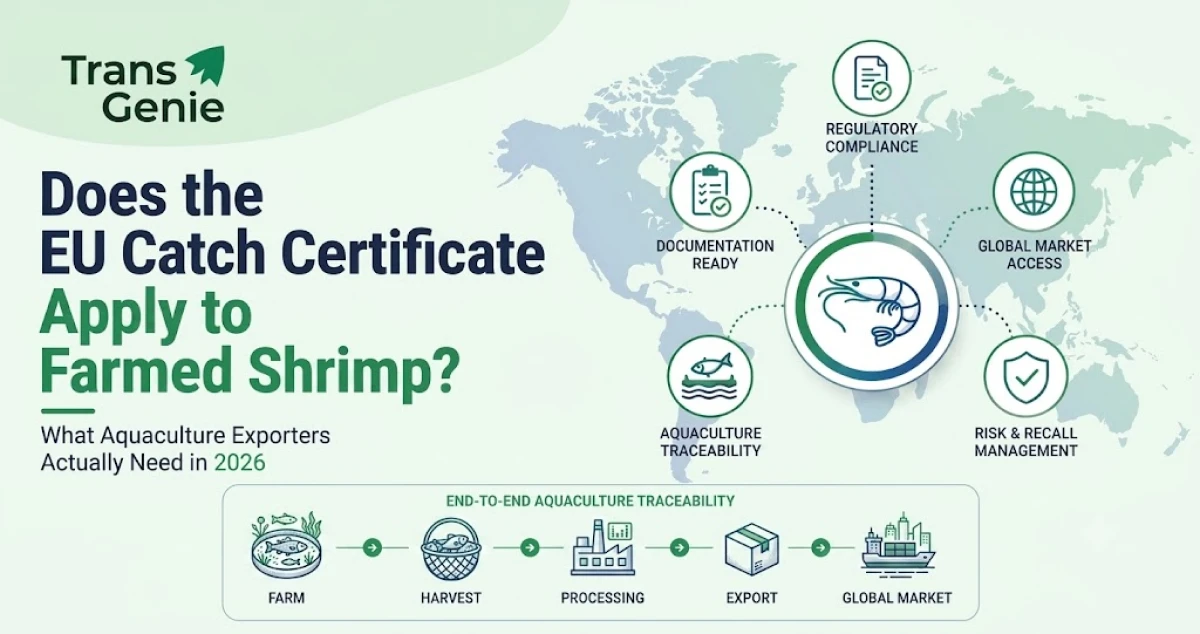
Most aquaculture exporters assume that just because shrimp is farmed, the EU Catch Certificate is automatically off the table. That’s not always the whole story.
The real question is how your shrimp was produced, what else is in the shipment, and which EU requirements still apply after the Catch Certificate is ruled out.
Does Your Farmed Shrimp Actually Fall Under the EU Catch Rule?
No, farmed shrimp raised from hatchery-produced larvae do not require the EU catch certificate. The EU IUU regulation specifically excludes aquaculture products obtained from fry or larvae, which are not treated as fishery products. Meanwhile, since January 10, 2026, a different rule applies, which requires farm-level and lot-level traceability data to be maintained digitally.
What Farmed Shrimp Slips the Net
The EU IUU Regulation, Regulation (EC) No 1005/2008, was designed specifically to prevent illegally caught fish from entering the EU market. The whole point of the catch certificate system is to link a fishery product to the vessel and flag state responsible for the catch.
Usually, farmed shrimp are treated differently. You can see that Article 2(8) defines “fishery products” by Combined Nomenclature (CN) codes, while Annex I excludes aquatic products that have been obtained from fry or larvae under the relevant codes in Chapter 3 and headings 1604 and 1605. So, shrimp raised from hatchery post-larvae in a pond or biofloc tank fall outside the definition of fishery product. No catch certificate, no flag state validation, and no Annex II paperwork.
What Else Falls Outside the Catch Certificate Rules?
Annex I excludes several other products from the EU Catch Certificate rules. However, some of the seafood products that might seem exempt still require a Catch Certificate.
Off the Hook
- Freshwater captured fish
- Bivalves, farmed or wild creatures, including scallops, mussels, oysters, and clams
- Live ornamental fish, Fish offal, and Jellyfish
Still on the Hook
- Cephalopods for food, including squid, cuttlefish, and octopus
- Any wild-caught marine fishery product under CN Chapter 3
What Actually Replaces the Catch Certificate for Farmed Shrimp? Article 58
Being exempt from the Catch Certificate doesn’t mean farmed shrimp are exempt from the EU paperwork. For farmed shrimp, a different set of traceability rules applies.
Article 58 of the EU’s Fisheries Control Regulation (Regulation (EC) No 1224/2009, as amended by Regulation (EU) 2023/2842) has applied since 10th January 2026. Unlike the IUU Regulation, this rule specifically includes aquaculture products under CN Chapter 3. It requires traceability data to be recorded for every lot using traceability software and made available digitally as the product moves from harvest to retail.
The regulation identifies every lot by an “anchor point”. Which one applies depends on where your product actually started.
Lot data links back to the fishing vessel, including where and when the catch was made and the relevant license details
Lot data links to the farm, pond, or hatchery where the shrimp were raised and stays with the lot through the supply chain
The Data Every Shrimp Lot Must Carry
As mentioned earlier, Article 58 does not require a paper certificate. Instead, it requires specific traceability data to be recorded for every lot and made available digitally to the next operator in the supply chain.
Here’s what it means in practical terms:
| Traceability Data | What It Means For Your Shrimp Lot |
|---|---|
| Lot ID | A unique reference ID that lets you track the lot through every stage, even if it’s split or combined later |
| Species | The shrimp species, including its scientific name, like "Penaeus vannamei" |
| Harvest Date | The exact date the shrimp were harvested from the farm or pond |
| Quantity | The actual weight or volume harvested from the pond or farm |
| Aquaculture Product Unit | The farm, pond, hatchery, or other production unit where the shrimp came from |
| Production Method | How the shrimp were raised, such as pond, biofloc, or RAS |
| Frozen Status | Whether the lot was frozen, relevant, or when it was frozen |
You may wonder why this data matters. For them, this information gives every shrimp lot a clear digital trail back to its source. If a buyer, distributor, or EU authority needs to verify a shipment, you should be able to identify the necessary information and follow its movement through the supply chain.
The Mixed Shipment Trap
Most exporters don’t ship just a single product. A single shipment could include farmed vannamei, farmed black tiger shrimp, or wild-caught squid going to the same buyer. This is the situation where things get confused, because different IUU regulation aquaculture products in the same shipment can have different compliance requirements.
What Else Do You Need to Export Farmed Shrimp to the EU?
Even though a Catch Certificate is not required, the farmed shrimp must meet some EU food-safety and other important requirements. The rules below determine whether your shipment enters the EU market or not.
Establishment & Health Certificate
The processing facility must be approved for EU exports, and each shipment needs an official health certificate from your country's responsible authority.
Residue Controls
Your shrimp must meet the EU limits for veterinary drug residues. Your country might also require testing before the shipment leaves the unit.
Antimicrobial Restrictions
Delegated Regulation (EU) 2023/905 requires EU-bound products to be free from antimicrobials used for growth promotion and those reserved for human treatment. Meanwhile, your country must also be on the EU’s recognized compliance list.
Farm-Level Identity
The farm or aquaculture production-unit ID issued by your responsible authority must match the identifier used for each lot under Article 58. Check that your farm registration and export documents use the same ID to avoid compliance issues.
Is Your Country on the EU’s Antimicrobial Compliance List?
Even if your shrimp meet the requirements, your country also needs to be recognized by the EU for antimicrobial controls.
The current list is in Annex XVIa of Regulation (EU) 2021/405, added through Implementing Regulation (EU) 2026/1189, effective September 3rd 2026.
Countries must have controls converting antimicrobials used for growth promotion and those reserved for human treatment under Delegated Regulation (EU) 2023/905.
Even if your shrimp passes the residue testing, an unlisted country can still prevent the shipment from entering the EU.
Check your country’s current status with the competent authority before shipping. The previous list under Implementing Regulation (EU) 2024/2598 has been revoked.
What Happens If Your Article 58 Lot Data Is Incomplete?
Missing or incomplete Article 58 data can create more than just a regular headache. If the required information isn’t available when your shipment is checked, you might face:
Border Delays
There’s a possibility that your shipment will be held until the incorrect data is provided.
Responsibility for Gaps
If incomplete information comes from an earlier supplier, you still have to resolve it before the shipment moves.
Buyer Concerns
Importers may flag weak traceability during supplier checks, which might affect future orders.
Enforcement Action
Non-compliance can lead to penalties under the applicable national enforcement rules.
What Changes for Farmed Shrimp Exporters in 2029
January 10th 2026, is not the final deadline. Article 58 is being introduced in stages, with additional requirements coming for processed aquaculture products and algae in 2029.
Processed Products From 2029
If you’re expanding beyond raw or frozen shrimp, 2029 is the date to keep an eye on. Cooked, breaded, canned, and other prepared shrimp products will enter the Article 58 framework under CN headings 1604 and 1605. This brings new traceability obligations for these kinds of product lines.
Separate Rules for Algae
Algae is covered separately under Article 58(11) and has its own minimum traceability requirements. This is especially relevant for businesses handling both shrimp and algae, as each product may require different traceability records and information.
Detailed Rules Pending
Article 58(9) requires the European Commission to conduct a feasibility study before finalising the detailed traceability rules for products under CN headings 1604 and 1605. The 2029 deadline is clear, but the exact data requirements are still to be established.
Your Export Compliance Checklist
Use this checklist to verify your Catch Certificate Requirements, Article 58 records, and farm-to-lot traceability before your next shipment. A quick review can help to identify missing information and compliance gaps before they become a problem.
-
Confirm Catch Certificate Requirements: Check each product line individually and distinguish the farmed shrimp from cephalopods and wild-caught products.
-
Audit Your Article 58 Lot Records: Confirm the records, including your lot ID, species, harvest date, production method, and aquaculture production unit.
-
Verify Farm-to-Lot Links: Ensure your pond, hatchery, or farm ID is correctly linked to the processing lot and final consignment.
Wrapping Up
For aquaculture exporters in 2026, understanding whether your shrimp needs a Catch Certificate is only the first step. Meanwhile, keeping up with Article 58 traceability, health certification, antimicrobial rules, residue controls, and the upcoming requirements helps keep every shipment compliant and avoid costly delays.
Yokesh Sankar