A food recall can expose weaknesses in your traceability program within hours. You may have the right food traceability software, plenty of records, and years of experience, yet struggle to answer a basic question within seconds: Where did this lot go?
This is where many food businesses discover the gap between having a traceability system and having a process that actually works. Building a dependable food traceability program is the only way to bridge this gap, and it takes more than just purchasing software. It requires clear processes, defined responsibilities, reliable data, and regular testing.
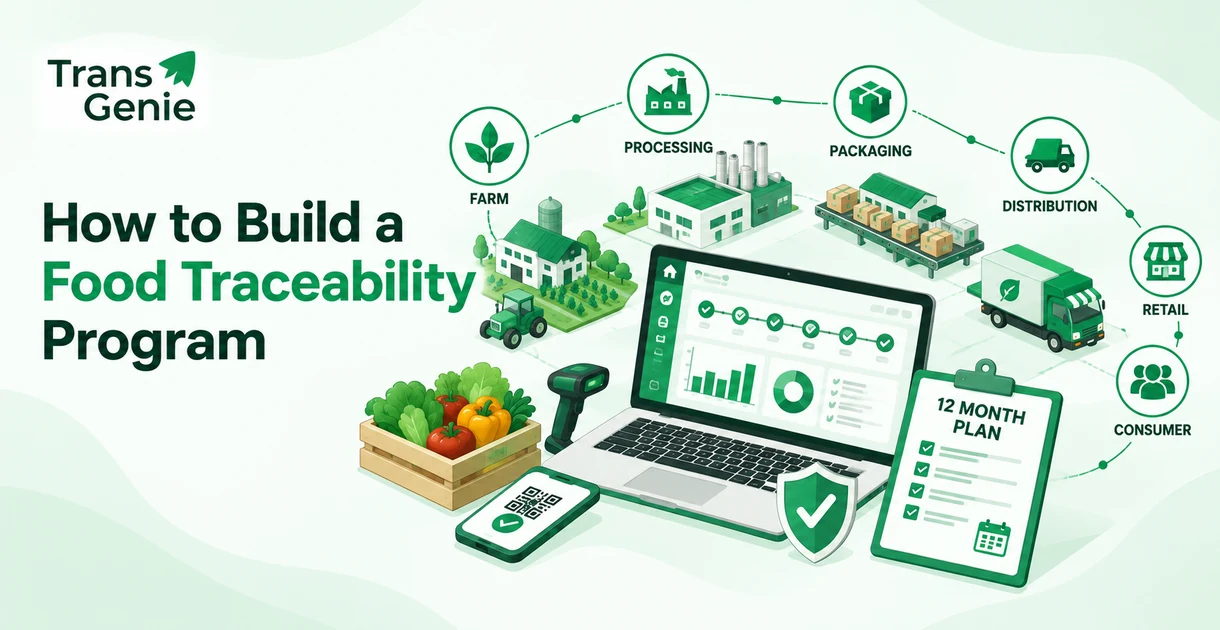
This guide breaks down the process for building a food traceability program in a practical 12-month plan. Each phase focuses on a specific part of the program, helping you build a traceability process that is easier to manage, test, and ready when you actually need it.
Traceability System, Program, Plan: These Aren’t the Same Thing
Traceability system, traceability program, and traceability plan - these three terms often get used as if they mean the same thing. Actually, they don’t. Each has different purposes, owners, and budgets.
A food traceability system is the technology behind the process. It handles product identification, data capture, recordkeeping, and lets you look up the lot’s history in either direction. This is the part you purchase.
A food traceability program is much broader, as it includes the system and everything that is needed to make it work every day. It includes a named owner, clear steps for every point where product changes hands, a practiced response process, and more. This is the part you build, and it can realistically account for around 70% of the total effort.
A food traceability plan is the written document that explains how the program works. This is what an FDA investigator, GFSI auditor, or major retailer’s supplier quality team might ask to review. It should cover who is responsible, what information is recorded, and how long the records are kept.
The common mistake businesses make is to buy the system first, skip the food traceability program, and write the plan before an audit. As a result, you’ll end up with a document that looks complete, but the process behind it may not work when you really need it.
TransGenie builds traceability software around how your product actually moves.
Explore TransGenieWhat Your Food Traceability Program Needs to Prove
Before starting the 12-month plan, know what your food traceability program must deliver. Here are the four major things that matter the most.
Track Every Lot
Know who supplied each lot you receive and where every lot you shipped actually ends up. Keep the supplier customer lot numbers connected.
Follow Every Change
When the lots are mixed, split, or repacked, record how the new lots are connected to the original. This makes it easier to identify exactly what needs to be recalled.
Keep Records Ready
If the FDA Food Traceability Rule applies, you must provide a sortable electronic spreadsheet within 24 hours of the request and keep the required records for a couple of years.
Measure Your Trace Time
Track how long it takes to go from identifying a problem with one lot to finding every affected lot to see how your food traceability system really works.
Test the Traceability Before You Spend a Dime
Before you contact vendors or are about to purchase software, test your current process. Pick a single finished product lot from three months ago and choose it at random. Don’t tell your team in advance. Ask them to find where the ingredient came from, which other products used those ingredients, and which customer received the finished product, including dates and quantities.
Measure how long the trace actually takes. Note how many hours it took, how many employees had to help, and how many pieces of information were missing.
Those missing links are your biggest gaps. A supplier may not have provided a lot number, or your team may have skipped recording the initial step. Either way, you now know exactly where the traceability process breaks.
Now, use these results as your starting point. Repeat the same test 12 months later and compare the numbers. You’ll get real evidence of how much your food traceability program has improved.
Here’s the practical 12-month plan for building a food traceability program from the ground up.
Start with setting clear ownership, scope, and budget early, so the food traceability program starts on solid ground. Put one operational leader in charge with line authority.
Months 1-2: Get the Ownership & Budget Straight
Start with setting clear ownership, scope, and budget early, so the food traceability program starts on solid ground.
Name One Owner
From the start, put one person in charge, not a committee. They should have enough authority to change the process on the packing line and approve spending, like buying a label printer.
This is usually someone in quality, food safety, or sometimes in the supply chain. Traceability projects led mainly by IT often fall behind because the biggest challenges here are operational, not technical.
Define the Scope
Be clear on what should and should not be included:
- Which sites and product lines?
- Which countries do you sell to?
- Which outside partners handle your products? Co-packers, cold stores, brokers, or 3PLs?
Document Applicability
If any product could fall under the FDA Food Traceability List (FTL), make a product-by-product decision on whether the rule applies.
The FTL has 23 line items, including three cheese entries and three finished entries, which is why it’s sometimes incorrectly summarized as 16 or 17 foods.
Document the decision even when the rule doesn’t apply. A note saying, “We reviewed this product and determined the rule doesn’t apply for these reasons, as of this date” is far more useful than having no record that anyone checked.
Also, don’t confuse the enforcement delay with a charge to the rule. Enforcement won’t begin before July 20, 2028, following a Congressional non-enforcement directive in the November 2025 appropriations act. FDA has said the extension does not change the final rule’s requirements.
The requirements in 21 CFR Part 1, Subpart S still apply. So even with the enforcement delayed, it’s better to build your food traceability plan around the actual requirements than waiting for the new enforcement date.
Build a Four-Part Budget
Most importantly, don’t treat traceability as a single “software” expense. Your first-year budget usually has four separate costs:
| Cost | What It Covers | Why It's Often Missed |
|---|---|---|
| Software | Traceability platform | Vendors usually quote this first |
| Implementation & Integration | Configuration, ERP integration, data migration | The real work becomes clear during the implementation |
| Capture Hardware | Scanners, printers, labels, and consumables | Costs add up across every capture point |
| Supplier Onboarding | Specifications, outreach, follow-ups, and expectations | Internal staff time isn’t included in the vendor quotes |
One useful question to ask the vendors: What percentage of your customer’s first-year spend typically goes to software and services? If they can’t give you a clear answer, they may not have much experience with the traceability implementations.
Review your sites, suppliers, and product lines with a team that’s scoped this before.
Get a Cost WalkthroughMonths 2-4: Map the Real Chain, Then Define the Data
Map how your products move and decide what data needs to be captured at each step.
Walk the Physical Flow
Start with what actually happened to the product, not how the organization is structured.
Follow every material coming in, every internal movement, every shipment going out, and every outside party that takes custody along the way. Do the walk yourself if you can. The process map created in a meeting room can look different from the path a product actually takes. Those gaps are where traceability usually breaks.
Find Your Tracking Points
Go through the physical flow again and mark every point where a lot is created, changed, combined, split, or handed to someone else.
These are your critical tracking events (CTE’s). They’re the points where the data capture actually matters the most. Under Subpart S, these include harvesting, cooling, initial packing, first land-based receiving, shipping, and transformation. If the rule doesn’t apply to your operation, use the same approach to identify the events that matter in your own process.
Standardize Your Data
For each critical tracking event, decide exactly what information needs to be recorded. Then keep the definitions consistent.
If the “lot code” means the supplier’s lot number at receiving, use that meaning consistently. Don’t use the same term later for your internal lot number, or it could create confusion during the traceability investigation or recall.
Define each term once, document what it means, and make sure every site and system uses the same definition.
Choose Your Lot Size Carefully
This is one of the biggest decisions that you’ll make in the entire food traceability program. There isn’t a single right approach. Small, more specific lots give you better control, but they also require more tracking and create more work.
| Tighter Lots (Per Shift, Run Tank) | Looser Lots (Per Day, Per Campaign) |
|---|---|
| Smaller, more precise recalls | Larger recall scope |
| Easier root-cause analysis | Root-cause analysis can be difficult |
| More data to manage | Lower data burden |
| More changeovers and labels | Fewer changeovers and labels |
| Stronger customer confidence | More questions when something went off track |
This is more important when the products are constantly moving or being mixed, such as in dairy tanks, oil systems, and bulk blending. This is why the FDA held a public meeting about tracking products by lot in June 2026.
Choose a lot size that actually fits your risks, costs, and day-to-day operations. Note why you chose it and review it at least once a year. Most importantly, don’t let the software’s default settings decide how you define your lots.
Keep Batch & Ingredient Traceability Separate
Batch traceability follows a product at the production-batch level. For most food businesses, tracing at this level is practical and sufficient. Tracking individual products usually adds unnecessary work, except for highly regulated industries like pharmacies, where pharmaceutical traceability is mandatory.
On the other hand, ingredient traceability looks backward. It links each ingredient in a recipe to its supplier and, when necessary, to where your supplier got it from.
This might get harder when the supplier’s ingredient is made from several others. Decide how far back you need to trace and focus on what you can actually verify. The further you go upstream, the more you depend on your suppliers to provide accurate records.
Month 4 - 6: Get the Identification Right
Set consistent codes, labels, and data carriers so everyone inside the food traceability program works from the same information.
Labels & Codes
Your internal traceability codes may make sense to your own team, but they don’t mean much to the supplier, distributor, or retailer. That’s why using common identification standards matters the most, so that different companies can understand.
GS1 identification keys provide these common identifiers. GTIN identifies a product, GLN identifies a company or location, and SSCC identifies shipping units such as pallets and cases.
Pick Data Carriers
For barcodes, GS1-128 is commonly used to store the product’s GTIN along with information such as lot number, batch, or dates. The GS1 DataMatrix does much the same thing in a smaller 2D barcode. The GS1 Digital Link uses a QR code to connect the product to online information, so that the same code can be useful in the supply chain for customers.
One thing to get right from the start, and that initiative is called Sunrise 2027, not Ambition 2027. It is the voluntary effort to move forward using the 2D barcodes at retail checkout. GS1 US also says companies don't need to adopt every 2D barcode feature by 2027.
So don’t treat Sunrise 2027 as a regulatory deadline or a traceability requirement. You’re not charged with anything if you don’t meet it. Instead, use it as a chance to plan if your business is likely to move toward 2D barcodes.
On the other hand, RFID is useful when you need to identify more items quickly without scanning each one individually. This can work well on pallets, returnable containers, and some high-value cold-chain products.
Control Your Labels
Finally, keep your label designs controlled. Every label change should have a clear owner and approval process. Even a small change in where the information appears on a label can cause systems to read things incorrectly. This will lead to weeks of bad data before anyone catches the problem.
Months 6 - 8: The Supplier Problem Nobody Warns You About
Get the suppliers aligned on the lot data you need and make those requirements clear from the start.
Supplier & Customer Agreements
This is the area where food traceability programs run into trouble. The issue is often not the technology or the budget. It’s getting suppliers to provide the lot and product information you need.
That is why supplier work should start before you buy the software, not after. A software demo will always look good when the sample data is clean. The real test is whether your suppliers can provide the right information consistently.
Rank Suppliers by Risk
You don’t have to tackle every supplier at once. Start by assessing risk and volume. First, focus on the supplier whose products have a higher food safety risk, make up a large part of your purchasing, or would have a major impact on your business during a recall.
Give suppliers Clear Requirements
Once you know which suppliers to prioritize, tell them what you actually need from them. Specify the required fields, the format they should use, how the information should be sent, and when you actually need it. Keep the requirements clear and include a complete example so there is little room for interpretation.
Make Compliance Easy
Even with the clear requirements, not every supplier will have the same technical capabilities. A huge manufacturer may have an ERP system and automated data exchange, while a small one may work entirely on spreadsheets.
Decide what the simplest acceptable option will be. It could be a structured spreadsheet sent by mail, a QR code scanned on a phone, or a pre-printed label that you provide.
Put Requirements in the Contract
Once the requirements are clear and practical, put them into your supplier agreements and approval process.
Don’t rely on a one-time email or an informal request. Traceability requirements should be something that suppliers are expected to meet as part of doing business with you. If a supplier cannot meet the requirement, and you have a bit of negotiating power, record that risk and decide how you will manage it.
Check Your Customer’s Requirements
The same conversation needs to happen on the other side of your supply chain. Your customers may have traceability requirements of their own, and they may expect them before a regulator does. Ask your three largest customers what information they need, what format they expect, and when they expect you to provide it.
Months 8 - 10: Now the Technology Conversation Makes Sense
Once your processes and data needs are clear, test traceability software using real business situations.
Know When Spreadsheets Are Enough
Spreadsheets can be practical food traceability solutions for smaller operations. They start becoming difficult to manage when your process gets more complex.
You may need dedicated software if your traceability process becomes more complicated. This is more likely if you have several production steps, multiple sites, many ingredient lots, or more than 20 suppliers sending lot traceability data.
Test Vendors With Your Data
Once you get to know what you need, take your process map and requirements into every software demo. Ask vendors to show their system handles your actual scenarios, not just a prepared example.
Also, test your chosen lot structure, real integrations, sortable record exports, and the process your least technical supplier would follow.
Choose How Data Moves
Decide how traceability data must move between you, your suppliers, customers, and other partners. EPCIS can share the supply chain events when your partner supports it. EDI works well for a structured data exchange.
Document which method each partner will use, and also decide where your traceability data will be stored. If it sits outside your ERP, you’ll need to keep both systems in sync.
If you actually plan to replace your ERP within the next 18 months, consider building traceability into that project. Otherwise, dedicated traceability software may be a better option. Just make sure it integrates properly with your existing systems.
Be Realistic About Blockchain
Blockchain can help when several independent companies need to share the records without a single company controlling the database. But for manufacturers tracking their own products, a standard traceability system is usually simpler and cheaper.
Blockchain also cannot fix bad data. If someone enters the wrong lot number, it will simply preserve that mistake. So use blockchain only when it solves a specific business problem, not just because it sounds modern and trending.
Make it easy for suppliers to send the lot data you need, even small suppliers.
See Supplier OnboardingMonths 10 & 11: Train People, Then Write It All Down
Train teams where the work happens and document the processes they need to follow.
Train People At the Point of Use
The people who make traceability work are the ones scanning products at receiving and recording information during production. Besides training them in a classroom, use actual screens, scanners, and processes that they use in real time.
Also, explain why the information matters. When people understand how a scan helps trace a product or limit a recall, they are more likely to follow the process consistently.
Document Your Traceability Plan
Your traceability plan is the document an auditor or investigator will look at when they need to understand how your system works.
At bare minimum, include:
- Scope: Which sites, products, and jurisdictions are covered, and what’s excluded.
- Responsibilities: Who owns the program and who handles each part of a trace.
- Applicability: Which requirements apply to your business, and why the decision was made.
- Process Map: Your supply chain, critical tracking events, and the key data elements.
- Definitions: The terms and field names used across the food traceability program.
- Lot Structure: How you define lots and why you choose that approach.
- Records: What you keep, where it’s stored, and in what format.
- Retention: How long the records must be kept.
- Response Process: Who is contacted during a trace or recall and in what order.
- Testing: How often you test the system and the results of your most recent test.
Check Your Certification Requirements
For many food businesses, the first person testing your traceability system may be a certification auditor rather than just a regulator.
GFSI-benchmarked schemes like BRCGS, SQF, FSSC, and IFS include traceability requirements. These generally call for a documented system and the ability to complete the trace within a limited time. Inspect the requirements of your certification scheme and build your process around whichever requirements are stricter.
Use the Right Chain-of-Custody Model
ISO 22005:2007 remains a useful reference for designing a traceability system. It was reviewed and reconfirmed in 2022, although work on a revision was put on hold in 2025. You can use it for design reference rather than expecting it to answer modern questions about electronic data exchange.
If your food traceability program also supports claims like organic, deforestation-free, single-origin, or fair trade, you may need to address the chain of custody separately.
ISO 22095:2020 defines five chain-of-custody models: identify preserved, segregated, controlled blending, mass balance, and book and claim. Choose the one that matches how your products and materials are actually handled.
Month 12 & Every Year After
Run a mock recall to see how quickly and accurately your team can trace a product.
A food traceability program should not be considered ready until it’s tested. So, run an unannounced mock recall at least once a year. If you handle products on the food traceability list, consider testing it quarterly. Keep the test simple, don’t warn the team. Choose the lot at random, and have someone outside the exercise track the time.
While doing a mock test, measure four things:
How long did it actually take compared with your original baseline?
Were you able to connect every required step, or were there gaps?
Did the customer and shipment information match the actual records?
How much staff time did the exercise require?
These measures show whether the system is improving and can handle a larger operation. If the test fails, it doesn’t mean the food traceability program has failed. It shows you where the process needs improvement. Find the exact link that broke, fix it, and test that part again.
The real risk is not a failed test. The risk is never testing the system and discovering the same gap during an actual recall.
Run an unannounced mock trace and see exactly where your data breaks.
Book a WalkthroughTurning Food Traceability Into Business Value
Don’t lead with thinking of food safety. Lead with how much of a recall you can contain. Without reliable records. A positive test can mean pulling everything you cannot rule out. Meanwhile, with lot-level traceability, you can isolate the affected products and customers.
Use your product values, customer numbers, and time-to-trace to show the potential savings. If the current process takes nine days and still leaves two gaps, finance can see the impact in your own numbers rather than relying on industry standards.
Use Recall Numbers Carefully
The often-quoted $10 million average food recall cost comes from a 2011 Grocery Manufacturers Association whitepaper, which was based on just 36 respondents. It’s not a strong enough source to treat $10 million as a reliable industry average.
The report actually found:
- Reported costs below $9 million 48%
- Reported $10 - 29 million 29%
- Reported $30 - 49 million 9%
- Reported $50 - 99 million 9%
- Reported more than $100 million 5%
So don’t call $10 million the average. Use the actual ranges and include the 2011 date and 36-respondent sample.
Put the Risk in Context
For broader context, theUSDA Economic Research Service estimates that foodborne illness costs the US $74.7 billion a year, based on a 2023-dollar estimate.
The WHO’s June 2026 fact sheet estimates that foodborne diseases cause 866 million illnesses, 1.52 million deaths, and $310 billion in losses worldwide each year.
Whereas, in the US, the CDC estimates around 48 million illnesses, 128,000 hospitalizations, and 3,000 deaths each year.
Here, your strongest argument is your own data: How much product can you isolate, how many customers can you protect, and how quickly can you trace it?
8 Common Food Traceability Program Mistakes
Small gaps can turn into a major problem when a recall or audit happens. Here are all the issues that often get overlooked until they become expensive to fix.
The committee manages the food traceability program, so nobody has clear authority to change the process or approve the budget.
The platform ends up deciding your lot structure before you map how your operation should actually work.
Suppliers actually need clear communication and follow-up, not just another portal to log into.
Receiving and shipping are tracked, but processing and transformation are missed, leaving a gap in the middle.
A “lot code” can mean different things across systems, making the records harder to match.
The documentation looks complete, but it doesn’t reflect what the team actually does every day.
Only running planned tests can hide gaps because the team knows when to prepare for them.
An export order can bring requirements like EU Article 18, EUDR, or Canadian retention rules that your records don’t support.
A Quick Traceability Readiness Check
Before calling the food traceability program built, make sure you can check off each of these:
- Owner is named in the plan and has budget authority.
- The result is recorded from an unannounced test.
- Included and excluded areas are listed with reasons.
- Each product has a dated, documentation decision.
- The map matches the actual process on the floor.
- All key events are marked on the map.
- Each event has clear and consistent data requirements.
- The chosen lot structure has a documented justification.
- GTIN, GLN, and SSCC are in use where required.
- Suppliers have written requirements and a working example.
- Requirements are included in supply contracts.
- Templates are versioned and approved by an owner.
- At least one smaller supplier is actively using it.
- Requirements from your top 3 buyers are documented.
- Traceability data connects to the system of record.
- Data mapping is documented for each trading partner.
- Staff are trained on the actual screens and stations.
- The plan is dated and includes a change history.
- The next test is on the calendar with an independent timer.
- Required records are retained and accessible for the required period.
Wrapping Things Up
A strong program takes more than just having recall management software. This 12-month plan helps you build a solid platform step-by-step, from setting the ownership to getting the suppliers aligned, choosing the technology, training your team, and testing the process.
Start with where you are today, work through the plan, and keep testing it after the first 12 months. The ultimate goal isn’t a perfect plan on paper. It’s a food traceability program that works when you actually need it.
TransGenie configures around your commodity, including seafood, dairy, meat, produce, and more.
Contact TransGenie Now
Yokesh Sankar