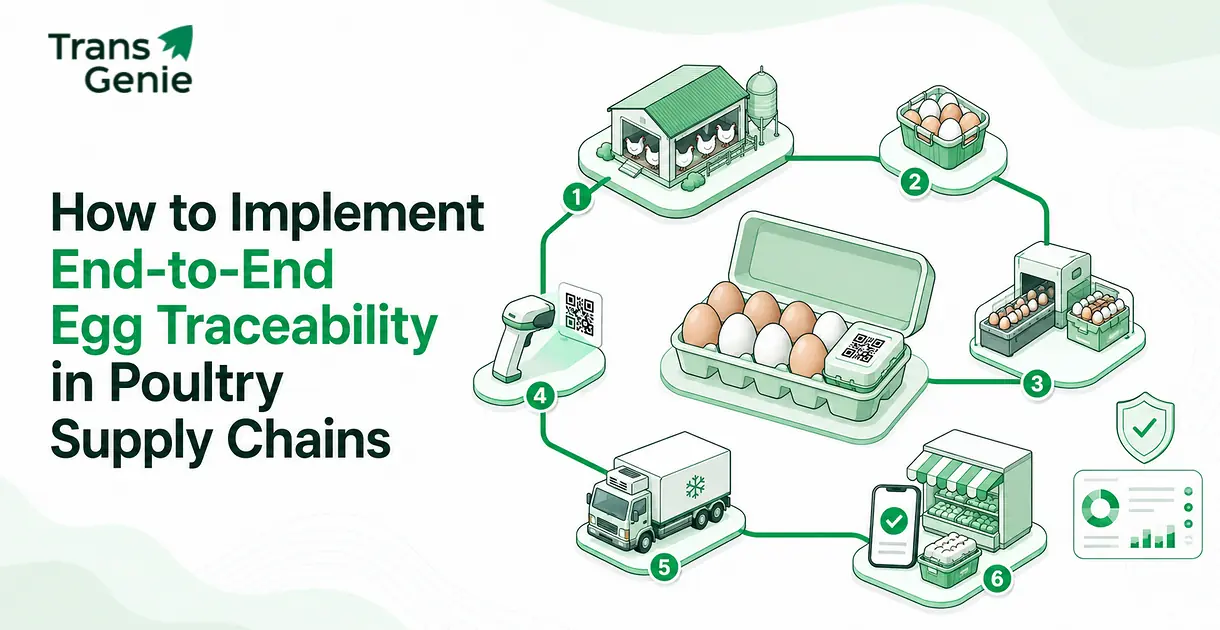
Before choosing egg traceability software, it is vital to map how eggs actually move through your operation. Although this sounds basic, it is where many traceability projects go wrong.
A flock may be easy to identify at the farm. But when the eggs start to move through gathering, transport, grading, packing, and distribution, that identity can become harder to follow. This is especially noticeable when eggs from different farms or flocks enter the same processing flow.
Hence, the real challenge is not collecting more records. It is all about keeping the right identity connected to the eggs as they move through the poultry supply chain, from production and gathering through grading, packing, and distribution.
This entire process matters the most in the U.S. as there is no single identification system that follows a shell egg from the flock to the finished product. NPIP offers permanent approval numbers for participants, while egg products have mandatory lot and plant identification. Shell eggs do not have an equivalent federal lot-code requirement. See the Egg Products Inspection Regulations under 9 CFR Part 590
That creates an important gap for egg producers and packers to address.
A practical egg traceability system connects the key data already created across your operation - from the premises, house, and flock to egg movements, grading, packing, lots, shipments, and customers.
“Quick answer: End-to-end egg traceability means being able to trace a finished egg lot back to its source flock or flocks, and trace a flock forward to the lots and customers it supplied. The key is preserving that connection when eggs move into shared grading and packing operations.”
In the sections below, we will break down where traceability can fail, what information you need to connect, and how to build an egg traceability system step by step.
What Does End-to-End Egg Traceability Actually Means
End-to-end egg traceability means being able to trace eggs through the supply chain in both directions.
In other words, you should be able to start with a finished lot and work backward to find its source. Also, you should be able to start with a flock or house and work forward to see which lots, shipments, and customers it supplied.
In simple terms:
And in the other direction:
The goal is not to create a separate record for every egg. It is to maintain the same connections between the important events and identifiers as eggs move through your operation. In that sense, farm-to-table traceability is all about maintaining a continuous chain of data from the source flock through production, packing, and distribution to the customer.
What should be connected?
Depending on your operation, an end-to-end traceability record may connect:
- Premises - where the flock is located
- House - the specific production area
- Flock - which flock produced the eggs
- Egg movement - when and where eggs were gathered, transferred, or received
- Grading or packing event - where eggs entered the processing flow
- Lot - which finished product group the eggs became part of
- Shipment - when and where the finished product left the facility
- Customer - who received it
The exact level of detail is based on how your operation handles and combines eggs.
Why the Connection Matters
Consider a customer who has given you a finished lot number and asks where those eggs came from. If your records only show the packing date, you may know when the product was packed but not necessarily which flock or farms contributed to it.
Now reverse the question.
If one flock needs to be investigated, you need to know which lots came from that flock and where those lots were shipped. That is the difference between having traceability records and having an end-to-end traceability system.
The Critical Point is Where Eggs are Combined
The hardest part is often not identifying the flock. It is maintaining that identity after eggs leave the farm.
For example:
If all three sources enter the same grading operation, the system must preserve the relationship between those sources and the finished lot they contribute to.
This is especially important for off-line operations, where eggs can arrive from multiple farms and be introduced into a shared grading flow. USDA APHIS NAHMS poultry industry survey reported that at least 20% of U.S. eggs were packed off-line in its 2010 industry survey, and eggs from multiple farms could be introduced onto a common conveyor through side-loading. This is a key point where source identity can become difficult to preserve.
So, when you define end-to-end traceability for your operation, do not ask only: "Can we identify our flocks?" but also ask: "Can we still identify which flocks contributed to a finished lot after the eggs have moved through grading and packing?"
That is the standard your traceability system should be designed to meet.
Map How Eggs Move Through Your Supply Chain
Before choosing traceability software, you should document how your operation currently records and moves information. The aim of this approach is not to create another process. Rather, it is to understand what you already have, where the records live, and where your team has to connect them manually.
This is important as the commercial egg supply chain involves several operations before a finished lot reaches a customer. Depending on the business, the flow may include pullet rearing, layer houses, egg gathering, receiving, grading, packing, and distribution.
The USDA's Structure of the U.S. Poultry Industry, 2010, published in December 2011, found that 92.3% of primary breeder farms and 86.6% of multiplier flocks were contract-owned. Fewer than 10% of table-egg companies owned hatcheries, and less than 3% of hatcheries supplying table-egg farms were owned by the production company.
This survey also found that 86.6% of layer farms raised pullets on a separate farm belonging to the same company. These figures are historical rather than a 2026 industry census, but they highlight why your traceability map should follow both where eggs move and where information changes hands across the chicken supply chain.
Thus, for egg producers, this means mapping the relevant part of the wider poultry value chain - from upstream flock and pullet sources through egg production, grading, packing, and distribution.
multiplier flocks
rearing
house
gathering
packing
Primary Breeder and Multiplier Flocks
These operations establish upstream flock information.
For most commercial table-egg companies, the important implementation question is not whether your traceability platform owns this data. It is whether the relevant source or flock identifiers can be connected to the birds that eventually enter your layer operation.
Hatchery
The hatchery is often an early boundary between organizations. The brief's USDA structural data found that less than 10% of table-egg companies owned hatcheries and less than 3% of hatcheries supplying table-egg farms were owned by the production company.
If hatchery information stops at an external supplier's records, the downstream system should at least preserve the relevant flock or source reference when the pullets enter your operation.
Pullet Rearing
Many operations rear pullets separately and transfer them to the layer farm around 16 - 17 weeks. That transfer is an important traceability event because it establishes the relationship between:
Layer House
This is where flock identity becomes relatively stable.
A flock can remain in production for:
- 78 - 80 weeks with no molt
- 102 - 106 weeks with one molt
- 140 - 150 weeks with two molts
Approximately 80% of U.S. laying hens are molted at least once. NAHMS farm-level data also found that molted flocks averaged 88.7 weeks in the laying house versus 64.2 weeks for non-molted flocks. That has an important implementation consequence:
Flock Identity is Not Usually the Expensive Part of Egg Traceability
Flock traceability is usually relatively straightforward when a flock has a clear identity linked to its premises and house. The challenge comes later, when eggs from different sources can enter the same operational stream.
Egg Grading and Packing
This is the point that deserves the most attention in your design. An in-line operation may move eggs directly from
An off-line operation is different.
Approximately 70% of U.S. eggs are sold as whole shell eggs, and at least 20% are packed off-line. That is where a farm-level traceability system can look complete while still failing to provide true end-to-end traceability.
Distribution
Once eggs are packed, the traceability problem changes. Now the focus moves from production identity to:
Your distribution records therefore need to connect the finished product identity created at packing with the commercial movement records already used by your business.
Map the Information at Each Handoff
You may already have most of the records needed for traceability. The problem is often that they sit in different systems, spreadsheets, forms, or paper records.
| Stage | What to map |
|---|---|
| Pullet transfer | Source, destination, flock information |
| Layer house | Premises, house, flock, production records |
| Egg gathering | Collection and movement information |
| Receiving | Source, quantity, date, and time |
| Grading and packing | Processing, product, and lot information |
| Distribution | Lot, shipment, and customer records |
For each handoff, ask:
- What is recorded, and who records it?
- Where is it stored?
- Is it entered once or copied elsewhere?
- Is there a clear identifier connecting it to the previous stage?
- Can the next team access it without manual reconciliation?
Monitor the recurring manual work such as matching receiving records to farm records, connecting flock details to packing records, reconciling lots with shipments, or assembling records for a customer or investigation.
If answering a basic traceability question requires checking several systems or files, that is a clear sign for improvement.
Find the First Point Where Identity Can Be Lost
After mapping the chain, look for points where an identifier changes, eggs moves between locations, product is combined or split, or eggs enter shared processing.
Then identify the first point where your team can no longer reconstruct the product history without manually combining records.
For many egg operations, this will be the grader, particularly when off-line eggs enter a shared processing flow.
That is the gap your traceability system should solve. Upon finding where the information breaks, the next step is to decide what unit you actually need to trace - a flock, house, gathering event, receiving event, grading run, or finished lot.
What Already Identifies Eggs - and What It Does Not
Before adding new technology, it is vital to take a look at the identifiers and records you already have.
The U.S. egg industry already uses several regulatory and operational identifiers. The issue is that they serve different purposes and do not automatically create one continuous chain from flock to finished egg.
NPIP Identifies Participants, Not Commercial Eggs
The National Poultry Improvement Plan (NPIP) is a federal-state-industry program governed through 9 CFR parts 145, 146, and 147.
Under 9 CFR 145.4(e), each NPIP participant will be given a permanent approval number. The regulation says the number "may be used" on certificates, invoices, shipping labels, and other sales documents.
This makes the number useful in finding a participant or business. However, this number does not identify a specific flock, batch, or egg.
That distinction is vital when you are building an egg traceability system. You may even have an NPIP number on supplier, movement, or production records. But you still need a way to connect that information to the specific premises, house, and flock involved.
NPIP records can offer useful upstream information. For example, VS Form 9-3 records the sale or movement of hatching eggs, chicks, and poults and is retained for three years. Similarly, official H5/H7 LPAI testing records for commercial layers are also maintained for three years under 9 CFR Part 146.
NPIP requirements were also updated through a USDA final rule published in September 2025, showing that the program continues to evolve. Hence, your internal traceability chain should connect:
NPIP requirements are also still evolving. In August 2026, USDA published a proposed rule with further changes to the program, so producers should distinguish current requirements from proposed changes.
Keep Breeder and Layer Requirements Separate
It is better not to confuse breeder classifications with commercial layer requirements. There is an important distinction here. Commercial table-egg layer flocks under 9 CFR Part 146, Subpart B have the U.S. H5/H7 Avian Influenza Monitored classification.
The U.S. S. Enteritidis Clean and U.S. Pullorum-Typhoid Clean classifications apply to breeder operations, and not to the commercial table-egg layers. Salmonella Enteritidis controls for shell-egg production are addressed separately under FDA requirements for egg producers.
These records can still provide useful flock and animal-health information. However, they should not be treated as the identifier for the commercial eggs produced by that flock.
Shell Eggs and Egg Products are Different
The regulatory picture is different when the shell is broken. The Egg Products Inspection Act defines egg products as dried, frozen, or liquid eggs. Egg products are overseen by USDA FSIS, while FDA and USDA AMS have roles covering shell eggs and shell-egg activities.
For egg products, 9 CFR 590.411 requires containers to carry a lot number or an alternative code showing the date of production. They must also carry the official inspection symbol and plant number.
Egg-product records can also include the date of lay, date and time of refrigeration, date of receipt, quantity, and quality. Shell eggs do not have the same federal lot-code requirement, and this eventually creates an important gap:
Egg products have mandatory lot identification, while whole shell eggs do not have an equivalent federal lot-code mandate.
i.e., Shell eggs do not have the same federal lot-code requirement. Under USDA's voluntary shell egg grading program, grading and labeling requirements serve a different purpose from a continuous production lot identifier.
The Real Issue is Connecting the Identifiers
Your operation may already have all of these records:
The complexity is ensuring those records to stay connected.
For example, a farm record can be used to identify the flock, a receiving record may help identify the incoming eggs, a packing record may support identifying the finished lot, and a shipping system may be used to find the customer.
If your team has to check for several systems and manually match those records, it means your traceability chain is still disconnected.
So the important question is not: "Do we have identifiers?" It is: "Can we connect the identifiers we already have into one product history?"
That connection is what turns separate records into end-to-end egg traceability.
Three Regulators, Three Thresholds, One Farm
An egg operation can fall under several regulatory programs at the same time.
The key is to know which rules apply to your operation and what records they require. These records do not automatically connect into one traceability system.
FDA: 3,000 laying hens
FDA's shell-egg Salmonella prevention should be done under 21 CFR part 118 that applies to egg producers with 3,000 or more laying hens. This framework includes areas such as environmental monitoring, biosecurity, refrigeration, and Salmonella Enteritidis prevention.
For traceability, the important point is that these production and food-safety records can offer useful information about a flock and its production history.
USDA AMS: above 3,000 hens
USDA AMS operates the Shell Egg Surveillance Program under 7 CFR part 57.
Those handling more than 3,000 hens must register before starting operations. The program also needs records covering the receipt, delivery, sale, movement, and disposition of eggs for two years.
These records can already contain much of the movement information a traceability system needs. However, the challenge is connecting them to the flock, house, grading, packing, and shipment records that sit elsewhere.
NPIP: 75,000 birds
NPIP's commercial-layer provisions use a higher threshold.
Commercial table-egg laying premises with fewer than 75,000 birds are exempted from the special provisions of NPIP subpart B under 9 CFR Part 146. Official H5/H7 LPAI testing records are maintained for three years.
This threshold becomes extremely important for larger commercial operations because the applicable animal-health and biosecurity requirements can add another layer of records to the operation.
It is to note that an audited biosecurity plan is not the same as an egg traceability system, but both depend on having clear and reliable operational records.
Why the Thresholds Matter for Traceability
A single farm can hold records built under FDA, USDA AMS, and NPIP, each for a different purpose. That does not mean you need three traceability systems. It means your implementation should help identify which records already exist, who owns them, and how they can be connected.
The practical question is:
Which regulatory records can become part of your existing traceability chain instead of being maintained separately? That offers you a better starting point than creating new records simply because you are implementing traceability software.
Where Egg Traceability Actually Breaks: The Grader
If there is one part of the poultry supply chain to investigate first, then it is the grader.
The key question is: "Can you take a finished lot and identify every source that contributed eggs to it?"
If not, capturing more farm data will not fix the problem.
In-line flow
An in-line operation can look like this:
When the source remains within a defined processing stream, then maintaining source identity can be more straightforward.
Off-line flow
The complexity increases when eggs from multiple farms enter the same grading operation. I.e., once those eggs move through a shared processing flow, the system needs to preserve which sources contributed to each finished lot. If the receiving and processing events are not properly connected, this is where source identity can be lost.
Preserve the Source-to-Lot Connection
Packer-level traceability is as important as farm-level traceability.
A system may know exactly which flock produced the eggs. However, if it cannot connect those eggs to the finished lots they entered, it doesn't truly mean end-to-end.
The key relationship to preserve is:
That is what allows you to trace a finished lot back to its sources and, when a source is affected, identify the finished lots that may be involved.
The Five-Stage Egg Traceability Implementation
Once you know where your current traceability process breaks, you can start building the solution step-by-step, starting with the most important gaps.
The goal is not to capture every possible data point. Rather, it is to create a reliable link between the source, egg movement, finished lot, and shipment.
Set Up Your Master Data
Before you introduce scanners, labels, integrations, or dashboards, controlled master-data structure. At minimum, define unique identifiers for:
- Premises
- Farm
- House
- Flock
- Grading or packing facility
- Processing line
- Product
- Pack configuration
- Lot
- Customer
- Shipment
It is better to use one controlled identifier for each. For example, do not let the same farm appear as Farm 04, Farm-4, and F4 in different systems.
Note that your master data becomes the foundation for connecting records later.
Besides, the flock record should have a defined lifecycle and should answer:
- Where was the flock placed?
- When was it placed?
- Which house contains it?
- What was its source?
- When did production begin?
- Has it moved?
- When did the flock leave the house?
- Which egg-gathering records relate to it?
The point is not to build a massive database. But is to create a reliable identity that downstream events can reference.
Decide What You Need to Trace
This is the most important design decision after mapping the physical flow. Instead of starting with what technology to use, proceed with what exactly we must be able to track.
Depending on your operation, this could be a:
- Flock
- House
- Gathering event
- Receiving event
- Grading run
- Finished lot
Choose the level that matches your actual process and customer requirements.
Do not promise more detail than your physical process can support. If eggs from several sources are mixed before their identities are captured, the software cannot reconstruct the individual source of every egg afterward.
Capture Traceability Events at the Source
Once the identifiers are defined, record the important events where they happen. For the farm, this may include:
It is better to capture the information as close to the event as possible rather than relying on someone to reconstruct it later.
In most cases, poultry operations will not always have ideal connectivity at every house, farm, loading area, or receiving point. The aim is simple:
Carry the Identity Through Grading and Packing
This is where your source records need to connect with the finished product. For each relevant receiving or processing event, capture the relationship between:
Depending on the operation, this may include:
- Source farm
- House and flock
- Quantity received
- Receiving date and time
- Processing or grading run
- Finished lot
- Quantity allocated to the lot
If multiple sources are combined, the system should preserve that relationship rather than replacing several sources with one generic receiving record.
For each receiving or processing event, keep the relationship clear:
Assign Responsibility for the Initial Packer Decision
Someone should be responsible for deciding: “Where does a traceability lot begin?” This should be clear and consistent across shifts. Thus, the person responsible should know:
- When a lot starts and ends
- Which source eggs belong to it
- How mixed sources are recorded
- What happens when a line stops
- How rework or repacking is recorded
- How the lot connects to cases and pallets
Without clear rules, lots can become difficult to trace even when the underlying records are available. The goal is not just to save delivery records. It is to keep a clear link between where the eggs came from and which finished products they became.
Test the Traceability Chain and Retrieval Under Time Pressure
A traceability system is not considered a success because the data is stored. It is successful when your team can retrieve the right answer quickly. Run two tests:
1. Backward trace
Start with a finished lot. Ask: “Where did these eggs come from?”
Your team should be able to move from:
without manually reconciling unrelated spreadsheets.
2. Forward trace
Start with a source flock or house. Ask: “Where did these eggs go?”
The answer should identify:
- Relevant lots
- Production dates
- Shipments
- Customers
- Quantities
- Potentially affected product
- Test the exceptions
Do not test only the cleanest scenario. i.e., you should also test:
- Mixed-source receiving
- Partial loads
- Line changes
- Repacking
- Rework
- Missing scans
- Offline capture
- Duplicate records
- Shift changes
- Product held in inventory
- A customer requesting records urgently
The exceptions are where traceability systems usually reveal their weaknesses. The need for connected traceability details can become even more important during an animal-health emergency. The Secure Egg Supply Plan includes the availability of traceability information as part of its movement guidance for egg industry products, helping support timely decisions about whether and how products can move during an outbreak.
What Should Your Egg Traceability System Capture During an HPAI Outbreak?
Egg traceability is not only useful for food recalls or customer requests. When it comes to commercial egg operations, it can also help you respond faster when an HPAI control area, movement restriction, or animal-health investigation affects your operation.
As of May 2026, more than 206 million birds across 50 states and Puerto Rico had been affected by HPAI since early 2022, with more than 1,000 commercial flocks depopulated as of March 31, 2026. Table-egg layers accounted for about three-quarters of domestic poultry losses, despite making up less than 4% of the domestic poultry population.
Know What Information May Be Needed
A permitted movement from an HPAI control area can require information such as:
- Premises identification
- GPS coordinates
- Premises Identification Number (PIN)
- Farm name
- Surveillance results
- Production information
- Vehicle biosecurity information
- Epidemiological assessment
It is to note that the Secure Egg Supply framework also treats different egg products differently. Pasteurized liquid egg has a different movement risk profile from that of the nest-run shell eggs. In the framework, nest-run shell eggs may move only to the premises without poultry.
Traceability software cannot guarantee movement approval. It can, however, help your team quickly find and provide the information needed when applying for approval. The value is that the required information is already organized and easier to retrieve when time matters.
Biosecurity Records Matter Too
Since October 30, 2025, commercial table-egg operations with 75,000 or more birds need an audited biosecurity plan to qualify for 100% HPAI/LPAI indemnity reimbursement. The plan must meet the applicable requirements.
Source: https://www.federalregister.gov/documents/2020/10/29/2020-20151/egg-products-inspection-regulations
That does not mean traceability software replaces a biosecurity plan. It means your flock, premises, movement, and related records should be easy to find and keep consistent with the rest of your operation.
The goal is simple:
- When an outbreak affects your operation, you should be able to produce the information you need without rebuilding it from scattered records.
What the U.S. Can Learn From Europe and Australia
The U.S. is not the only market trying to solve poultry traceability. Europe provides a useful example of upstream identity.
Under Commission Regulation (EC) No 617/2008, hatching eggs must carry the producer's distinguishing number, while chick boxes carry the hatchery number. Hatcheries also have reporting requirements.
The lesson is not to copy the European system wholesale. Rather, it is to see the value of an identifier that stays connected to the product as it moves through the supply chain.
Besides Europe, Australia also offers a more direct implementation example. Australian Eggs publishes an egg traceability manual and provides EggTrace, a browser-based tool intended to help farmers trace eggs from lay through dispatch. Its purpose is to help find the relevant farms, production areas, or sheds when a food-safety or quality issue occurs.
For U.S. producers, the key lesson is simple:
- Traceability should identify the operational level where action can actually be taken. When the problem originates in one house, "Farm X" may not be enough.
- If eggs from three different sources are mixed during grading, knowing only "Flock Y" may not be enough either. The right resolution depends on where the risk occurs.
7 Egg Traceability Mistakes That Can Break Your Supply Chain
Even a well-designed traceability system can fail if key process gaps are missed. Here are seven common mistakes that can break the connection between your egg sources, finished lots, and shipments.
Buying Software Before Defining the Lot
Traceability software cannot fix an unclear process. It is better to first decide on where a lot starts, what it includes, and when it changes.
Then proceed to set up the technology around that process.
Tracking Everything at the Farm but Losing Identity at the packer
This is one of the biggest egg traceability mistakes to avoid.
Detailed farm records do not offer end-to-end traceability if the grader cannot connect the source flock to the finished product.
Making Flock Identity More Complicated than Necessary
Flock identity is usually relatively stable. The problem is keeping that identity connected as eggs move through receiving, consolidation, grading, packing, and shipment.
It is better to focus your effort on the points where identity actually changes.
Building Around Just One Regulator
FDA, USDA AMS, USDA FSIS, NPIP, animal-health authorities, and commercial buyers may all need different information. So, it is better not to build a separate traceability system for each one.
Instead, create one operational identity model that can provide the information each party needs.
Building for Compliance But Not for Buyers
A retailer or distributor may ask for traceability details in a different format from your regulatory records. Your system should support these customer requests without creating a separate source of data.
Leaving Lot Ownership Unclear
Someone needs to decide where the initial packing lot begins. If the answer is "the system will figure it out," the process is not clearly defined yet.
Testing Only Under Normal Conditions
A normal shipment is not the real test. You should test whether your team can respond when:
- Two farms are received together
- The production line changes
- A shipment is only partially delivered
- An operator is absent
- Connectivity fails
- Product is repacked
- A customer asks for records immediately
Your traceability process should still work when operations do not go as planned.
Your 90-Day Roadmap to End-to-End Egg Traceability
It is not required from your end to digitize everything at once. Instead, you can start with the biggest gaps in your traceability process and build from there.
Days 1 - 30: Map Your Process
Document the key points in your operation:
- Every premises and house
- Flock identifiers
- Pullet transfers
- Egg-gathering points
- In-line and off-line flows
- Grading facilities
- Side-loading points
- Lot creation rules
- Case and pallet relationships
- Shipment destinations
Then find the first point where source identity can be lost. That becomes your priority.
Days 31 - 60: Connect Your Records
Build the links between:
Use the records you already have where possible and standardize your identifiers before asking teams to enter more data.
At this stage, you do not need a perfect dashboard. All you need is a clear and reliable chain of identity.
Days 61 - 90: Test With Real Records
Choose a recent finished lot and trace it back to its source. Then choose a flock and trace its eggs forward to the finished lots and shipments.
Check for:
- How long the trace takes
- Missing records
- Manual matching between systems
- Duplicate data entry
- Unclear ownership
- Gaps when multiple sources are mixed
- Information that exists but is difficult to find
Fix these gaps before expanding the system to more processes or locations.
Where Egg Traceability Software Fits
Software should support your traceability process and not decide how it works.
A useful system should help your team:
- Manage premises, house, and flock data
- Capture source information at the farm
- Connect incoming eggs to grading and packing
- Keep source relationships when eggs are combined
- Create and manage production lots
- Link lots to cases, pallets, and shipments
- Trace backward from a finished product
- Trace forward from a source flock or house
- Export records when needed
- Work when connectivity is limited
- Keep a clear record of changes
The real value is not simply having another place to store data. It is all about connecting the records and minimizing the manual work needed to trace a product. For example, if your QA team has to check a flock spreadsheet, receiving log, packing report, and shipping records before responding to a customer, the data already exists.
The problem is that the records are not connected. That is where traceability software fits: helping turn separate records into one usable product history.
The Bottom Line - Connect the Identity, Not Just the Records
The U.S. egg supply chain already creates a large amount of information. The problem is that this information does not automatically stay connected as eggs move through the supply chain.
NPIP can identify participants. Farm records can be used to find the houses and flocks. Receiving records can help identify incoming eggs. Packing systems is used to find finished lots, while shipping records can identify customers.
End-to-end egg traceability connects these records into one product history. And the first place to focus is not always the layer house.
It is often the point where eggs from different sources enter the same grading and packing flow.
That is where the connection between flock identity and finished product can be lost.
A practical implementation comes down to five steps:
- Map your poultry supply chain.
- Set up clear premises, house, flock, product, and lot identifiers.
- Decide exactly what you need to trace.
- Keep source identity connected through grading and packing.
- Test your ability to trace products forward and backward using real records.
FDA FSMA 204 traceability rule information explains that the FDA will not enforce the Food Traceability Rule before July 20, 2028. But there is little value in waiting for a deadline to start improving traceability.
Egg businesses already need to respond to customer requests, recalls, quality issues, and animal-health events. The best traceability system is not the one that collects the most data. It is the one that helps you quickly answer:
"Where did this egg come from?" and "Where did it go?", even after the eggs have been moved, mixed, packed, and shipped.
Yokesh Sankar