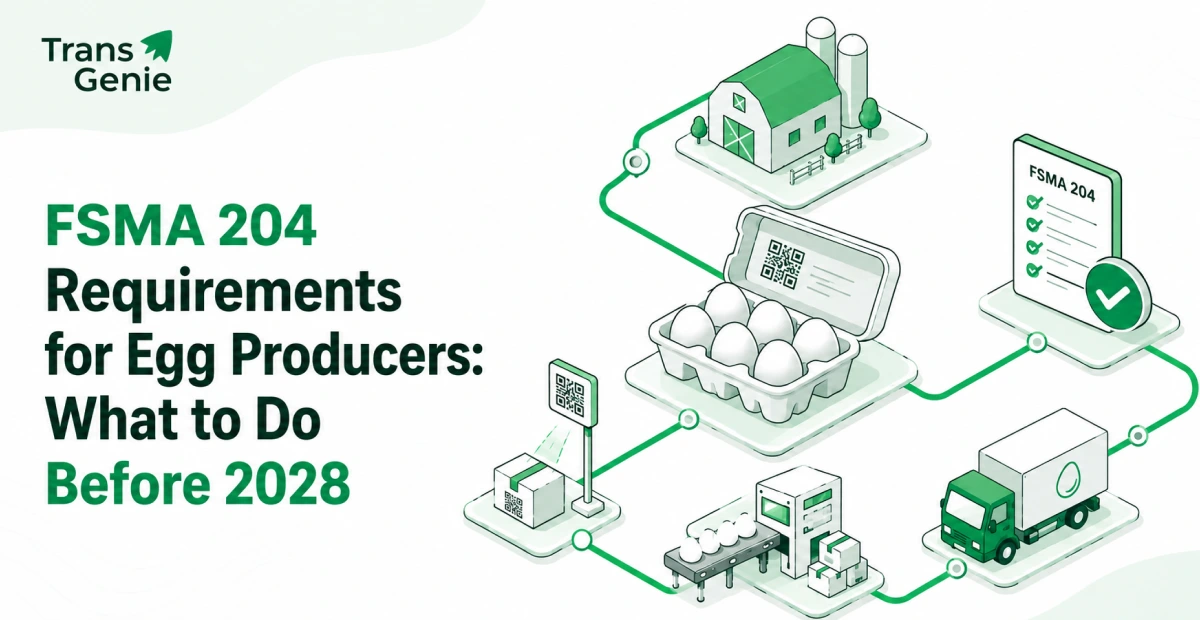
If you are an egg producer, the good news is the timeline for FSMA 204 requirements has been changed. The original January 20, 2026 date is now under a federal enforcement pause until July 20, 2028. Thus, for those egg producers and packers, this new date gives more time to review your traceability process, work through data gaps, and prepare your team without the pressure of the original deadline.
But the delay is not a reason to put traceability on hold. Waiting until 2028 could put you under pressure when buyers start asking for better traceability.
Some large retailers have already started following their own traceability requirements and timelines. For instance, Walmart is expecting suppliers of Food Traceability List products to meet its requirements by August 1, 2025. Even after the federal delay, it still told suppliers to keep working toward those requirements.
So the question for your business is no longer simply “When will FDA enforce FSMA 204?”
For shell egg producers, that answer could shape your traceability plans long before July 2028.
Quick Answer: What Should Egg Producers Know About the FSMA 204 Delay?
The FSMA 204 requirements now have more time for federal enforcement, but egg producers still need to know what their customers already expect.
In this guide, we cover:
- What changed: Why FDA will not enforce the Food Traceability Rule before July 20, 2028, & what the delay does & doesn't change.
- Buyer requirements: How Walmart and Kroger have set traceability requirements that can run ahead of the federal timeline.
- The commercial risk: Why supplier compliance can affect business relationships even when FDA enforcement is delayed.
- FSMA 204 egg traceability: The key data, lot codes, records, and traceability steps egg operations need to understand.
- The 98% exemption: What the small-producer exemption means and why producer count does not tell the whole story.
- The cost of waiting: Why data gaps and correction cycles can make a late start harder than it looks.
- What to do now: A simple one-afternoon check to review buyer requirements, test one lot, and decide what to fix first.
The key takeaway: July 2028 may be the federal enforcement date, but it doesn't necessarily have to be your business's start date.
What Actually Changed in November 2025?
The federal timeline changed in late 2025, and thus offered businesses more time to prepare for the Food Traceability Rule.
FDA will not enforce the rule before July 20, 2028
The original date was January 20, 2026. In August 2025, FDA proposed a 30-month extension. Then in November 2025, Congress directed that federal funds could not be used to administer or enforce the rule before July 20, 2028. Hence, the safest way to describe the change is: FDA will not enforce the Food Traceability Rule before July 20, 2028.
The rule itself has not been removed
The delay is about enforcement and not the removal of the traceability framework. The FSMA 204 traceability framework still covers Traceability Lot Codes, Critical Tracking Events (CTEs), Key Data Elements (KDEs), traceability plans, and recordkeeping for covered businesses. This delay means businesses can use the extra time to prepare rather than start from scratch later.
FDA is still reviewing how the rule should work
In November 2025, Congress directed that the Food Traceability Rule will be finalized before July 20, 2026. The agency published draft Q&A guidance in February and started the stakeholder discussions on implementation challenges.
In May, FDA also opened a consultation on lot-level traceability and possible flexibilities. The agency said it had not yet decided the scope of those flexibilities.
What this means for egg businesses
You do not need to treat every current interpretation of the rule as final. On the other hand, you also should not assume that waiting for 2028 means starting from zero later.
So, for egg businesses, this indication means that some details may still change before 2028. It also makes it important to build the parts of your traceability process that are unlikely to change. Thus, it helps you keep the system flexible enough to adapt if FDA changes specific requirements.
Your Buyer May Have Set the Deadline Already
The FDA timeline is not the only thing that matters now. Large buyers can set their own traceability requirements based on what they need from suppliers.
When it comes to egg producers, it is important to check your customer's supplier portal along with the latest FDA updates.
What Walmart's Supplier Page Actually Says About the Extension
Walmart's food traceability guidance page mentions the FDA's proposed extension. It also tells suppliers to keep working toward the original timelines. For Food Traceability List products, Walmart's stated deadline was August 1, 2025.
What Walmart Requires From Suppliers
Walmart's published requirements cover lot or batch codes, date codes and the source where the lot code was created. It also covers SSCC-18 on pallets linked to the ASN, GS1-128 on cases, and EDI 856 advance shipping notices.
These requirements give suppliers a clear example of how a retailer can turn traceability into a day-to-day data and shipping requirement.
The Requirement Goes Beyond FTL Products
Walmart's traceability program is broader than just the foods listed on FDA's Food Traceability List.
Its supplier guidance includes food suppliers more broadly, covering products such as beverages, meat and poultry, baby food, and pet food. That implies you should check the requirement that applies to your Walmart relationship rather than assume it only follows the FDA list.
Shell Eggs Are on the Food Traceability List
Shell eggs are included on FDA's Food Traceability List. Hence, covered egg businesses need to understand the relevant FSMA 204 rule and requirements. For Walmart suppliers, this also means looking at Walmart’s general traceability requirements along with its separate requirements for fresh shell eggs.
Walmart's Egg Requirements Show the Commercial Stakes
Walmart separately requires GFSI-recognized certification at fresh shell egg packing and processing sites, with annual audits.
Its fresh shell egg guidance says that losing the required certification can lead to loss of business and deactivation. This is not an FSMA 204 penalty, but it shows how seriously Walmart treats supplier compliance.
Kroger Sets Its Own Timeline Too
Like Walmart, Kroger has also published traceability requirements for all food products entering its facilities. These requirements apply beyond those products on the Food Traceability List.
Its requirements cover EDI 856 ASNs, SSCC pallet labels, and case information such as GTIN-14, lot and production, packing, or expiration dates. Its transition deadline was June 30, 2025.
Kroger's requirements were set before the federal rule took effect and go beyond it in some areas. However, Kroger has not publicly confirmed whether these requirements change in response to the later federal delay.
What About the Other Retailer Claims?
ReposiTrak, a company that sells traceability compliance software, has reported that 70 to 80 retailers and wholesalers have set their own deadlines. That figure has not been independently verified, so it should not be treated as a confirmed industry-wide number.
For your business, there is a simpler way to get the answer: check your largest customers’ current supplier requirements and ask whether their deadlines changed after the federal delay.
Walmart Was Setting Traceability Deadlines Years Before FSMA 204
Even before FSMA 204, Walmart has been asking suppliers for stronger traceability. Its 2018 approach to fresh leafy greens shows that retailers can set their own expectations before a federal rule takes effect.
Walmart asks leafy-greens suppliers to track production lots.
Supplier network connection
End-to-end farm traceability
Earlier in September 2018, Walmart had asked its fresh leafy greens suppliers to track each production lot back to the farm. Here, the goal of Walmart was to find the source of the product "in seconds and not days."
Walmart had even asked the direct suppliers to be connected to its traceability network by January 31, 2019. It then expected an end-to-end traceability back to the farm by September 30, 2019.
What Egg Producers Can Learn From This:
The point is not that Walmart will use the same timeline for eggs. But its earlier approach shows that a retailer can set its own traceability expectations when they need better supply-chain visibility. For egg producers, the takeaway is that the FDA sets the regulatory timeline, but your buyers can set their own business deadlines.
Why Kroger's Deadline Still Matters for Egg Producers
Kroger published its food traceability requirements in December 2023 and mentioned a transition deadline of June 30, 2025.
Kroger's requirements apply to all food products entering its facilities in addition to all those products on the Food Traceability List. Its requirements included:
- EDI 856 ASNs
- An EDI 856 for every shipment
- Alignment with Kroger's Track and Trace receiving specifications
- Palletized barcode labels matching the EDI 856 data
It is to note that Kroger's requirements were set before the federal delay and extend beyond the rule in some areas. However, Kroger has not publicly confirmed whether its requirements will change after the delay.
If you supply Kroger, the practical step, the practical step is to check the latest Kroger supplier requirements instead of assuming the FDA delay changed your customer's deadline. That gives Kroger enough importance without creating another section that repeats the same information.
Why Starting in 2028 Could Still Put You Behind
The extra time may look useful, but traceability takes more than choosing software. You need time to test your data, fix gaps, and make sure the process works across your farm, packing and shipping operations.
Traceability Data Needs Testing
According to ReposiTrak, a traceability software provider, initial supplier data error rates of 40% to 60% are found across roughly two million records. Although this is vendor-reported data, it still shows why traceability data may need several rounds of testing and correction.
FDA Testing Found Gaps
As per FDA's 2026 readiness exercises, about 80% of participants had a Traceability Lot Code in their records, and 73% recorded where that code came from. However, only 40% kept that lot code connected across every tracking step they performed.
Early Coordination Can Save Time
When supply-chain partners had already coordinated their processes, FDA found that work that might have taken 48 to 96 hours or longer could be completed in a single day.
Hence, starting earlier gives you time to find these gaps, fix them, and test again before a buyer needs the information.
What an Egg Operation Actually Has to Build
The goal of FSMA 204 egg traceability is not just to keep more records. Your operation needs to hold the right information connected as eggs move from the farm through packing and shipment.
The Key Data Your Egg Operation Needs
Under the initial packing requirements, the Traceability Lot Code is linked to 16 Key Data Elements (KDEs). For the relevant initial packing requirements, five important data points are required and that includes:
- Farm location
- Harvester business name and phone number
- Harvest date
- Cooling location
- Cooling date
These details should be linked to the Traceability Lot Code so the history of a lot can be followed when needed.
FDA also suggests that covered businesses should keep a traceability plan and retain the required records for 2 years. When asked, the records must be provided to FDA within 24 hours, subject to the rule's provisions.
Decide Where the Lot Code is Created
Decide where the Traceability Lot Code will be assigned and make sure every team uses it consistently throughout the process. If the farm, packing centre, and shipping team use different identifiers, note that connecting the records later will become difficult.
Make Sure the Data Can Follow the Shipment
The information that goes along with a shipment depends on the applicable rule and your buyer's requirements. Your customer may also require specific labels, identifiers, or electronic data such as an EDI 856. So, check those requirements before deciding how your process should work.
Be Ready to Produce Records Quickly
Covered records generally need to be provided to FDA within 24 hours of a request. The rule also calls for an electronic, sortable spreadsheet when applicable during an outbreak or recall. Your team should be able to retrieve the required data without spending hours putting it together manually.
Keep the Right Records for the Right Length of Time
The Food Traceability Rule generally requires covered records to be kept for two years.
Egg businesses may also have separate recordkeeping duties under other FDA requirements, so the FSMA 204 retention period should not be treated as the only recordkeeping rule that applies to your operation.
What Happens When a Buyer Requests Traceability Records?
A buyer may ask for traceability data during a product investigation, recall, or routine review. At this point, having the data somewhere in your system is not enough; your team needs to find the right records quickly.
If lot, packing, inventory, and shipment records are spread across different files, your team may need to search through several systems before they can answer the request. However, with a connected process, it becomes much easier to follow one lot and provide the information your buyer needs.
Can Your Team Find One Lot Quickly?
Take one real egg lot and ask your team to trace it from the farm through packing and shipment. See how quickly they can find the complete record without creating new information or checking multiple disconnected files.
If the process takes too long, that gives you a clear point for improvement.
Why This Matters During a Recall
A traceback request can become time-sensitive when there is a food safety concern. The faster your team can find out the lot, its source, and where it went, the faster you can respond. That is why traceability should work as part of your normal operation, rather than something your team has to rebuild when a buyer asks for it.
The 98% Exemption: What Egg Producers Need to Know
FDA estimated that about 98% of shell egg producers would be exempted from the Food Traceability Rule. However, that estimate is based on the number of producers and not the amount of eggs they supply.
What the 3,000-Hen Threshold Means
Farms with fewer than 3,000 laying hens may qualify for an exemption, depending on the rule's conditions. There are other exemptions that may apply to certain treated shell eggs and direct farm-to-consumer sales.
The 98% Figure Does Not Mean 98% of Egg Volume
The 98% estimate is based on producer count and not based on egg volume. Most of the exempt producers are small farms, so the number does not mean that 98% of commercial egg production is exempt. These farms account for only a small share of covered shell egg sales, and so the 98% figure should not be read as meaning that most commercial egg volume is exempt.
An FDA Exemption Does Not Exempt You From Buyer Requirements
Even if your operation qualifies for an FDA exemption, your customers will still ask for traceability information. If you supply a major retailer, then check its requirements before assuming that the exemption means you can delay your traceability work.
What Should Egg Producers Do Now - A Simple Step-by-Step Approach to Get Ready
You do not need to change your whole traceability process at once. Start with one customer, one lot, and one clear workflow, then improve it step by step.
Check Your Three Largest Customers
Start with the supplier portals for your three largest customers. Check their current traceability requirements, deadlines, required data, and preferred formats. You can use these details to identify what your customers expect today rather than focusing on what FDA may require in 2028.
Confirm Whether Their Deadlines Changed
If a buyer had a traceability deadline before the federal delay, it is better to ask whether that deadline still applies. A simple question is: "Has your traceability requirement or deadline changed after the FDA delay?" Thus, you will be able to get the answer directly from the buyer.
Trace One Lot From Farm to Customer
Choose one real egg lot and follow it from harvesting through cooling, packing, storage, and shipment. See how long it takes your team to find the full record. This will show you where data is missing or difficult to find.
Decide Where the Lot Code Starts
Before choosing food traceability software, decide where your Traceability Lot Code will be assigned. Then make sure the same code connects your farm, packing, inventory, and shipping records.
Fix the Biggest Gap First
Use your test to identify the step that causes the most delay or missing data. You need to fix that first, then repeat the same lot test. This gives you a practical way to improve your FSMA 204 traceability process without trying to change everything at once.
When Should Egg Producers Consider Traceability Software?
If you understand your buyer requirements and test one lot, you will get a clearer idea of where your current process needs help. This is where food traceability software can make things easier.
Instead of keeping lot, packing, inventory, and shipment records across different spreadsheets or systems, food traceability software can bring them together and make the information easier to find.
You do not need to choose the best food traceability software before you understand your needs. Firstly, find where data is missing, duplicated, or hard to retrieve, then choose a system that can solve those problems.
For an egg operation, the right system should help connect records from the farm through packing and shipment. It should also help retrieve information when a buyer asks for it or when you need to investigate a recall.
The extra time before 2028 is the best chance to test this with a real lot. A small pilot can show whether your current process works and where technology could save your team time.
The Bottom Line: 2028 Is Not Your Only Deadline
The FDA delay is the best opportunity for egg producers to prepare. However, your customers may still have their own traceability requirements and deadlines.
Walmart is one clear example. Its FTL deadline was August 1, 2025, and it has told suppliers to keep working toward its original timelines. That does not mean every retailer has its own FSMA 204 deadline. It means you should understand your own customer needs before deciding to wait.
The best place to start is simple: check your three largest customers, trace one real egg lot, and see how quickly your team can find the complete record. If you find gaps, use the time before 2028 to fix them. That way, you are not starting from scratch when a buyer needs the information.
“The goal is simple: use the extra time to be ready before a buyer asks for the data, rather than starting when they do.”
Yokesh Sankar