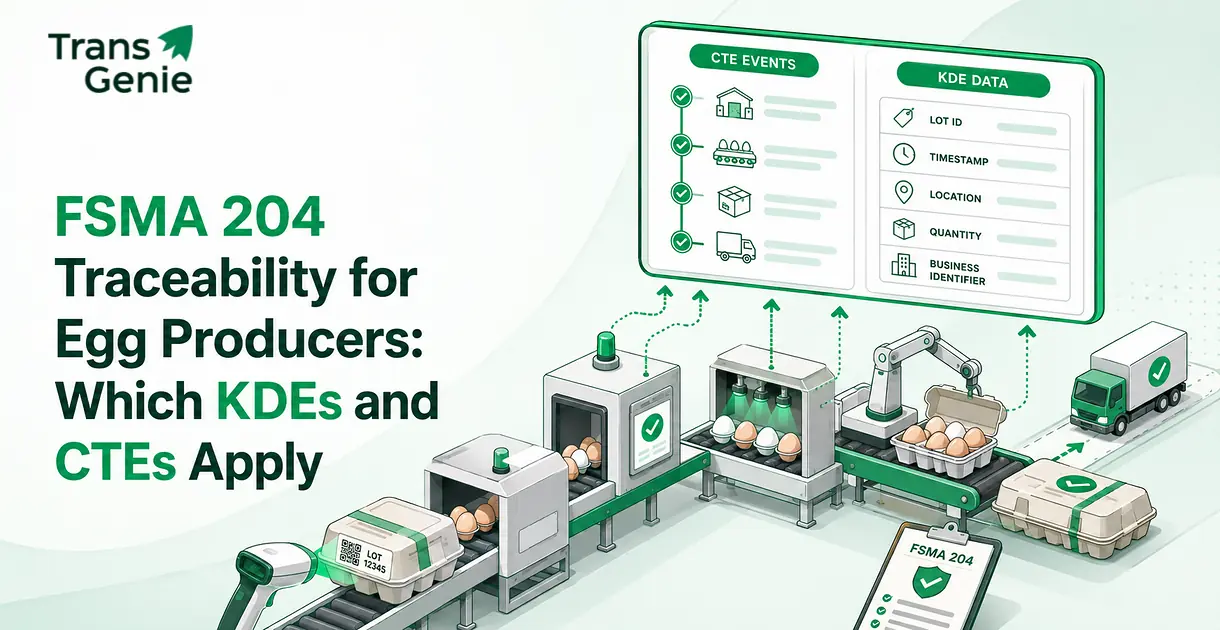
If you have been trying to understand what FSMA 204 traceability actually means for your egg operation, then you may find the rule a bit confusing.
You may have come across 16 Key Data Elements listed for initial packing and assumed you need to capture all of them. You may also have seen five items listed for a traceability plan and assumed all five apply.
The reality is they do not. In simpler terms, two of the 16 KDEs do not apply to shell eggs, two are conditional, and one traceability plan requirement specifically excludes eggs.
What this Guide Covers:
- Which FSMA 204 traceability requirements actually apply to shell egg operations
- Which Critical Tracking Events you may perform &
- The two questions FDA has still not clearly answered
A Quick Update Before We Start:
- Key 2026 Update: FSMA 204 has not gone away. Enforcement has been delayed until at least July 20, 2028.
- FDA will not enforce the Food Traceability Rule before July 20, 2028, following a Congressional directive in the FY2026 appropriations act. FDA had also separately proposed moving the compliance date to the same day.
These are two different things, and the safest way to put it is that enforcement has been delayed.
But a delay in enforcement does not mean the requirements have gone away. Your largest customers may still be working to their own timelines. We have covered this in Why Waiting Costs Egg Producers Their Biggest Buyers First. “
Before You Start: Check Whether FSMA 204 Applies to You
Before you start mapping KDEs and CTEs, it is vital to check whether the 21 CFR Part 1 Subpart S - Food Traceability applies to your operation in the first place. Some FDA traceability requirements may not apply if your operation qualifies for an exemption. There are four exemptions that could change the rest of the analysis.
The Four Exemptions to Check First:
Before mapping your traceability requirements, check whether your shell egg operation falls into one of these categories:
1. Fewer Than 3,000 Laying Hens at a Particular Farm
FDA FSMA 204 does not apply to shell egg producers with fewer than 3,000 laying hens at a particular farm, for the shell eggs produced at that farm. According to 21 CFR §1.1305
Quick Fact:
“FDA estimates that roughly 98% of shell egg producers fall under this exemption.”
The catch is that the estimated figure is based on the number of producers and not based on the volume of eggs they produce. So, the exemption may cover most producers by count while covering very little of the commercial egg supply.
2. All Eggs From the Farm Receive a Treatment - Even Before Treatment is Applied
Shell eggs are also exempt when all eggs produced at a particular farm will receive a treatment as defined under the Shell Egg Rule. FDA's Food Traceability Rule FAQs confirm that this exemption can apply even before the treatment has been applied.
Important distinction:
“The eggs do not necessarily have to be treated before the exemption applies. The exemption can apply where all eggs produced at a particular farm will receive a qualifying treatment.”
FDA specifically clarifies this in its Food Traceability Rule FAQs. FDA Food Traceability Rule FAQs 21 CFR Part 118
3. Food Within USDA's Exclusive Jurisdiction
Food that is within the exclusive jurisdiction of the USDA is also exempt from the Food Traceability Rule under §1.1305(g). 21 CFR §1.1305
4. Commingled Raw Agricultural Commodities: Different Farms Under Different Company Management
The commingled raw agricultural commodity exemption is more limited than it may first sound.
For eggs, combining or mixing only qualifies when the eggs come from different farms under different company management. Multiple farms owned or managed by the same company do not meet this definition simply because the eggs are mixed. According to FDA Food Traceability Rule FAQs.
| If the eggs come from... | Does this qualify? |
|---|---|
| Different farms under different company management | Yes, potentially |
| Multiple farms owned or managed by the same company | No, not simply because the eggs are mixed |
This is especially important for integrated producers. So, mixing eggs from multiple farms under the same company management does not automatically create this exemption.
What "A Particular Farm" Means for Eggs
For shell egg producers, §1.1310 defines a farm does not mean the corporate entity, the parcel, or simply the physical site. Under the rule, it means all poultry houses and the surrounding grounds covered under a single biosecurity program.
That means:
- Two poultry houses under one biosecurity program are counted as one farm.
- Two sites under separate biosecurity programs are counted as two farms, even if they have the same owner.
This definition can affect your hen count, treatment coverage, and whether mixing eggs qualifies as commingling.
What You Still Owe Even When Exempt
Important: Not every exemption means you are free from all the recordkeeping requirements.
For example, the commingled raw agricultural commodity exemption is a partial exemption. If the required written agreements are in place, you still require a traceability plan.
Those facility-registered entities must also keep two years of immediate-previous-source and immediate-subsequent-recipient records. 21 CFR §1.1315 FDA Supply Chain Examples, March 2025
So, before assuming you are completely out of scope, check which exemption applies and whether it is full or partial.
The Five CTEs, and Which Ones You Actually Perform
A Critical Tracking Event (CTE) is a point in the supply chain where the rule requires you to keep specific records. Not every CTE applies to a shell egg operation. Here are the CTEs you need to consider:
| CTE | Section | Does an egg operation perform it? |
|---|---|---|
| Harvesting and cooling | §1.1325 | Unresolved - explained below |
| Initial packing | §1.1330 | Yes - this is where your lot code is created |
| First land-based receiving | §1.1335 | No - this applies to fishing vessels |
| Shipping | §1.1340 | Yes |
| Receiving | §1.1345 | Yes |
| Transformation | §1.1350 | Usually yes - washing, sorting, and repacking count |
Where is Your Traceability Lot Code Created?
Your traceability lot code is created at one of three points:
- Initial packing
- First land-based receiving or
- Transformation
For shell eggs, §1.1320(b) also makes one thing clear: you do not create a new traceability lot code when carrying out other activities, such as shipping. In simple terms, shippers, distributors, warehouses, and retailers do not create new egg lot codes. Your packer does.
We explain how this works in Traceability Lot Codes for Eggs in a simpler tone.
In-Line and Off-Line Operations Can Perform Different CTEs
The CTEs your operation performs can also depend on how your business is set up.
- An in-line operation, where eggs are laid, washed, graded, and packed at one site under one entity, brings multiple activities together in one location.
- Whereas an off-line operation is entirely different. Here, eggs may be gathered at a producer farm and then transported to a separate grading or packing facility. That difference becomes important when looking at the next two questions: whether gathering eggs counts as harvesting and whether refrigerating them counts as cooling.
Initial Packing KDEs: Which of the 16 KDEs Apply to Shell Eggs?
This is the main part to understand. §1.1330(a) lists 16 Key Data Elements (KDEs) for the initial packing of a raw agricultural commodity. But not all 16 KDEs apply to shell eggs.
At a Glance: What Applies to Shell Eggs?
| Of the 16 initial-packing KDEs | How they apply |
|---|---|
| 12 | Apply without conditions |
| 2 | Apply only if cooling is applicable to your operation |
| 2 | Do not apply to shell eggs |
The rule says so clearly that out of the 16 KDEs listed for initial packing:
1. Two are Not Relevant to Shell Eggs:
- Item (5) starts with "For produce" and requires the name of the field or growing area. Shell eggs are not produce.
- Item (6) starts with "For aqua-cultured food" and requires the name of the container, such as a pond, pool, tank, or cage. Shell eggs are not aqua-cultured food.
So, these two KDEs do not apply to shell eggs.
2. Two More are Conditional
Items (9) and (10) cover the cooling location and cooling date. Both end with "if applicable."
Whether they apply to your operation depends on if your egg handling process counts as cooling under the rule. That is the second important question FDA has not clearly answered, and we will cover it later.
So, for a shell egg packer, the breakdown is:
- 12 KDEs apply unconditionally
- 2 KDEs are conditional
- 2 KDEs do not apply
One important clarification:
“This is our reading of the FSMA 204 regulation, not an official FDA statement. FDA has not published any guidance stating that shell egg operations need exactly 14 of the 16 KDEs. This count comes from the qualifying language in items (5) and (6), and while it is a defensible reading of the rule, it should be understood as our analysis.”
The Five KDEs That Carry the Actual Traceability Information
Of the 12 KDEs that apply without conditions, many are likely already part of your existing records, such as:
- The commodity
- Dates
- Quantities
- The traceability lot code
- Where the eggs were packed &
- Reference document
The KDEs that do the most work from a traceability perspective, and that many operations may not currently carry through to the pack record, include:
- The location description for the farm where the food was harvested
- The harvester's business name and phone number
- The date of harvesting
- The cooling location, if applicable
- The date of cooling, if applicable
Put together, these offer house-and-date-level traceability, which is important for Salmonella Enteritidis because SE is predominantly vertically transmitted. In other words, contamination can be linked to a specific flock in a specific house over a particular laying period.
It is also the level of detail that can be lost when eggs are commingled at the grading centre. We have even explained the commercial impact in How Egg Traceability Contains a Salmonella Recall.
Why FDA's Farm Map Requirement Gives Another Important Clue
There is one another part of the rule that supports this reading. §1.1315(a)(5) requires a farm map, but specifically excludes eggs. It starts with:
"If you grow or raise a food on the Food Traceability List (other than eggs), a farm map…"
In other words, FDA specifically excluded eggs from this geospatial-location requirement. This is not a direct statement that items (5) and (6) of §1.1330 do not apply to eggs. However, it is the strongest additional evidence that field- and growing-area-style location requirements were not intended to apply to the layer houses.
Does Gathering Eggs Count as Harvesting?
This is the first question FDA has not clearly answered. However, it matters the most if you run an off-line operation.
Under §1.1310, the definition of harvesting covers activities that remove raw agricultural commodities from the place they were "grown or raised" and prepare them for use as food.
The examples include "cooling, field coring, filtering, gathering, hulling, shelling, sifting, threshing, trimming of outer leaves of, and washing raw agricultural commodities grown on a farm."
Two words in that definition are important for eggs. One is "Raised," which plainly covers animal commodities, and the other is "Gathering," which is the ordinary industry term for egg collection.
Against that, the example sentence ends with "grown on a farm" - dropping "or raised" - and every other example listed is clearly related to crops. So the main definition can cover eggs while the examples are written entirely around produce.
FDA Uses "Harvested" When Talking About Eggs
FDA's own materials use harvest language for eggs. Its Food Traceability Rule Supply Chain Examples deck of March 2025 says, twice: "In this off-line egg production example, eggs are harvested and packed on different farms…" That is FDA describing egg collection as harvesting in an official 2025 presentation.
It is not a legal determination, and the statement appears in a passage about a different question - but it is the closest thing to an FDA position that exists.
What Does Not Exist:
There is no FAQ, guidance document, or preamble text that says whether gathering eggs triggers the §1.1325 harvesting CTE, or tells an egg producer what it would have to send its packer.
FDA's dedicated shell-egg FAQ says egg handlers must maintain KDEs "for the Critical Tracking Events they perform" - and then never identifies which CTEs those are.
Why it May Not Matter to You
For an in-line operation, the question is largely academic. The eggs are laid and packed at one location under one entity, and §1.1325’s requirement to send information to the next party largely falls away.
Why it Might Matter
For off-line production, the question is much more important. If a producer farm gathers eggs and ships them to a separate grading plant, gathering could be a Critical Tracking Event with six sendable data elements behind it.
What to Do while it is Unresolved
When it goes unresolved, the practical approach is to capture the data either way. The six harvesting KDEs are things an off-line producer largely knows already - recipient, commodity, quantity, farm location, harvest date. Recording them costs little and helps close the gap. Deciding you are not a harvester, and finding out you are wrong in 2028 could cost considerably more.
Does Refrigerating Eggs Count as Cooling?
This question has a clearer answer than the last one. It depends on how your operation cools the eggs, not on the fact that they are eggs.
Under §1.1310:
"Cooling means reducing the active temperature of a raw agricultural commodity using hydrocooling, icing (except icing of seafood), forced air cooling, vacuum cooling, or a similar process."
Now compare this with 21 CFR 118.4(e), the Shell Egg Rule requirement you already follow: eggs must be held and transported at or below 45 °F ambient starting 36 hours after they are laid.
These are two different things. Section 118.4(e) is all about keeping eggs at a certain temperature. The traceability rule defines cooling as actively reducing the temperature using a specific method.
Thus, simply keeping eggs cooler and letting them at 45 °F is holding and is not actually cooling.
But forced-air cooling is specifically named in the definition. i.e., when your operation uses forced-air or rapid-cooling systems to actively bring the egg temperature down, as many operations do to meet the 45 °F requirement within the 36-hour window - that fits within the definition of cooling.
There are two other points that decide whether this creates an actual traceability requirement for your operation:
1. When does the cooling happen?
The cooling CTE under §1.1325(b) only applies before the initial packing. For an in-line operation, if cooling happens at or after packing, it is not a §1.1325(b) event. This means the cooling CTE is mainly a concern for off-line operations that actively cool eggs at the producer farm before shipping them.
2. Did cooling actually occur?
"If applicable" means exactly that. If no cooling under §1.1310 takes place before packing, initial-packing items (9) and (10) - cooling location and cooling date - are not applicable. They can be left empty. Simply holding eggs under refrigeration does not automatically make these reportable data elements.
What FDA Still Has Not Answered
FDA has not directly addressed this question either. There is no FAQ explaining how the FSMA 204 definition of cooling applies to Shell Egg Rule refrigeration, and the March 2025 supply chain examples do not connect the two.
Shipping, Receiving, and Transformation: What Egg Operations Need to Record
Once eggs move through the supply chain, the records you need depend on what you are doing with them. Here is what FSMA 204 requires for shipping, receiving, and transformation.
1. Shipping
Under §1.1340, shipping records must include
- Traceability lot code
- Quantity and unit of measure
- Product description
- Location description of the immediate subsequent recipient, other than a transporter
- Location you shipped the eggs from
- Shipping date
- Traceability lot code source, or a reference to it
- Reference document type and number
Most of these details must also be sent to the next recipient, either electronically, on paper, or in another written form.
2. Receiving
§1.1345 has similar requirements for receiving.
There is one point to pay close attention to in paragraph (b). If you receive food from someone who is not covered by the rule, you must assign a traceability lot code if one has not already been assigned. The exception is for a retail food establishment or restaurant.
3. Transformation
This is where egg operations can easily get caught out.
Under §1.1350, transformation includes activities such as commingling, repacking, and relabelling. A grading plant that washes, sorts, and repacks eggs is therefore transforming them.
That also makes the grading plant the FSMA traceability lot code source. However, not every change is treated as a transformation. FDA's February 2026 draft Q&A specifically says:
"Putting a sticker on a case of food to help with internal tracking does not constitute 'relabelling.' Similarly, adding a pallet license plate or other type of designation on a pallet does not constitute 'relabelling.'"
Also, breaking a pallet to pull out a single case is also not transformation.
FSMA 204 Traceability Plan Requirements for Egg Operations
If you are covered by the rule, you need a traceability plan under §1.1315(a). For a shell egg operation, your traceability plan must cover four things:
- A description of how you maintain the required records, including their format and location
- A description of how you find out the Food Traceability List foods you handle
- A description of how you assign traceability lot codes under §1.1320
- A point of contact for questions about your plan and records
The fifth requirement - a farm map - specifically excludes eggs.
How Long Do You Need to Keep the Plan?
Your traceability plan will actually work differently from your other records.
Under §1.1315(b), you must keep the previous version of your traceability plan for two years after you update it. In other words, the two-year period starts from the date you update the plan and is not from when the old version was first created.
Your current plan stays in place for as long as it is your active plan.
The Plan Still Applies Under the Commingling Exemption
The commingling exemption does not remove every requirement.
FDA's March 2025 supply chain examples explain that §1.1305(h)(2) is only a partial exemption. If you have the required written agreements in place, you must still maintain a traceability plan.
Facility-registered entities must also keep records of their immediate previous source and immediate subsequent recipient for two years under §1.1305(h)(3).
A Common Mistake About the Commingling Exemption
The commingled raw agricultural commodity exemption is under §1.1305(h), not §1.1305(d).
Section 1.1305(d) covers processing and kill-step exemptions.
There is another important limit. According to FDA's February 2026 draft guidance, the §1.1305(h) exemption only applies when food from different farms under different company management is combined or mixed.
So, if an integrated producer combines eggs from multiple farms under the same company management, that does not count as commingling for this exemption.
For those producers, the exemption does not apply and the full recordkeeping requirements remain. This is worth checking before assuming that mixing eggs from different farms automatically creates an exemption.
Records: How Long, How Fast, and in What Format?
The rule is clear on three things:
The Three Numbers to Remember
| Requirement | What you need to do |
|---|---|
| 2 years | Under §1.1455, records must be kept for two years from the date they were created |
| 24 hours | Provide the records to FDA within 24 hours of a request |
| Same 24 hours | During an outbreak or recall, provide the requested records as an electronic, sortable spreadsheet, with limited relief for certain small entities |
And that last point is the real test.
It is not just about whether you have the data. It is about whether you can pull it together, sort it into a spreadsheet, and provide it within a day.
FDA's Traceability Readiness Tabletop Exercises Final Report found that only 40% of participants were able to capture the traceability lot code across every Critical Tracking Event, and only 27% had complete traceability lot code source information for every event.
The exercises also showed the value of preparation. Where supply chain partners had coordinated in advance, work that might otherwise have taken 48 to 96 hours, or longer, could be completed within a single day.
What This Means for Your Egg Operation
What This Means for Your Egg Operation
First, you should start checking for the exemption. Most egg operations are exempt by number of producers, although those operations account for very little of the commercial egg supply.
If FSMA traceability applies to you,
You will perform
- Initial packing
- Shipping
- Receiving, and
- Most likely transformation.
For initial packing, you have 12 KDEs that apply without conditions and note that not all 16 apply.
For your traceability plan, you have four requirements.
- How you maintain the required records, including their format and location
- How you identify Food Traceability List foods you handle
- How you assign traceability lot codes
- Who to contact with questions about your plan and records
There are two questions still unresolved:
- Does gathering eggs count as harvesting?
- Does your refrigeration process count as cooling?
The answer to both can depend on whether you run an in-line or off-line operation, and FDA has still not clearly answered either question.
But Here is the Bigger Challenge
Capturing the data is only half the job. The harder part is being able to find it, sort it, and provide it within 24 hours when the Food Safety Modernization Act (FSMA) asks for it.
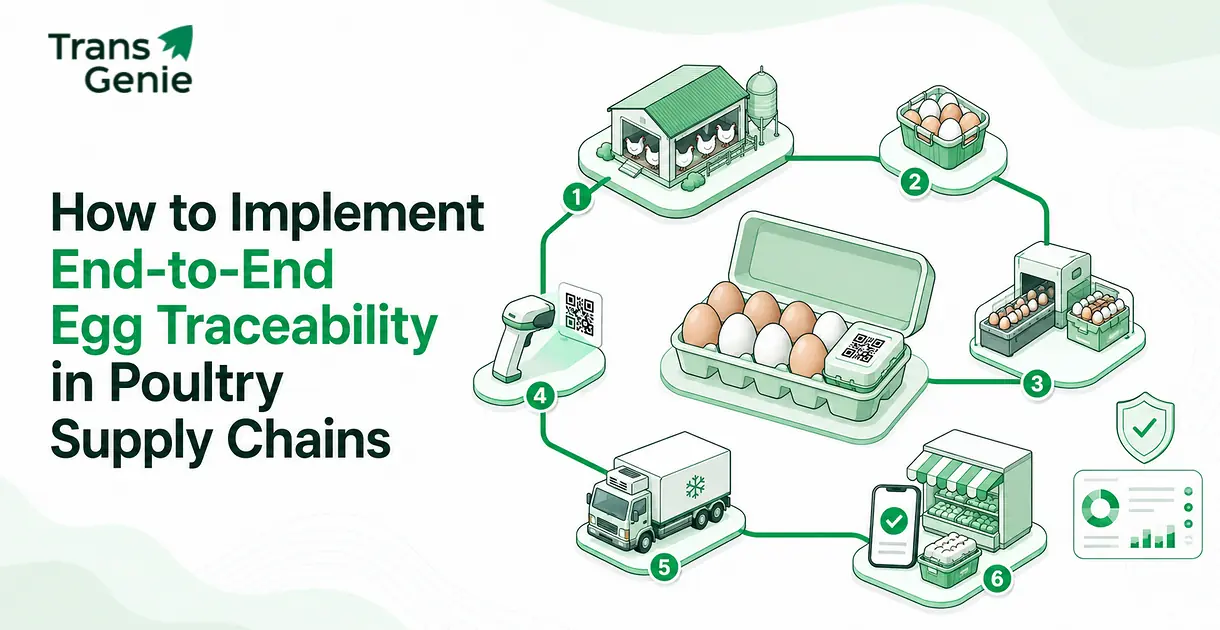
If you want to understand the bigger picture on how egg identity can get lost across the poultry supply chain and how to build a system that keeps it connected - start with End-to-End Egg Traceability in Poultry Supply Chains. If you are choosing a system, our Food Traceability Software is built around the same record structure explained in this guide.
Yokesh Sankar