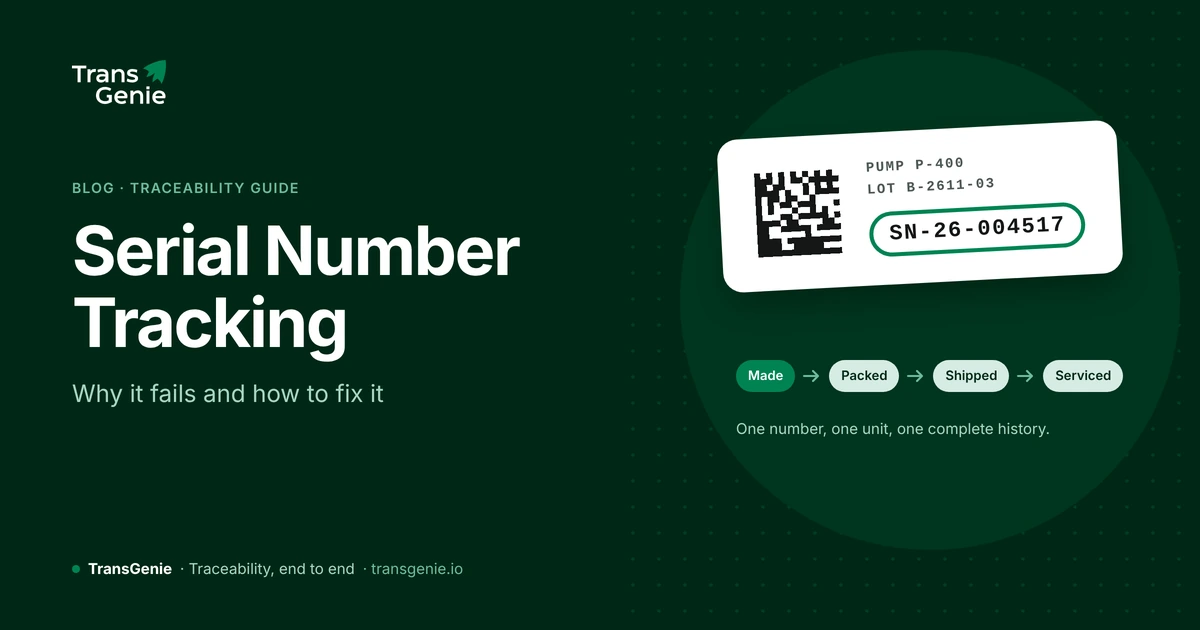
Serial number tracking gives every individual product a unique identity and allows your team to follow its journey from manufacturing and packaging to warehousing, distribution, and after-sales service.
However, assigning a serial number to each unit isn’t just enough. It is vital to connect that number to a list of items that includes:
- Components
- Production records
- Quality checks
- Shipment details
- Customer information
Without all these connections, finding the history of a specific product during a recall, warranty claim, or quality investigation can become a time-consuming task.
But, with the right serial number tracking system, it is possible to maintain a complete record of every unit, quickly find the affected products, and even avoid relying on those disconnected spreadsheets and manual records.
Key Takeaways
- A serial number identifies one unit, while a batch or lot number helps identify a group.
- Serial number tracking links each unit to its parts, tests, location, customer, and service history.
- Prescription medicines in the US and the EU must carry a serial number on the pack, and medical device identifiers can include one.
- The most common failures are duplicate numbers, missed scans, manual entry, and data spread across systems.
- Serial number tracking software fixes these by capturing each scan automatically and keeping a single record per unit.
What Is Serial Number Tracking?
Serial number tracking is the process of assigning a unique identification number to every individual product and recording its details throughout its lifecycle. Unlike batch tracking, which follows a group of products, serial-level tracking lets your team find and retrieve the history of one specific unit.
In other words, no two units share a number; you can answer questions about one exact item, not just the batch it came from. For example, if your company manufactures 5,000 industrial pumps, each pump can have its own serial number.
If one of them is SN-26-004517, your team can use that number to find when the pump was manufactured, which components were used, whether it passed quality inspections, where it was shipped, and which customer received it.
A reliable serial number tracking system connects three key elements:
1. Unique Product Identification
Assign a unique serial number to every product to distinguish individual units.
2. Machine-Readable Codes
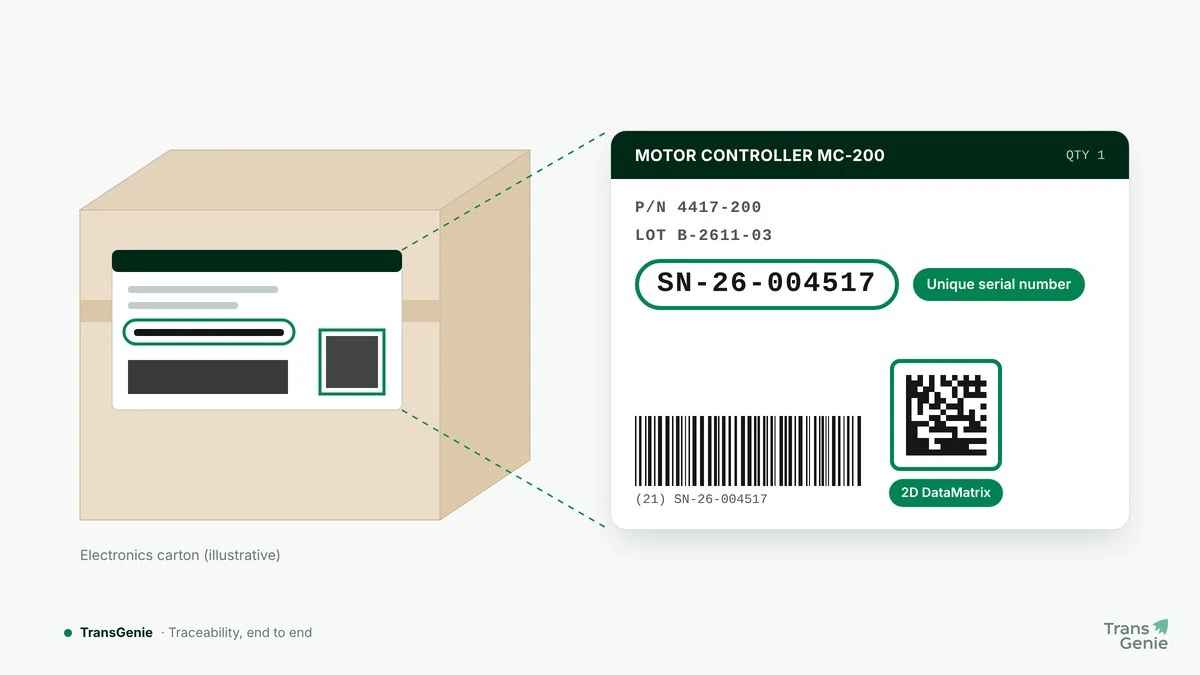
Use barcodes, QR codes, DataMatrix codes, or RFID tags to scan products at different operational stages. For more details, check out our RFID traceability system guide.
3. Centralized Product Records
Link each serial number to production, quality, inventory, and shipment records. This makes the system a serial code tracker for every unit.
What Does a Serial Number Look Like?
A serial number format is usually a combination of letters, numbers, or both. Each manufacturer can define its own format based on its production requirements, identification needs, and tracking processes.
Here are three examples of serial number samples:
| Serial Number Samples | How to Read It | Common In |
|---|---|---|
| SN-26-004517 | SN = serial number, 26 = 2026, 004517 = the 4,517th unit made | Electronics, machinery |
| A3K7Q9X2M1 | Random 10-character code, so numbers cannot be guessed or copied | Pharma packs, luxury goods |
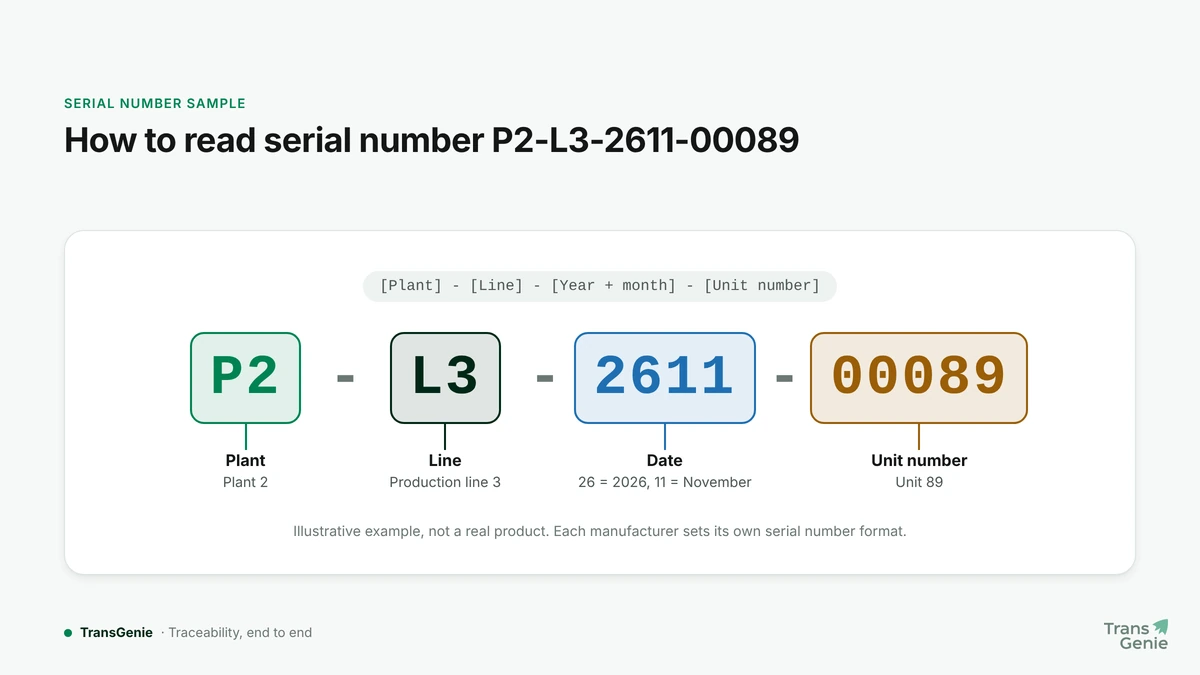
| P2-L3-2611-00089 | Plant 2, line 3, November 2026, unit 89 | Automotive and industrial parts |
Important Note: These are illustrative examples and are not actual product serial numbers.
The format you choose for the serial number should make it easy to identify individual products while preventing duplicate numbers. For regulated products, manufacturers may also need to follow industry-specific identification requirements.
Manufacturers generally use two approaches:
- Sequential numbering: Assign numbers in a running sequence. This is straightforward to organize and manage.
- Random numbering: Generate less predictable alphanumeric codes, making them harder to guess or counterfeit. This is particularly important in pharmaceutical serialization.
For example, under EU Delegated Regulation (EU) 2016/161, Article 4, the serial number on a medicine pack must contain no more than 20 numeric or alphanumeric characters and meet specific randomization requirements.
Serial Number vs. Batch vs. Lot Tracking
Serial number, batch, and lot tracking all help manufacturers maintain product traceability. However, each method is useful for identifying products at a different level.
- Serial number tracking helps identify an individual product.
- Batch tracking helps in finding out a group of products manufactured together under similar production conditions.
- Lot tracking is useful in finding out a group of materials or products associated with a common source, supplier, or production characteristic.
Here’s how they compare:
| Comparison | Serial Number Tracking | Batch Tracking | Lot Tracking |
|---|---|---|---|
| Identifies | Individual product | Production group | Group of materials or products |
| Example | One industrial pump | 500 pumps manufactured in one production run | Steel supplied under one supplier lot |
| Best Suited For | Electronics, machinery, medical devices | Food, cosmetics, chemicals | Raw materials, ingredients and components |
| Traceability | Tracks the history of one specific unit | Tracks products from a particular production run | Tracks materials or products sharing a common lot |
| Recall Scope | Specific affected units | Affected production batch | Affected lot or source |
Do You Need All Three Tracking Methods?
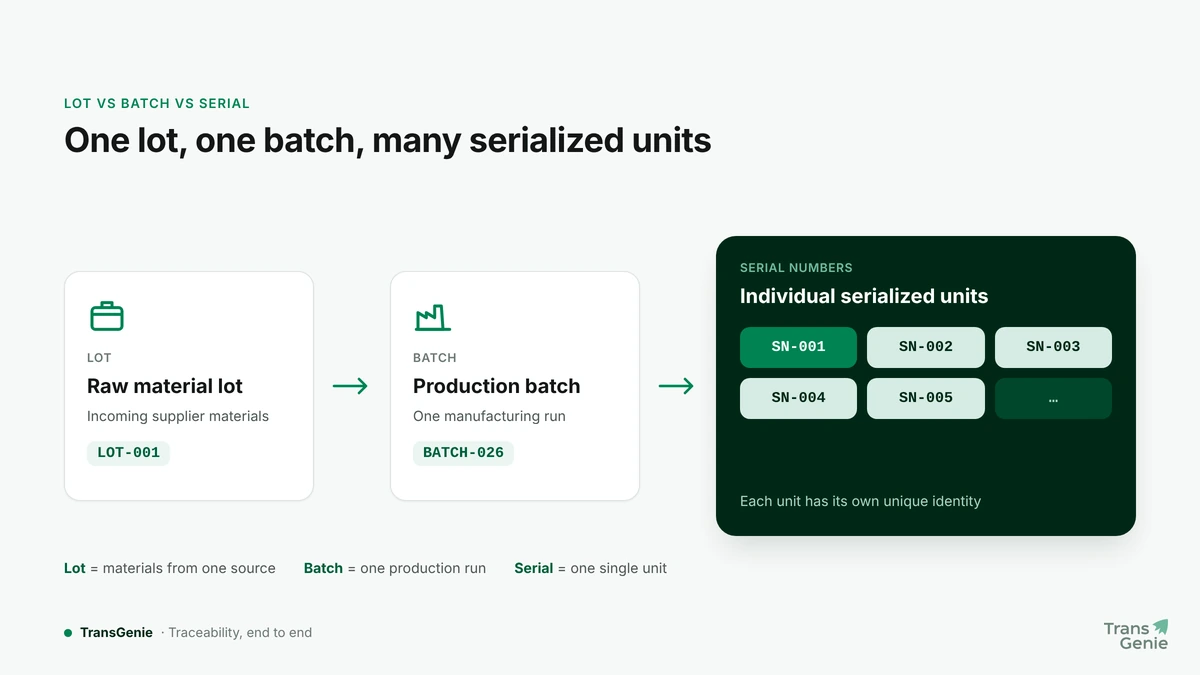
Rather than choosing just one, many manufacturers use serial, batch, and lot tracking together. For example, a pharmaceutical manufacturer may:
-
Assign Lot Numbers
Assign lot numbers to incoming raw materials.
-
Use Batch Numbers
Use batch numbers to identify medicine produced during a particular manufacturing run.
-
Assign Serial Numbers
Assign unique serial numbers to individual medicine packs.
This builds multiple levels of traceability and thus helps your team quickly find out the source of a problem and locate the specific products affected.
With TransGenie, you can explore batch tracking software and lot traceability software alongside serial-level traceability.
Why Does Serial Number Tracking Fail? 6 Common Problems
Assigning unique serial numbers to products is only the beginning. Your team also needs to capture, update, and maintain accurate records as products move through manufacturing, warehousing, and distribution.
However, when these processes rely on spreadsheets, manual entries, or disconnected systems, tracking gaps can quickly start to develop.
Here are six common problems that make serial number tracking difficult.
1. Duplicate or Reused Serial Numbers
When serial numbers are generated or assigned manually, two products may end up with the same identifier. This can happen during label reprints, production line changes or manual record updates. As a result, your team may find it hard to identify which product a particular record belongs to.
2. Manual Data Entry Errors
Entering long serial numbers manually usually increases the risk of typing mistakes. Even one incorrect character entry can break the connection between a product and its production, inspection, or shipment records.
3. Missed Scans During Product Movement
Products pass through several checkpoints. This includes packaging, storage, dispatch and delivery. If your team misses a scan at any stage, the product’s tracking history may break and this makes it harder to confirm its current location or movement.
4. Disconnected Business Systems
Production details may sit in your manufacturing system, inventory records in your WMS, and order information in your ERP. When these systems don’t share data, your team cannot easily retrieve a complete history using one serial number. Get to know more from our ERP traceability guide.
5. Missing Links Between Components and Finished Products
A finished product can contain multiple components sourced from different suppliers. If these parts aren’t linked to the product’s serial number, then your team may struggle to find which products contain a defective part.
6. Delayed Product Identification and Traceability
When a quality issue, recall, or warranty claim occurs, your team may need to search multiple spreadsheets and databases to find out the affected products. This delays the investigations and can make it difficult to determine which units need attention.
Assigning serial numbers isn’t enough. Your team also needs connected records and regular scans to track every product properly.
How Does Serial Number Tracking Work?
A reliable serial number tracking system follows the same five steps in any industry:
-
Generate Unique Serial Numbers
Assign a unique number to every product using a predefined format or serial number generator. This helps your team find out the individual units without creating duplicate records.
-
Mark Products With Serial Numbers
Print the serial number as human-readable text plus a machine-readable code on product labels. This includes barcodes, QR codes, or 2D DataMatrix codes. You can also use RFID tags to find and track products.
-
Link Products to Their Records
Connect each serial number to its production batch, components, quality inspection details, and packaging information. This helps your team easily understand how each product was made.
-
Record Product Movements
Scan products during packaging, warehousing, shipping, and delivery. Each scan updates the tracking record with the latest movement or location details.
-
Search and Retrieve Product History
Use the serial number to find a product’s complete history whenever needed. Your team can also trace products forward to customers or backward to their components and suppliers.
How Serial Number Tracking Works
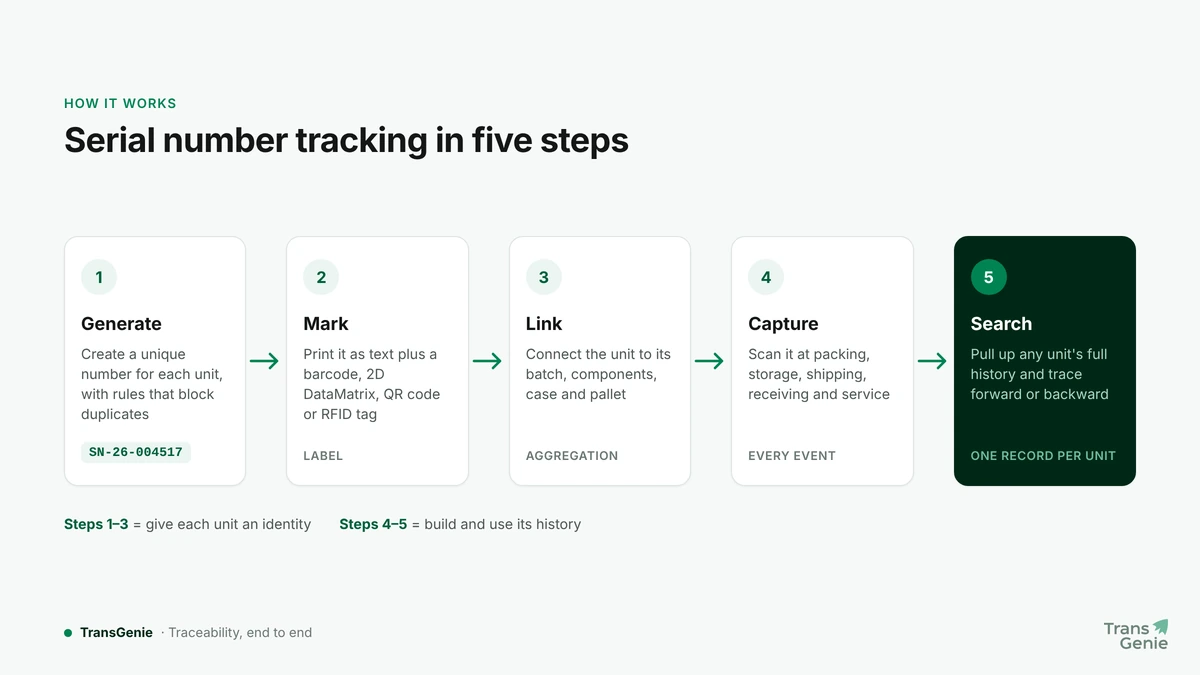
When these steps work together, your team can identify individual products, check their movement, and retrieve relevant records without searching through multiple spreadsheets.
Real-World Example: How Serial Number Tracking Helps Trace a Defective Product
An illustrative scenario, not a real customer.
Imagine your company manufactures industrial pumps. A customer reports that one pump has stopped working just three weeks after delivery. Now, the task for your team is to find out what went wrong, whether other pumps have the same issue, and which customers might be affected.
Here’s how serial number tracking helps:
-
Look Up the Unit
Search for SN-26-004517 to see when it was assembled (4 November 2026), where it was made (line 3), whether it passed its final pressure test, which case it was shipped in (C-1182), the distributor, and the sale date (18 November).
-
Check Its Components
The product record shows the serial or lot number of each key part. The motor came from supplier lot M-7731.
-
Trace Backward
The supplier reports a winding defect in part of lot M-7731. Your team can now check which other pumps used motors from this lot.
-
Trace Forward
Searching for lot M-7731 identifies 38 pumps, along with their serial numbers, cases, distributors, and customers. Of these, 22 are still in the warehouse and 16 have shipped.
-
Act on Affected Units
Put the 22 pumps in stock on hold and send the 16 customers a service notice identifying their specific units. Other pumps remain unaffected.
-
Record Every Action
Log each hold, notice, repair, and replacement against the unit’s serial number. These records are ready for audits and supplier claims.
What Would Happen If You Don’t Have Serial Number Tracking?
Without unit-level records, your team may only know that some pumps manufactured in November could be defective. You might have to check hundreds of products and contact more customers than necessary to find the affected units.
That’s the value of serial number tracking: It helps your team find specific products, identify related components, and take action without affecting products that have no connection to the issue.
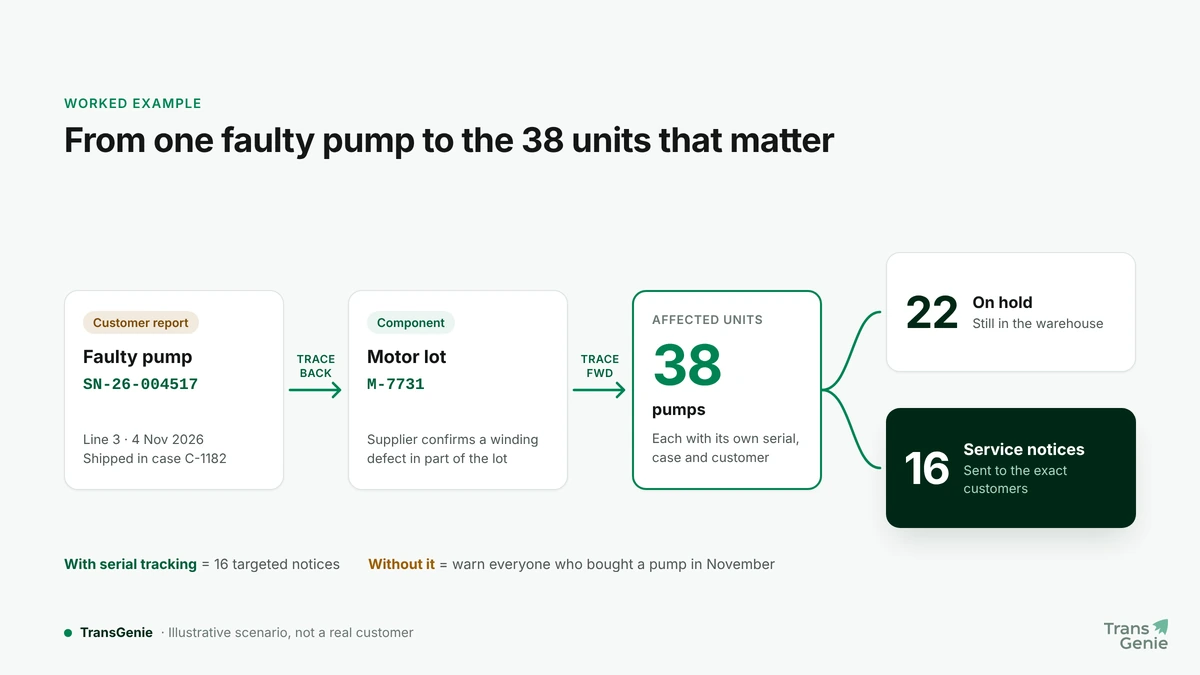
This is forward and backward traceability at the unit level, and it is what makes a targeted recall possible.
Which Industries Need Serial Number Tracking?
Serial number tracking helps almost any business identify individual products, monitor their movement, and maintain product records. It is particularly useful in industries where product quality, safety, authenticity, and service history matter.
Here’s how different industries use it:
| Industry | What They Track | Why It Matters |
|---|---|---|
| Pharmaceuticals | Individual medicine packs | Verify products, trace affected packs, and meet serialization requirements |
| Medical Devices | Equipment and implants | Maintain device records and manage recalls or service requests |
| Electronics | Individual products and components | Track warranties, identify defective units, and verify authenticity |
| Automotive and Manufacturing | Finished products and components | Investigate defects, manage repairs and trace affected units |
| Luxury Goods and Wine | Individual products and bottles | Verify authenticity and reduce counterfeit risks |
| Equipment Rental and Service | Machines, tools and equipment | Track equipment locations, maintenance, and returns |
Serialization Rules You Should Know
While many industries use serial numbers for product identification and traceability, some sectors also have specific regulatory requirements. Here are three important examples from the pharmaceutical and medical device industries.
1. US Prescription Drugs (DSCSA)
The Drug Supply Chain Security Act (DSCSA) requires certain prescription drug packages in the US to carry a product identifier with a product code, unique serial number, lot number, and expiration date (21 U.S.C. 360eee).
2. EU Medicines (EU FMD)
Under EU Delegated Regulation 2016/161, medicine packs should carry a unique identifier containing a product code, serial number (up to 20 characters), batch number, and expiry date (Delegated Regulation (EU) 2016/161).
3. US Medical Devices (FDA UDI)
The FDA’s Unique Device Identification (UDI) system uses a Device Identifier (DI) and Production Identifier (PI). The PI covers the serial number, lot number, manufacturing date, or expiration date, depending on the device. See our guide to ISO 13485 identification and traceability.
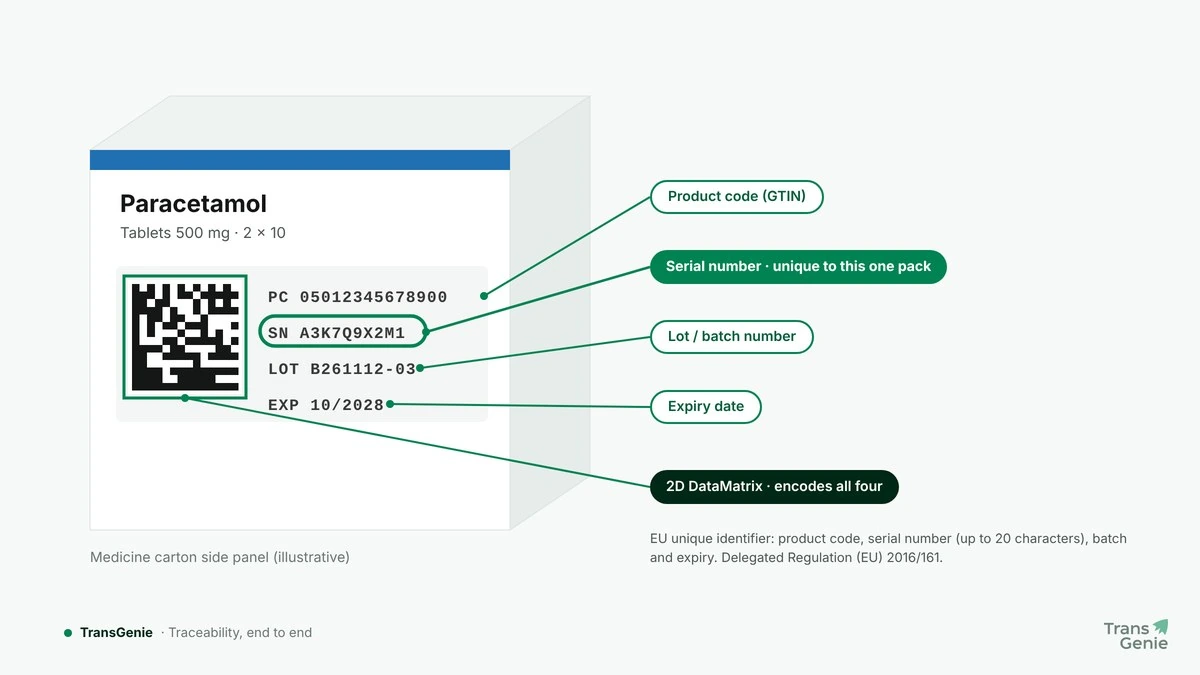
With the right tracking process, your team can maintain product records, identify affected units, and retrieve the information needed for quality checks, recalls, and regulatory audits.
What Is Serialized Inventory and How Does It Work?
Serialized inventory is a way of managing stock by tracking each product through its unique serial number instead of recording quantities alone.
For example, instead of showing that your warehouse has 40 industrial pumps, serialized inventory records the serial number, location, and status of each pump. This helps your team find out exactly which units are in stock, shipped, returned, or under repair.
Serialized Inventory Management Helps Your Team:
- Track individual units: Identify each product by its serial number instead of relying only on stock quantities.
- Manage shipments: Check which specific units are assigned to customer orders.
- Handle returns and repairs: Retrieve the product’s service and warranty history using its serial number.
- Find missing products: Identify units with missing records or unexpected stock movements.
- Maintain accurate inventory records: Keep product details updated as units move between locations.
Why Do You Need Serialized Inventory Management Software?
When you manage hundreds or thousands of individual products, it becomes harder to keep inventory records accurate in spreadsheets. Serialized inventory management software helps your team record product movements, update stock details, and retrieve individual product information from one system.
This gives you better control over your inventory and makes it easier to track products throughout their lifecycle.
How to Fix Your Serial Number Tracking Process in 6 Steps
To make serial number tracking more reliable, your team needs to prevent errors, keep product records connected, and make it easier to find individual units. Here are six ways to improve your serial number tracking process:
1. Set Clear Serial Number Rules
Create a standard numbering format for your products. Ensure every unit gets a unique number and that old serial numbers are never reused.
2. Use Machine-Readable Codes
Print serial numbers as barcodes, QR codes or 2D DataMatrix codes. This helps your team to scan the products rather than entering long numbers manually.
3. Record Every Product Movement
Make sure your team scans products during packaging, warehouse transfers, shipping, and receiving. This helps you maintain updated product records.
4. Link Components to Finished Products
Connect component serial numbers or lot numbers to the finished product. This helps your team find out which products contain a particular component if a defect occurs.
5. Connect Your Business Systems
Integrate your ERP, WMS, and production systems to keep product details connected. This helps minimize duplicate records and makes it easier to find product details. Get to know more about track and trace systems ERP integration.
6. Test Your Tracking Process Regularly
Select a product and check whether your team can retrieve its complete history, from production and components to shipment and delivery. Each quarter, select a random serial number and time how long your team takes to trace its complete history, from components to customer and back.
Following these steps helps your team maintain accurate serial number records and find individual products when quality issues, recalls, or customer requests arise.
How to Choose the Right Serial Number Tracking Software
The right serial number tracking software depends on how your business manages products, inventory, and supply chain operations. If you’re looking for serial number tracking software free of charge, spreadsheets and free tools may work for a few hundred units. As your inventory grows, dedicated serial number software becomes essential.
Before selecting a platform, look for the essential features given below:
1. Unique Serial Number Generation
Choose software that can generate unique serial numbers and prevent duplicate assignments across products.
2. Barcode and RFID Scanning
Look for barcode, QR code, DataMatrix, and RFID support, so your team can capture product information quickly during different operations.
3. Batch and Lot Tracking
The software you are about to choose should support serial, batch, and lot tracking together. This helps connect individual products with their production batches and raw materials.
4. Product and Component Tracking
Check if the platform can link finished products to their components, cases, and pallets. This makes it easier to trace defective parts and find out the affected products.
5. ERP and WMS Integration
Choose a system that connects with your existing ERP, warehouse management, and production systems. This helps keep product records consistent across the operations.
6. Complete Product History
Your team should be able to search using a serial number and retrieve relevant production, inspection, inventory, and shipment records.
7. Audit Trails and Record Security
Look for secure records that show product movements and changes over time. This helps your team maintain reliable information for audits and investigations.
Serial Number Tracking Software Checklist
Use this checklist when comparing different platforms:
- Unique serial number generation
- Barcode, QR code, DataMatrix and RFID support
- Batch and lot tracking
- Component, case and pallet linking
- ERP and WMS integration
- Regulatory records (DSCSA, EU FMD, UDI) if you are in pharma or medical devices
- Searchable product history
- Audit trails and secure records
Choosing software with these capabilities helps your team maintain better product visibility and manage serial-level traceability across your supply chain.
Simplify Serial Number Tracking With TransGenie
Managing serial numbers across production, packaging, and distribution can become complex and time-consuming when product records are spread across different systems. TransGenie brings serial-level tracking and product traceability together in one platform, helping your team maintain visibility from production to delivery.
With TransGenie, your team can:
1. Track Products by Serial Number
Our platform lets your team trace individual products alongside batch and case-level records. You can even search using a serial number, purchase order, packing slip or work order to find product information.
2. Connect Products to Cases and Pallets
With TransGenie, your team can link serialized products to their respective cases and pallets. This helps your team track individual units as they move through the supply chain.
3. Record Product Movements
Our software captures product scans at different stages and maintains records as products move through packaging, storage, and distribution.
4. Maintain Secure Traceability Records
TransGenie uses blockchain-secured records to help protect product history from unauthorized changes and maintain a reliable audit trail. Learn more about our traceability software.
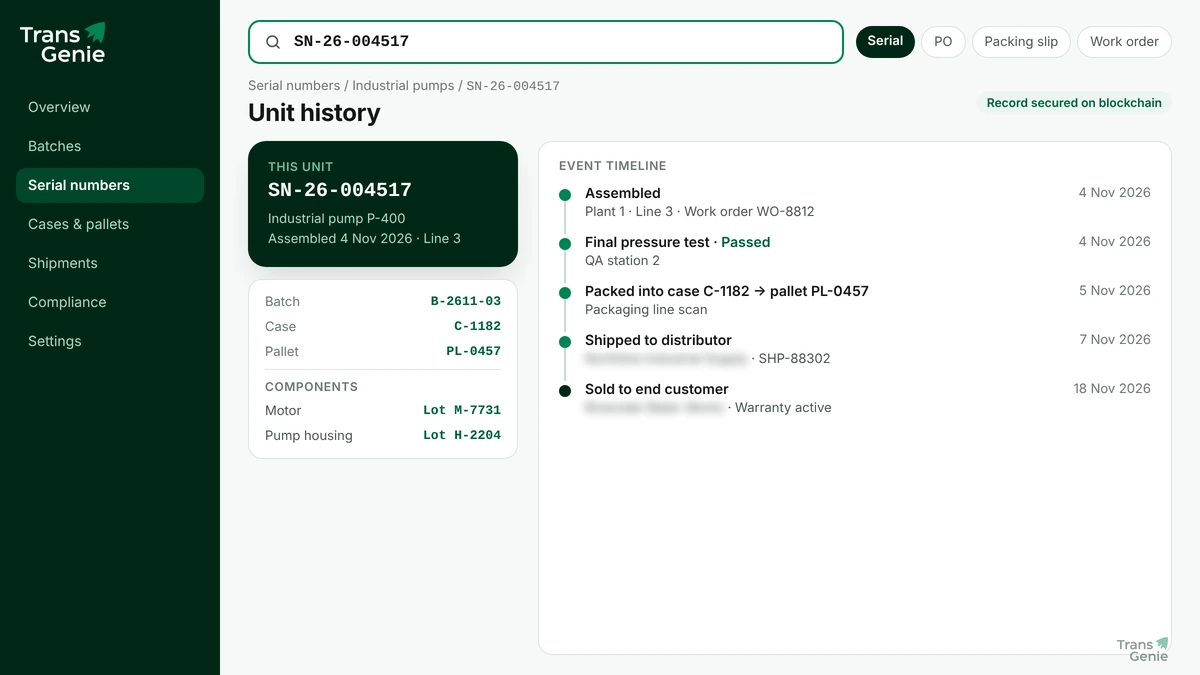
Want to see how serial-level traceability works?
Book a live demo to discuss your serial number tracking, traceability, and recall needs with our team.


Yokesh Sankar