Real-time supply chain visibility gives businesses a live view of where every product, batch, and shipment is across their supply chain. It also shows their current status and condition as events move across suppliers, warehouses, and distributors. It captures movement and condition data through scans and sensors at different supply chain stages. It then connects partner systems and brings all the information together on one shared platform.
A shipment leaving a supplier is only one part of its journey. It still needs to pass through carriers, warehouses, and distribution networks before reaching its destination. During this journey, delays, temperature changes, or missing records can affect product quality, inventory availability, and delivery schedules. Yet businesses often discover these issues only after receiving a delayed update or chasing a supplier for information.
The challenge goes beyond knowing where a shipment is. Teams also need to know which products are affected, whether they have been kept in the right conditions, and which customers may be impacted. Without this information, even a single delay can lead to stockouts, spoiled goods, slow recalls, and missed compliance deadlines.
This is where real-time visibility in supply chain operations becomes important. By replacing end-of-day spreadsheets and scattered supplier emails with a live, shared record of product movements, businesses can track each stage of the journey, spot exceptions, and make decisions with more current information.
In this guide, we'll explore:
- What real-time supply chain visibility means and how it compares with traditional tracking methods
- The key benefits of improved visibility, supported by real examples
- The products, movements, and conditions businesses need to track from suppliers to distributors
- The technologies that capture, connect, and analyse supply chain data
- How to achieve real-time supply chain visibility through a practical 7-step implementation plan
- How to evaluate and choose the right supply chain visibility software
- The major trends shaping supply chain visibility in 2026
What is Real-Time Supply Chain Visibility?
Real-time supply chain visibility allows businesses and their supply chain partners to see where products are, their current status, and the conditions they are in as events happen. For example, a pallet leaves a supplier, arrives at a warehouse, crosses a border, or experiences a temperature change; the information is recorded and updated within seconds or minutes.
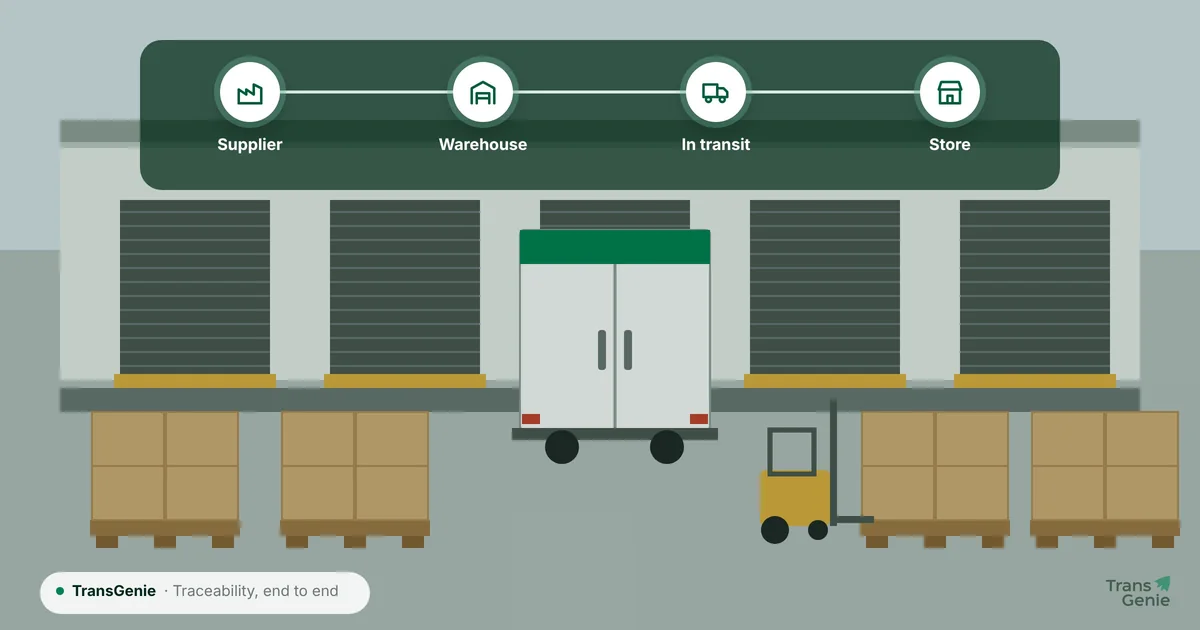
Real-time visibility of supply chain activity covers three key areas:
1. Location
Where each item, lot, pallet, or shipment is currently located.
2. Status
What has happened to it, such as production, packing, shipping, receiving, holding, or recall.
3. Condition
Whether it has remained within the required temperature, humidity, or other conditions, including shock and tamper events where relevant.
Real-Time vs. Traditional Supply Chain Visibility
The main difference between traditional and real-time visibility is how quickly information is collected, shared, and acted on.
| Area | Traditional Visibility | Real-Time Visibility |
|---|---|---|
| Data timing | Updates collected daily or weekly | Updates recorded as events happen |
| Data sources | Spreadsheets, emails and ERP exports | Scans, sensors, GPS and partner APIs |
| Scope | Mostly your own sites and tier-1 suppliers | Suppliers, warehouses, carriers and distributors in one shared view |
| Response | Problems are identified after they occur | Alerts help teams respond before problems escalate |
| Traceability | Product history must be gathered manually during a recall | Item or lot history is available through a single search |
Visibility and traceability may look closely connected, but they serve different purposes. Visibility shows where products are now and their current condition. In contrast, traceability shows where they have been and what materials or components went into making them. Both use supply chain event data, allowing businesses to monitor product movements and access their history through the same system.
Benefits of Real-Time Supply Chain Visibility
When businesses know what is happening across their supply chains, they can respond to delays sooner, prevent product losses, and make better decisions. The benefits of real-time supply chain visibility go beyond tracking shipments. They also improve inventory planning, recall management, regulatory compliance, and customer service.
| Benefit | What It Looks Like in Practice |
|---|---|
| Earlier exception alerts | A delayed inbound container triggers an alert before production runs short, giving planners time to arrange an alternative supplier or faster delivery. |
| Faster recalls | A contaminated ingredient lot can be traced to affected batches and customers within minutes instead of days. |
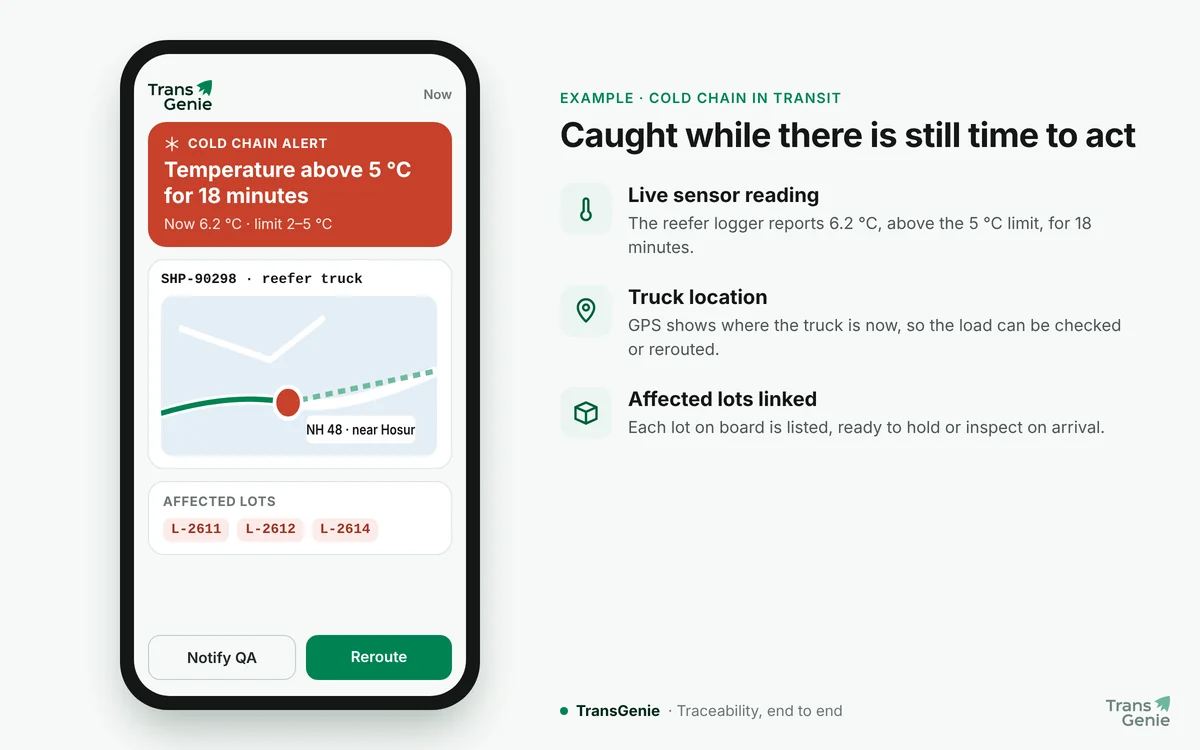
| Less spoilage and waste | A temperature excursion in a refrigerated container can be detected during transit, allowing teams to inspect or reroute the shipment before the warehouse rejects the goods. |
| Lower inventory buffers | Planners have better visibility into incoming shipments and can reduce the extra safety stock they keep to cover unexpected delays. |
| Easier compliance | Records required for regulations such as FSMA 204 and the EU Digital Product Passport are captured as products move, rather than collected manually before an audit. |
| Better customer service | Customer service teams can provide more accurate delivery dates using current shipment information instead of relying on estimates. |
| Stronger supplier management | Businesses can measure supplier performance using actual delivery, quality, and documentation records rather than relying only on supplier updates. |
Supply chain real-time visibility also helps teams work better together. When procurement, operations, quality, and customer service teams share the same live updates, they spend less time chasing shipment information through emails and phone calls.
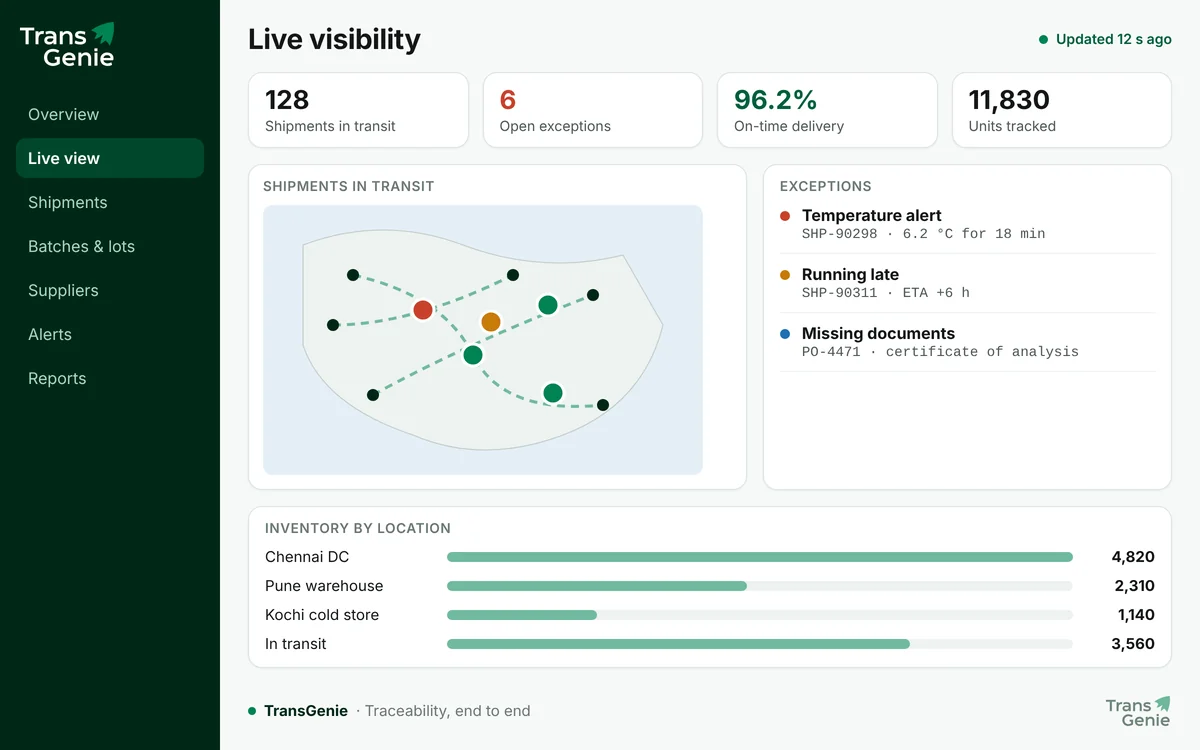
Real-Time Tracking: How to Follow Products Across Suppliers, Warehouses and Distributors
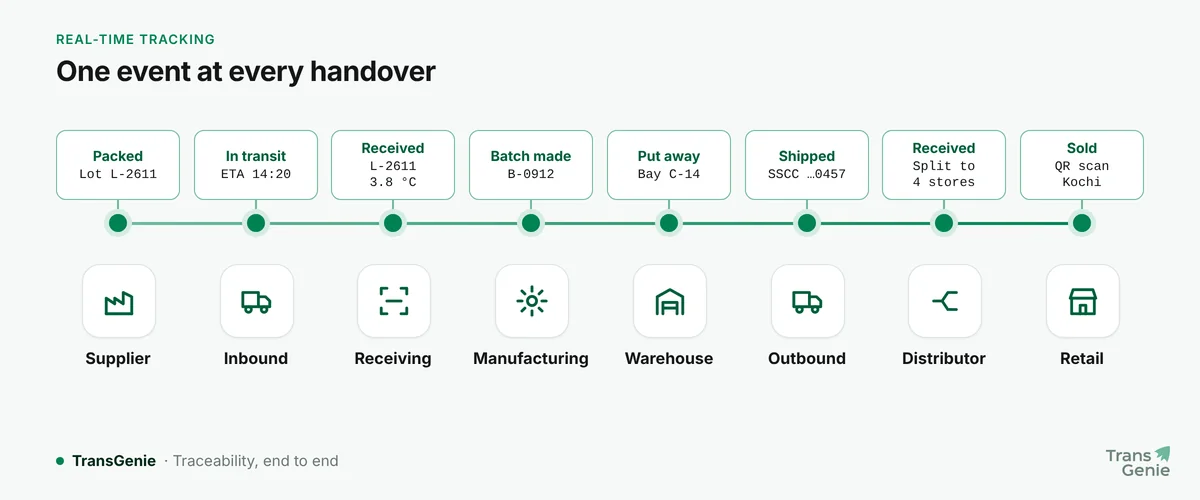
Tracking products in real time starts with assigning a unique ID to every item, lot, or pallet. Each time a product changes location, moves to another partner, or reaches a new stage, the event is recorded. Real-time visibility supply chain systems use these records to show what happened, when and where it happened, who handled the product, and whether its condition changed.
Here is what supply chain visibility real-time tracking looks like at each stage:
| Stage | Key Events | Data to Capture | How It Is Captured |
|---|---|---|---|
| Supplier | Production, packing and dispatch | Supplier details, material lot, certificates and ship date | Supplier portal, EDI or API, ASN |
| Inbound transport | Pickup, transit, delays and arrival | Carrier, GPS location, ETA and temperature | Carrier APIs, GPS and IoT trackers |
| Receiving | Goods received, inspected, accepted or held | Quantity, lot numbers and inspection results | Barcode or RFID scans at the dock |
| Manufacturing | Lots consumed and batches produced | Input lots linked to output batches and process data | MES or production app, line scanners |
| Warehouse | Put-away, stock movements, picking and holds | Location, quantity, status and expiry | WMS, handheld scanners and RFID portals |
| Outbound transport | Loading, shipping and delivery | SSCC or pallet ID, carrier and proof of delivery | Shipping scans and carrier APIs |
| Distributor | Receiving, splitting and re-shipping | Distributor ID, onward customers and quantities | Partner portal, EDI or API |
| Retail or end customer | Delivery, sale and scanning | Store, date and consumer scans | POS data and QR code scans |
1. Use Shared Identifiers
Tracking becomes difficult when each supply chain partner uses different product and location codes. With global standards, the task becomes easy as everyone uses the same identifiers.
GS1 provides identifiers such as GTIN for products, GLN for locations, and SSCC for pallets and cases. These give every partner a common reference, making it easier to track products as they move between businesses.
2. Track at the Right Level
Not every product needs to be tracked individually. The right tracking level depends on the product type, value, and risk:
- Item level: High-value goods, pharmaceuticals, and serialised parts that need individual tracking.
- Lot or batch level: Food, chemicals, ingredients, and most manufactured goods. Businesses can manage this through lot traceability.
- Pallet or shipment level: Bulk goods and low-risk products that do not require individual or batch-level tracking.
Real-Time Supply Chain Visibility Technologies
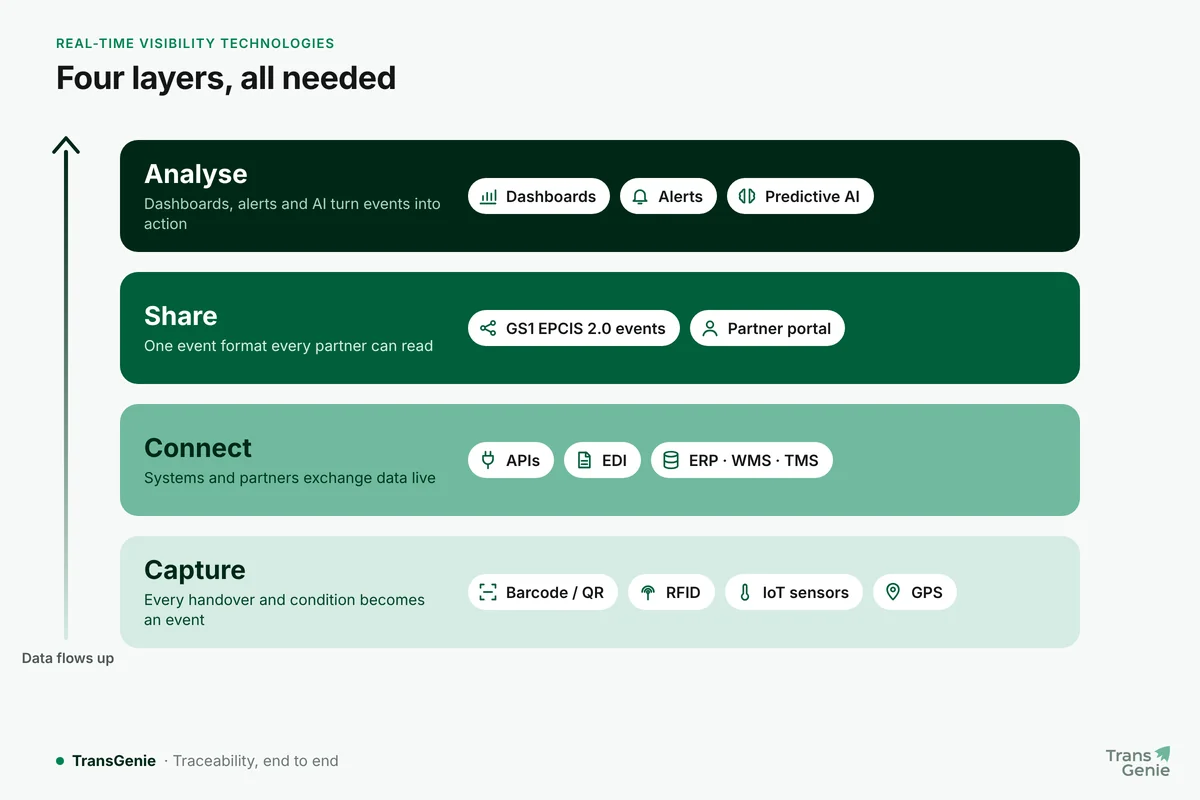
Real-time supply chain visibility technologies work together in four layers. First, they capture product movement and condition data using barcodes, RFID, IoT sensors, and GPS. Next, APIs and EDI connect different business systems. GS1 EPCIS provides a common format for sharing supply chain events, while dashboards, AI, and alerts help teams analyse the information and respond to issues.
All four layers are important, and sensors alone cannot provide complete visibility. They need to connect with other systems to share data and offer a clear, real-time view of the supply chain. Similarly, dashboards are only useful when the information they display is accurate and up to date.
| Technology | What It Does | Best For |
|---|---|---|
| Barcodes and QR codes | Scan items, lots, and pallets at different handover points | Almost every product and consumer-facing traceability |
| RFID | Reads multiple tagged items at once without needing a direct line of sight | High-volume warehouses, apparel and returnable assets |
| IoT sensors | Collect temperature, humidity, shock, light, and location data | Cold chain, pharmaceuticals, and high-value goods |
| GPS and telematics | Track the live location and estimated arrival time of trucks, containers, and vessels | In-transit tracking and delay alerts |
| APIs and EDI | Connect ERP, WMS, TMS, carrier and supplier systems | Real-time integration and supply chain visibility across partners |
| GS1 EPCIS 2.0 | Provides a common format for recording and sharing supply chain events | Sharing data between partners using different software |
| AI and predictive analytics | Use live and historical data to predict delays, demand changes, and supply chain risks | Real-time predictive supply chain visibility |
| Blockchain or tamper-evident ledgers | Make shared records difficult to change without detection | Multi-party supply chains where data trust is a concern |
1. Why EPCIS Matters
EPCIS 2.0, published by GS1 and adopted as ISO/IEC 19987:2024, provides a standard way to record what happened to a product, where and when it happened, and why. When suppliers, warehouses, and distributors use the same format, real-time visibility supply chain data can be shared between their systems without creating separate custom mappings for every partner.
2. From Visibility to Prediction
Real-time data shows what is happening across the supply chain. Predictive models use this information along with historical data to predict what might happen next.
- For example, they can flag a shipment that is likely to arrive late or a supplier that may not meet an upcoming order. This helps businesses act on potential problems instead of waiting for them to happen. It also explains why AI and predictive features are becoming important in supply chain visibility platforms.
Real-Time Supply Chain Visibility Examples
One well-known real-time supply chain visibility example is from Walmart. In a 2017 pilot with IBM, tracing a pack of sliced mangoes back to its source farms took nearly seven days. With the new digital system, the same process took just 2.2 seconds, as reported by Supermarket News. The system even identified the two farms in Mexico and every stop along the supply chain.
What made this possible was the digital recording of each handover. Instead of collecting information from different partners when needed, Walmart could access the product's complete history through recorded supply chain events.
How It Works in Different Industries
Real-time visibility can support different tracking needs depending on the industry type. Here are some practical examples of how businesses can use it. These are illustrative scenarios and are not named customer cases.
For a closer look at one industry, explore our guide to seafood traceability software.
Seafood
Visibility in Action
Each catch is recorded at landing, linked to processing lots and monitored through cold storage using temperature sensors.
Outcome
Temperature issues are flagged during transit, and export documents can be prepared using the same records.
Food Manufacturing
Visibility in Action
Ingredient lots are scanned and linked to each production batch.
Outcome
If a supplier recalls an ingredient, businesses can quickly identify affected batches and customers.
Pharmaceuticals
Visibility in Action
Serialised packs are tracked with temperature loggers from the manufacturing plant to the pharmacy.
Outcome
Temperature issues can be identified before products reach patients, with records available for regulatory checks.
Automotive Parts
Visibility in Action
Incoming parts from tier-2 suppliers are tracked using ASNs and GPS.
Outcome
Planners receive early warnings about delays and can adjust production schedules.
Retail and E-commerce
Visibility in Action
Distributor stock levels and shipments in transit are brought into one view.
Outcome
Customer service teams provide more accurate delivery dates, while stores can better manage stock availability.
How to Achieve Real-Time Supply Chain Visibility in 7 Steps
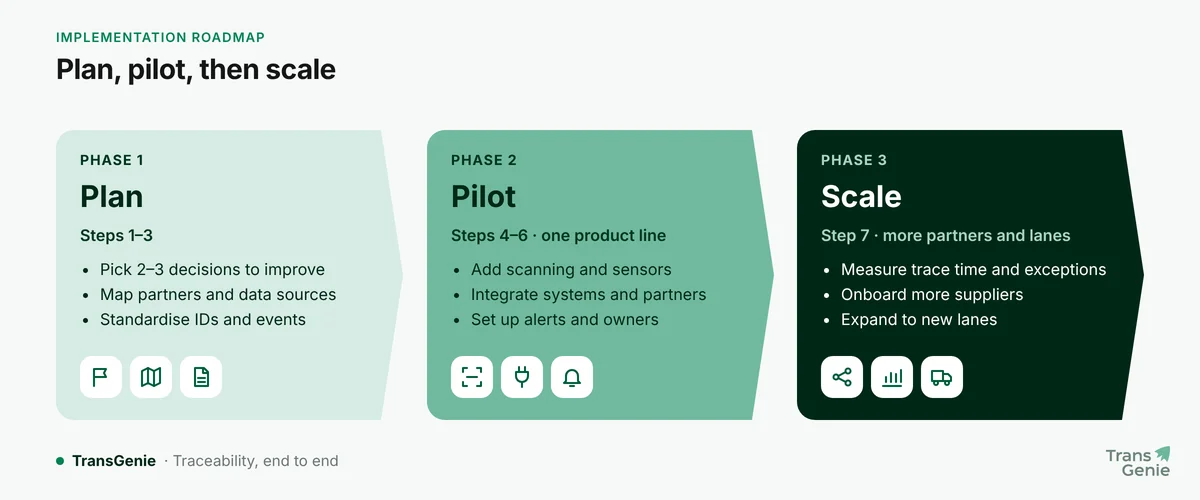
Achieving real-time supply chain visibility takes more than installing tracking devices. Businesses must first decide what to track, organize product and event data, connect partner systems, and introduce tracking in stages. A well-planned real-time supply chain visibility implementation starts with reliable data and partner participation.
1. Identify what you want to improve.
Choose two or three use cases, such as faster recalls, cold chain compliance, or on-time delivery. These priorities will help you decide what information to collect and how quickly you need it.
2. Map your supply chain and data sources.
List your suppliers, contract manufacturers, warehouses, 3PLs, carriers and distributors. Identify where their data is stored, including ERP, WMS, TMS, spreadsheets, and emails.
3. Standardise identifiers and events.
Set common IDs for products, lots, locations and pallets, preferably using GS1 standards. Also, decide which events to record at each stage and what information each record should include.
4. Set up data capture points.
Introduce barcode or QR code scanning at every product handover. Use RFID in high-volume operations and IoT sensors where temperature or product conditions need monitoring.
5. Connect systems and supply chain partners.
Real-time integration and supply chain visibility rely on APIs and EDI connections with your ERP, WMS, and carrier systems. Provide smaller suppliers with a simple web or mobile portal so they can share updates without complex integrations.
6. Set up dashboards, alerts, and workflows.
Highlight important issues such as shipment delays, products outside required conditions, and missing documents. Assign someone to handle each alert and define the steps they should take.
7. Test, measure and expand.
Start with one product line or trade lane. Measure how quickly products can be traced, how many issues are identified early, on-time delivery rates and data completeness. Use these results to improve the process before adding more partners and locations.
Start with the Areas That Need Visibility Most
When building real-time visibility for supply chain operations, you don't need to track everything from day one. Start with high-risk or high-value products where delays or poor tracking can cause bigger losses. These may cover perishable goods, regulated products, and shipments that often face delays. When the process works well, you can expand visibility to other products and routes.
Choosing Real-Time Supply Chain Visibility Solutions
The right real-time supply chain visibility software should connect with your existing systems, making it easy for suppliers to share updates and track products across different locations. It should also support standards such as GS1 and EPCIS, provide lot-level tracking, and turn supply chain events into alerts and compliance records. The best option varies based on what you need to track and where your current visibility gaps are. For product-level tracking across partners, see our supply chain traceability solutions.
1. Types of Real-Time Supply Chain Visibility Solutions
Different solutions focus on different parts of the supply chain. Understanding what each one can and cannot track will help you choose the right fit.
| Solution Type | What It Tracks Best | Typical Gap |
|---|---|---|
| Transportation visibility platforms | Shipments, carriers and estimated arrival times (ETAs) | Limited information about what is inside a shipment or where the products came from |
| Product traceability platforms | Items, lots and batches across suppliers, plants, warehouses and distributors | Carrier integrations may be needed to track live shipment locations |
| Supply chain control towers | A combined view of planning, inventory and logistics | Can be expensive and take longer to implement |
| ERP or WMS add-ons | Your own facilities and inventory | Limited visibility across suppliers and distributors |
Many businesses now combine a product traceability platform with carrier data. This helps them not only see where a shipment is but also which products and lots it contains.
2. Evaluation Checklist for Real-Time Supply Chain Visibility Software
Before choosing a platform, check whether it supports your tracking needs, existing systems, and compliance requirements.
- Integrations Ready-made connectors or APIs for your ERP, WMS, TMS and carrier systems
- Supplier onboarding A simple portal or mobile app for suppliers without their own tracking systems
- Tracking depth Item, lot, batch and pallet-level tracking, with forward and backward traceability
- Standards Support for GS1 identifiers, EPCIS 2.0 events, QR codes and RFID
- Condition monitoring IoT sensor data, including temperature and humidity, linked to product lots
- Alerts and workflows Customisable alerts, assigned owners and escalation processes
- Compliance Records for applicable regulations, such as FSMA 204, the EU Digital Product Passport and export certificates
- Analytics Dashboards, supplier scorecards and predictive alerts
- Deployment Time needed to capture the first live data, configuration versus custom development, and pilot options
During a vendor demo, ask them to track one of your actual products from start to finish. A real-time supply chain visibility solution should show how it handles your product data, partner updates, and tracking requirements, not just demonstrate a sample dataset.
Common Challenges and How to Solve Them
Getting supply chain real-time visibility in place is not always easy. Some suppliers may not share data, partners may use different product codes, and older systems may not offer updates quickly enough. Poor scanning practices can also lead to missing or incorrect records. Simply adding the tracking devices will not solve these problems.
Suppliers will not share data
Start with your largest or highest-risk suppliers. Explain the benefits, such as faster payments, fewer disputes, and easier compliance. Give them access to a free, simple portal to share updates.
Small partners lack systems
Let smaller partners use mobile scanning or web forms instead of requiring EDI or API integration.
Inconsistent codes across partners
Use GS1 identifiers and map existing product and location codes in one central system.
Missing or incorrect scans
Make scanning part of every product handover. Add checks to prevent incomplete records from being submitted.
Legacy systems update overnight
Use APIs or event streaming for information that needs real-time updates. Keep batch updates for data that does not need to be shared immediately.
Too many alerts
Set alerts only for issues that need attention and assign a clear owner to each one.
Unclear return on investment
Start with one measurable problem, such as reducing recall time or product spoilage, and track the results of the pilot.
Supply chain visibility programmes often struggle because of poor coordination and a lack of partner involvement, not just technology issues. Give supplier onboarding a clear owner, timeline, and support plan to make it easier for everyone to participate.
Real-Time Supply Chain Visibility Trends 2026
Real-time supply chain visibility is changing in 2026 as businesses come across new regulations, adopt better tracking technologies, and look for ways to prevent delays. The key trends include regulatory traceability requirements, 2D barcodes, predictive AI, shared data standards, multi-tier supplier tracking, and modernisation of older systems.
1. Regulations Are Making Supply Chain Visibility More Important
Businesses need to show where their products and materials come from and how they move through the supply chain. Several regulations are making accurate tracking and recordkeeping increasingly important.
| Regulation | What It Requires | Key Date |
|---|---|---|
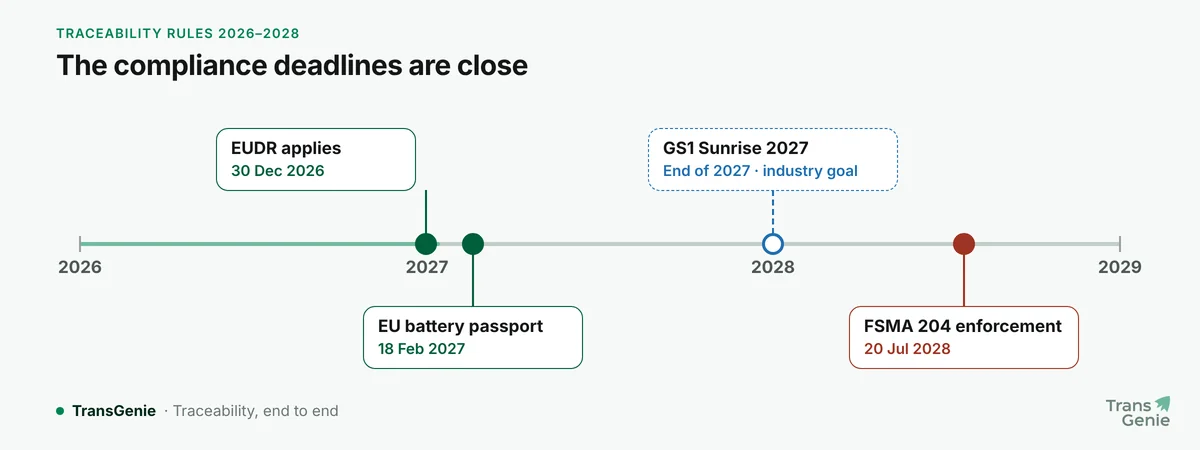
| EU Deforestation Regulation (EUDR) | Geolocation and due diligence records for cattle, cocoa, coffee, palm oil, soy, wood and rubber | 30 December 2026 for large and medium operators; 30 June 2027 for micro and small |
| EU battery passport | Digital product information for EV, light transport and large industrial batteries | 18 February 2027 |
| FDA FSMA 204 Food Traceability Rule | Traceability records for foods on the Food Traceability List | Enforcement from 20 July 2028 |
The EU battery passport is the first mandatory Digital Product Passport. More product groups are expected to follow under the EU's Ecodesign for Sustainable Products Regulation. Businesses already recording supply chain events in real time will find it easier to prepare the records needed to meet these requirements.
2. 2D Barcodes Provide More Information With Every Scan
GS1's Sunrise 2027 initiative aims to enable retail point-of-sale systems to read 2D barcodes, including QR codes with GS1 Digital Link, by the end of 2027. According to IFPA's implementation guidance, this is an industry goal, not a legal requirement.
Unlike traditional barcodes, 2D codes can carry additional details, such as lot numbers and expiry dates. This means a single scan can offer more details about a product and improve supply chain tracking.
3. AI Helps Predict Supply Chain Problems
Real-time predictive supply chain visibility uses current supply chain events and past data to spot potential problems before they happen. For example, AI can flag shipments that may arrive late or suppliers that could miss an order.
Some platforms can also suggest actions, such as changing delivery routes or moving stock between locations, instead of simply sending alerts.
4. Shared Event Standards Make Data Exchange Easier
Suppliers, manufacturers and distributors often use different software systems. Thus, sharing data between them can become difficult when every partner follows a different format.
Standards such as GS1 EPCIS 2.0 allow partners to record and exchange supply chain events in a common format. This makes it easier to exchange data and connect new suppliers and distributors without building separate integrations for each partner.
5. Visibility Extends Beyond Direct Suppliers
Businesses are looking beyond their direct suppliers to understand where raw materials come from. Regulations covering deforestation, forced labour and due diligence are increasing the need to track the products across multiple supplier levels.
This multi-tier supply chain visibility is becoming important for industries such as food, textiles, electronics and batteries.
6. Modernising Older Supply Chain Systems
Many businesses still depend on spreadsheets and overnight data updates to manage supply chain information. These methods make it harder to respond quickly when shipments are delayed or product conditions change.
Real-time supply chain visibility modernization means replacing these manual updates and batch files with APIs and cloud-based platforms. Businesses can continue using their existing ERP to manage business records while connecting it to other systems for faster data sharing.
How TransGenie Delivers Real-Time Supply Chain Visibility
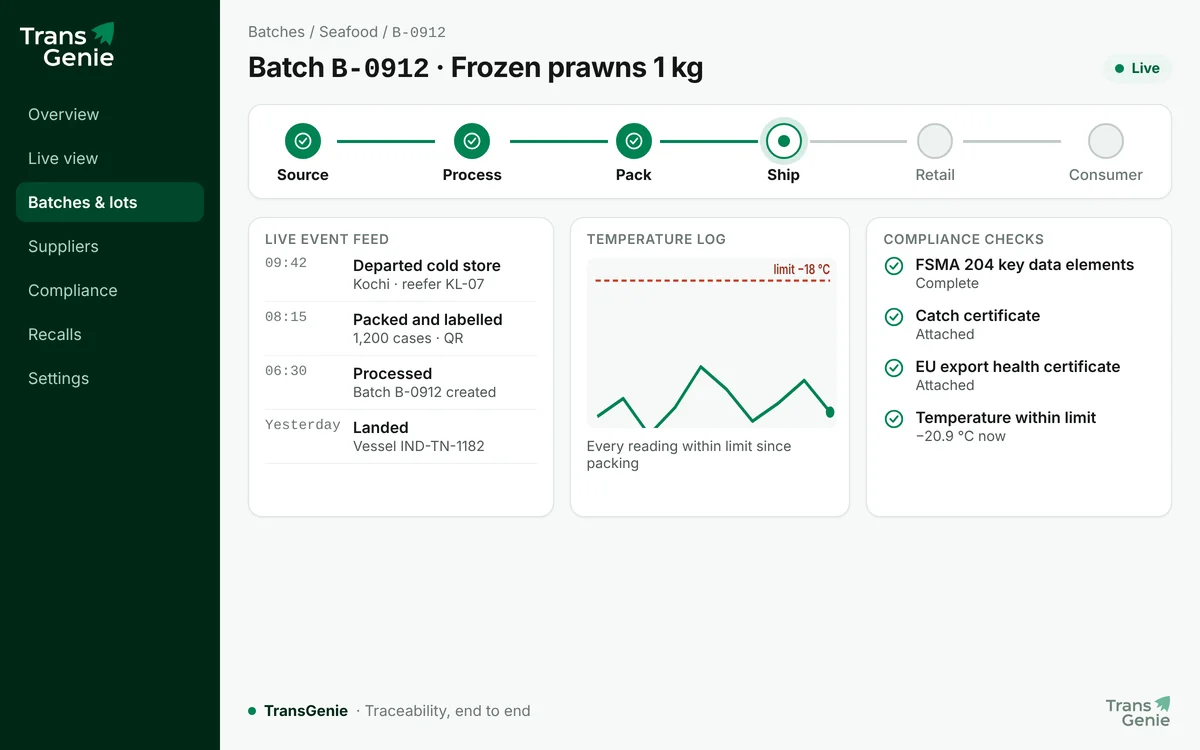
TransGenie is a traceability software platform that tracks products, ingredients, batches and shipments from source to consumer in one connected system. It helps food, seafood, pharmaceutical, and manufacturing businesses get real-time supply chain visibility without replacing their existing systems.
Here's how TransGenie supports product tracking across the supply chain:
Live traceability network
Records every event, from sourcing and processing to packing, shipping, retail, and consumer scans, as it happens.
Lot and batch tracking
Supports forward and backward tracing, helping businesses quickly identify affected products during a recall.
QR, NFC and RFID
Uses smart identifiers to track products, cases and pallets, while providing consumer-facing product information.
Supplier collaboration
Allows suppliers to share product details and compliance records through the same platform.
Standards and compliance
Supports GS1 standards and recordkeeping for FSMA 204, the EU Digital Product Passport, and export requirements.
System integrations
Connects with ERP, inventory, manufacturing and warehouse systems to share supply chain data.
Cold chain records
Links temperature records to individual batches and shipments to help monitor product conditions.
If your team still relies on spreadsheets and emails, TransGenie can help with real-time supply chain visibility modernization one product line at a time. You can start with a 14-day free pilot using your own products.
Conclusion
Real-time supply chain visibility brings information from different companies into one shared, live record. Each product has an ID, every handover is recorded, and all partners can access the same updates. This helps businesses quickly find out about delays, manage recalls faster, reduce waste, and maintain compliance records as products move.
You don't have to connect your entire supply chain at once. Start with the product or route where delays, spoilage, or compliance risks cause the most problems. Test the solution with one product line, measure the results, and then expand to more suppliers, warehouses, and distributors.
With EUDR, the EU battery passport, and FSMA 204 requirements coming into effect between late 2026 and 2028, businesses that start recording supply chain events now will be better prepared.
Looking for a Real-Time Supply Chain Visibility Solution?
Book a TransGenie demo or start a 14-day free pilot using your own products.
Yokesh Sankar