Every plant produces a defective part sooner or later. The real issue starts when nobody catches the defect before the product reaches the customers. That’s exactly why control of non-conforming product becomes essential for every quality system.
When things are handled properly, the defects become documented issues that help prevent future inconsistencies. Ignoring this can lead to customer complaints, recalls, and audit findings. This blog covers how to identify non conforming product, manage it, choose the right actions, maintain records, and meet ISO 9001 requirements.
A non conforming product is any part, material, or finished goods that fails a specified requirement. To manage it, identify and tag it, segregate it, contain other affected lots, record it in a non conforming product report (NCR), decide its disposition, verify the result, and fix the root cause. ISO 9001 covers this in clause 8.7.
What is a Non Conforming Product?
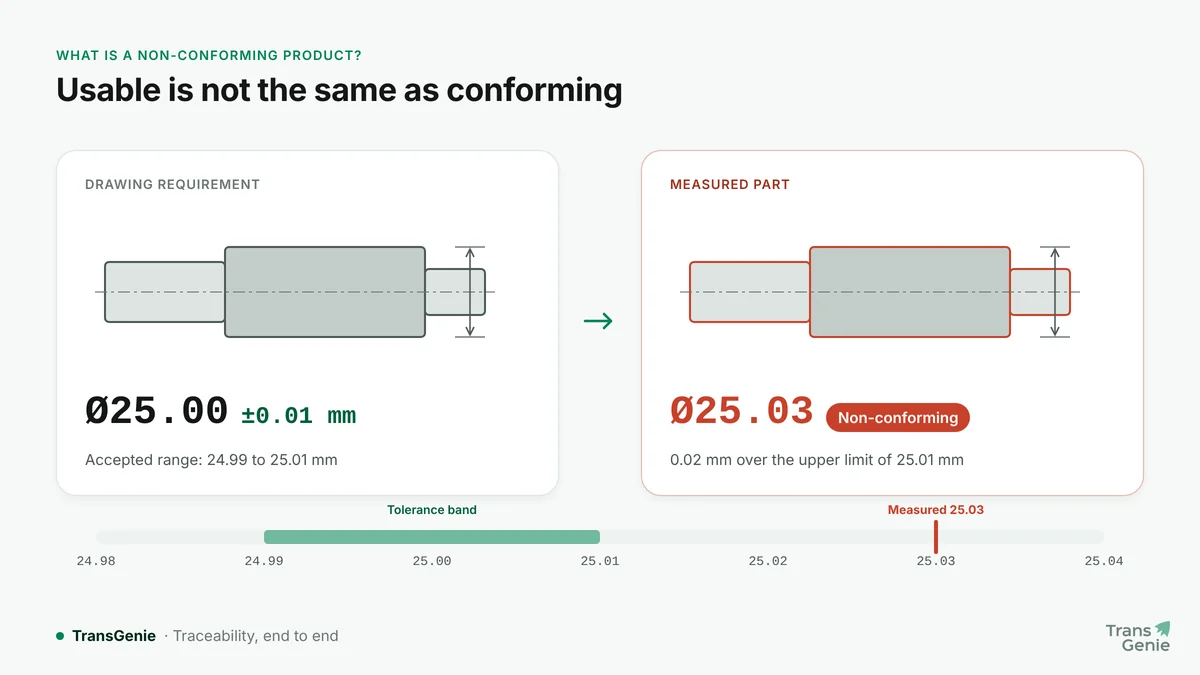
It means a material, component, or finished product that fails to meet the required quality standards, specifications, or regulations. In simple terms, if a product doesn’t meet the agreed requirements, it is considered non conforming, even if it appears to be in good condition.
These requirements can come from different sources, which include:
1. Customer Specs
Product dimensions, design requirements, and agreed quality standards.
2. Internal Standards
Internal procedures, production guidelines, and inspection criteria.
3. Regulations
Industry-specific rules that cover safety, materials, packaging, and handling.
4. Supplier Contracts
Approved materials, quality certificates, and delivery specifications.
Not every non conforming product is visibly defective or unusable. For example, imagine a manufacturer producing plastic bottles for a beverage company. If the bottles have thinner walls than the approved specs, they are considered non-conforming, even if they look fine and hold the liquid without leaking. The issue should be identified and addressed before those bottles move any further through production or reach customers.
Nonconformity, Defect & Suspect Product: Know the Differences
These three terms may sound familiar, but they describe different quality issues. Understanding each helps you pinpoint problems quickly and handle the products correctly.
| Term | What It Means | Example |
|---|---|---|
| Nonconformity | A product that has failed to meet the specified requirement | A carton has an incorrect batch number printed on it |
| Defect | An issue that affects how a product is supposed to function or perform | A cracked weld makes a metal bracket weaker than required |
| Suspect Product | A product that may have a quality issue but hasn’t been confirmed as defective | Parts produced by a machine later found to be out of calibration |
The main difference is that every defect is a nonconformity, but not every nonconformity affects the product’s performance. All suspect products should also be isolated and placed on hold until inspection confirms whether they meet the required standards or not.
Where the Bad Parts Really Come From
All the non-conforming products can enter your production process in many ways. Knowing where the issues usually emerge can also help you spot them early and prevent them from affecting the final product.
Wrong or Poor Inputs
Incorrect raw materials, missing quality certificates, or damaged supplier packaging.
Process Drifts
Changing temperatures, worn-out tools, or incorrect machine settings.
Equipment Problems
Faulty or uncalibrated measuring instruments that produce inaccurate readings.
Human Slips
Missed inspections, incorrect labels, or products placed in the wrong storage bins.
Paperwork Gaps
Missing inspection records, outdated drawings, or incomplete approval documents.
Non Conforming Product Examples From Different Industries
As mentioned earlier, a product doesn’t have to be completely unusable to fail quality requirements. At times, even a small issue with its material, performance, dimensions, or labeling is enough to make it non-conforming. Here are some examples across different industries:
| Industry | Example | Why It Fails |
|---|---|---|
| Automotive | A car door that doesn’t align properly with the frame | Inconsistency in dimensional requirements |
| Electronics | A smartphone battery that overheats during testing | Fails safety and performance test requirements |
| Food Processing | Milk that is stored above the permitted temperature | Violating storage requirements |
| Pharmaceuticals | A medicine bottle containing fewer pills than stated on the label | Irregularities while packing |
| Packaging | A cardboard box that collapses under the required load | Fails to meet the strength requirements |
| Metal Fabrication | A metal pipe with uneven thickness | Collapsing dimensional specifications |
| Textiles | A batch of shirts with irregular stitches | Doesn’t meet workmanship standards |
| Plastics | A plastic container with visible cracks | Fails product quality requirements |
| Other Sectors | Products assigned to the wrong batch during labelling | Compromises product traceability |
The above examples show why even minor issues deserve attention.
Classifying Severity Before Opening a Full NCR
Not every quality issue needs the same level of attention. A minor one can be corrected on the spot, while a defect that affects product safety needs immediate action before reaching customers. This classification by severity helps your quality team prioritize risks and decide when a formal Non-Conformance Report (NCR) is necessary.
| Level | Description | Required Action |
|---|---|---|
| Minor | A small issue that doesn’t affect the product safety, fit, or performance and can be corrected immediately | Fix the issue and record it in the quality log. A complete NCR isn’t necessary |
| Major | A problem that affects the product performance or specifications, potentially involving multiple batches | Raise an NCR, isolate affected products, trace the issue, and arrange a formal review |
| Critical | A serious issue involving safety or health compliance, particularly when affected products have been shipped | Stop the affected work, escalate immediately, and inform customers or regulators where required |
How to Identify Non Conforming Products
Quality issues can surface at any stage, from the moment the materials arrive to the point where the product reaches the customers. Building inspection checkpoints into your operations helps catch these issues before they affect larger batches.
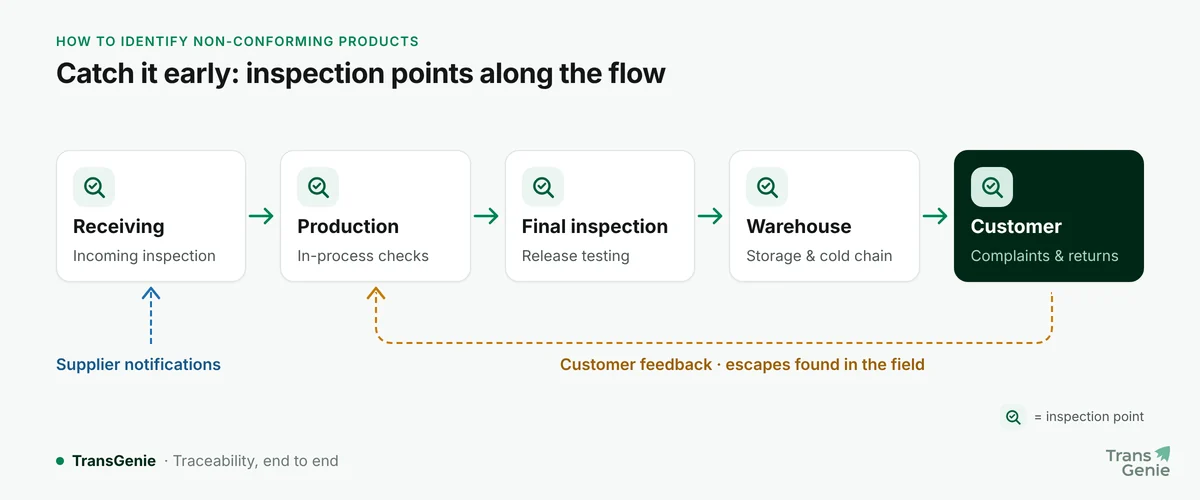
Here are the seven key points where your team should look for potential issues:
-
1. Incoming Inspection
Verify the delivered materials against the purchase orders, approved samples, and supplier documents.
-
2. In-Process Inspections
Check the production samples for changes in dimensions, appearance, or process-related variations.
-
3. Storage & Logistics
Review the warehouse conditions, handling practices, and temperature records to identify storage-related issues.
-
4. Final Inspection
Test the completed products against the required performance, appearance, and labelling criteria.
-
5. Internal Audits
Examine the quality procedures and inspection records to uncover weaknesses in existing records.
-
6. Customer Feedback
Review the complaints, returns, and warranty claims to identify the problems reported after delivery.
-
7. Supplier Notifications
Inspect the supplier alerts for material defects or quality concerns involving previously delivered goods.
Also, watch for unusual patterns, such as rising scrap rates, inconsistent inspection results, frequent production adjustments, and unexpected supplier changes. When an issue arises, review the production and inspection records to establish how far back it may have started and what batches could possibly be involved, and rectify the mistakes.
The First 60 Minutes After the Discovery
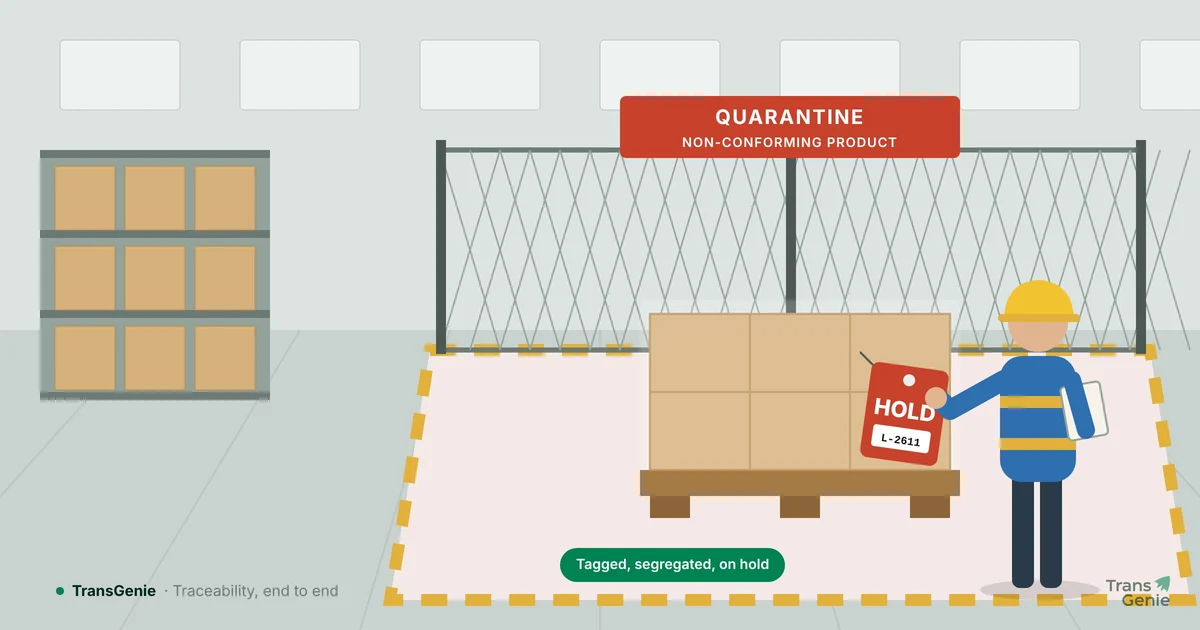
Once a quality issue has been discovered, the immediate priority is to prevent the affected products from moving further through the supply chain. You can follow these four steps within the first 60 minutes:
-
1–10MinutesStep 01
Stop & Tag
Pause production if needed and mark the affected item, container, or pallet with a red tag or hold status on it.
-
10–20MinutesStep 02
Isolate the Product
Quarantine the affected goods or apply a system hold if physical movement isn’t practical, and notify the supervisor.
-
20–40MinutesStep 03
Identify Affected Batches
Review the production details, including the machine, shift, material lot, and time period. Inspect the work in progress and recently shipped goods.
-
40–60MinutesStep 04
Document the Issue
Create an NCR and include supporting evidence, such as photographs or measurement results. And, determine whether the situation needs an escalation or customer notification.
You don’t need to establish the root cause or final disposition within the first hour. Just focus on keeping the affected products under control until the investigation is complete.
Eight Steps in a Non Conforming Product Control Procedure
Follow the eight steps to manage affected products, decide the next course of action, and prevent the same issues from happening again. The procedure can be divided into three phases:
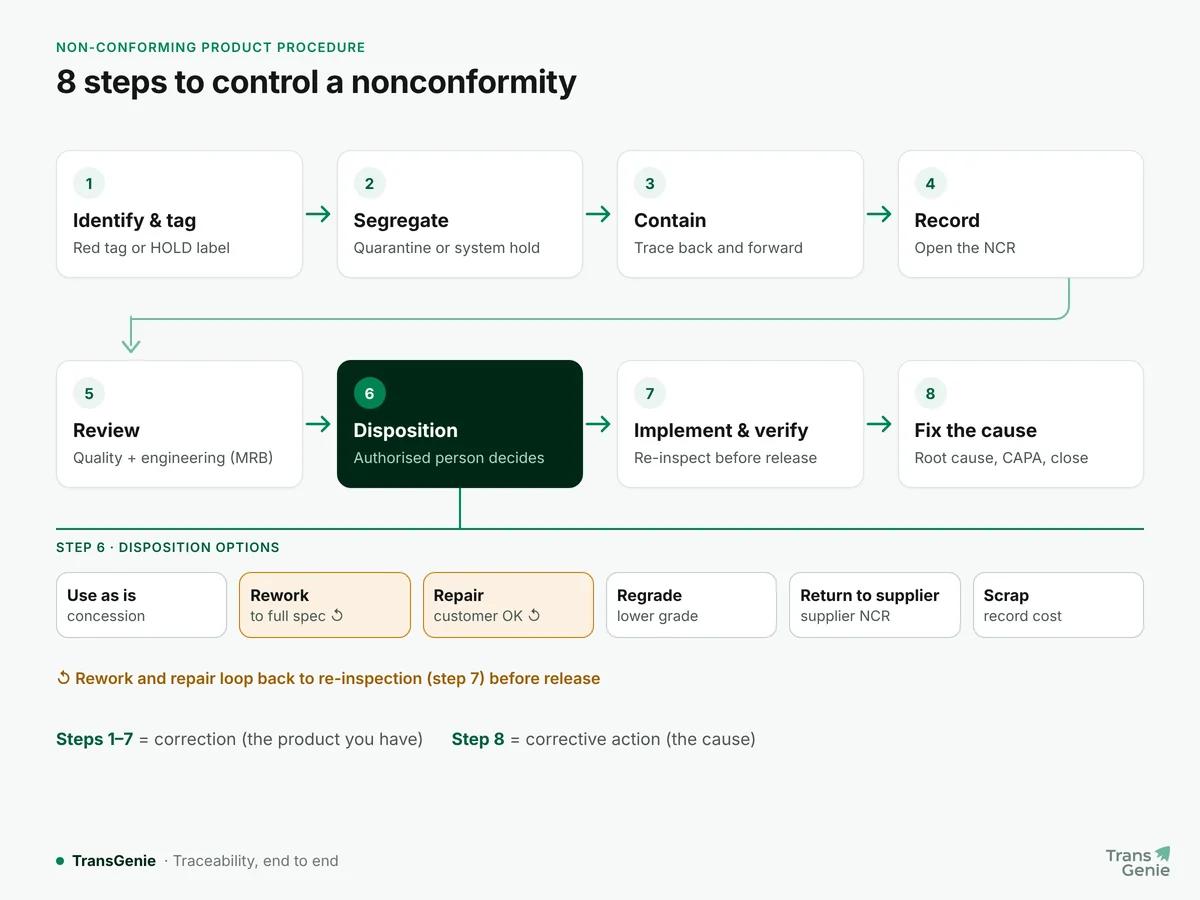
Phase 1: Control the Issue Steps 1–3
This phase is what we’ve discussed above, which tends to be done within the first hour:
-
Identify & Tag
Note the product number, batch details, affected quantity, and discovery location.
-
Segregate
Keep the affected product separate from the approved inventory or apply a system hold.
-
Trace Affected Batches
Review the connected materials, production activities, and customer shipments. Good lot traceability makes this step fast.
Phase 2: Review & Decide Steps 4–7
-
Create an NCR
Assign a unique reference number and attach relevant inspection results, photographs, and other evidence.
-
Evaluate the Issue
Bring the quality and production teams together to address the issue. Larger facilities may use an MRB (Material Review Board).
-
Approve a Disposition
Have an authorized person select the appropriate action and document the decision.
-
Verify the Outcome
Inspect the repaired or reworked products against the original requirements before approving their release.
Phase 3: Prevent Recurrence Step 8
-
Address the Root Cause
Use your own methods to investigate the recurring or significant problem. Assign corrective actions, check their effectiveness, and close the NCR.
Complete all eight steps, document the process, and make sure your team knows how to handle similar issues in the future.
Disposition of Non-Conforming Product: Selecting the Right Option
The disposition of non conforming product determines what happens to products that fail to meet the requirements. Depending on the issue, there are six possible ways to handle them:
| Decision | Action | Records to Maintain |
|---|---|---|
| No impact on safety, fit, or function | Approve use under concession, with customer approval where required | Concession number, justification, quantity, expiry |
| Can meet original specifications after correction | Rework using an approved instruction | Method, operator, inspection results |
| Can be used without meeting the original specifications | Repair, usually with customer approval | Method, customer approval, inspection results |
| Suitable for another grade or purpose | Regrade and update the product identification | New grade, relabelling, stock update |
| Issue originated from purchased material | Return to supplier | Supplier NCR, return reference, credit |
| No suitable alternative | Scrap the product | Quantity, disposal method, witness, cost |
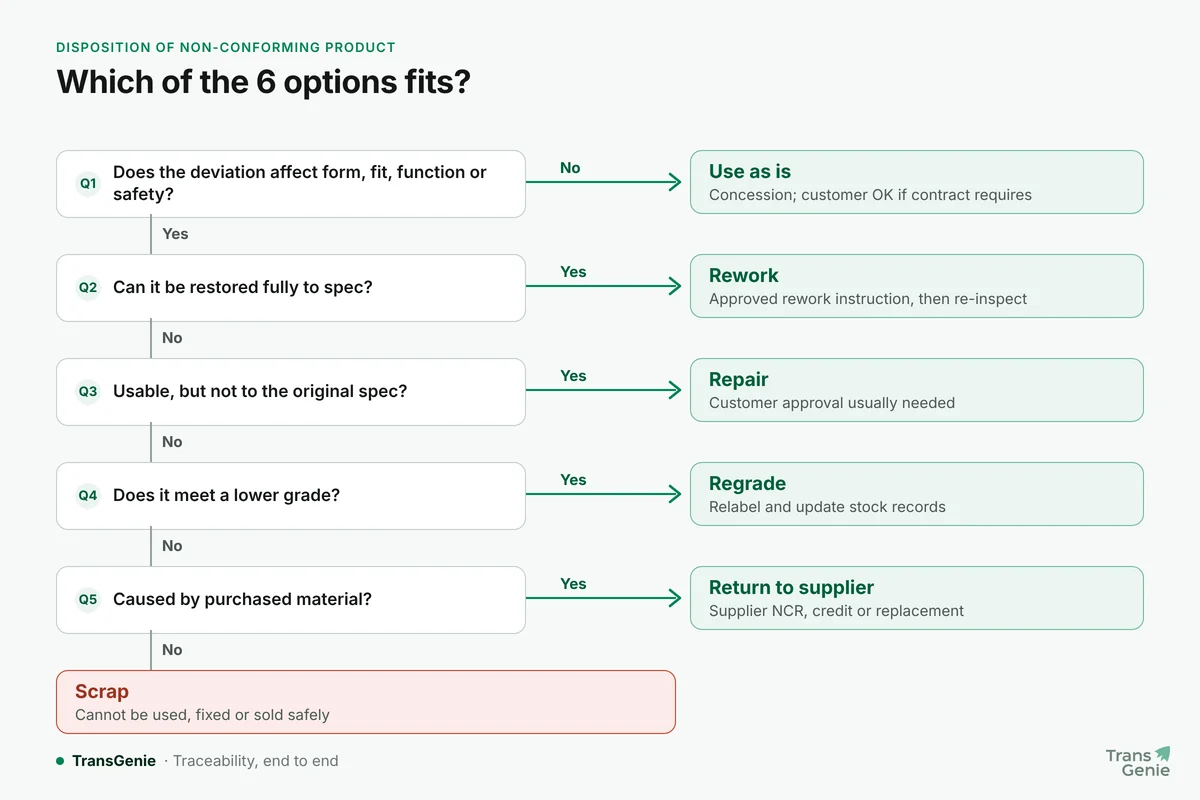
Also, one important distinction is the difference between rework and repair. A rework brings a product back to its original specifications, while a repair makes it usable without necessarily restoring full conformity. This is why a repair generally requires customer approval.
Under IATF 16949, automotive suppliers must obtain customer authorisation for concessions. Similar requirements may apply in aerospace, medical device, and defense industries.
How to Write a Non-Conforming Product Report (NCR)
A non conforming product report (NCR) should clearly describe the issue, the affected products, and the actions taken. Avoid using vague sentences and use specific details that clearly explain what went wrong.
For example, instead of writing “parts out of spec”, you can mention that 11 out of 75 inspected parts have a bore diameter of 25.08mm, while the drawing specifies 25.00 ± 0.02 mm. Similar to this, instead of saying “bad material”, you need to identify the incorrect resin grade, supplier lot, and missing certificate.
While you’re writing an NCR, you should cover these essential details.
- NCR reference number, date, and the name of the person reporting the issue.
- Product identification, affected lot, quantity, and discovery location.
- The original requirement and the actual result.
- Supporting evidence, including photographs, measurements, or test reports.
- Actions taken to control the affected products.
- Final disposition, approval details, and any customer concession.
- Inspection results following the rework or repair.
- Root cause and corrective action reference.
- Associated costs, including scrap, rework, sorting, and freight.
- Closure date and final approval.
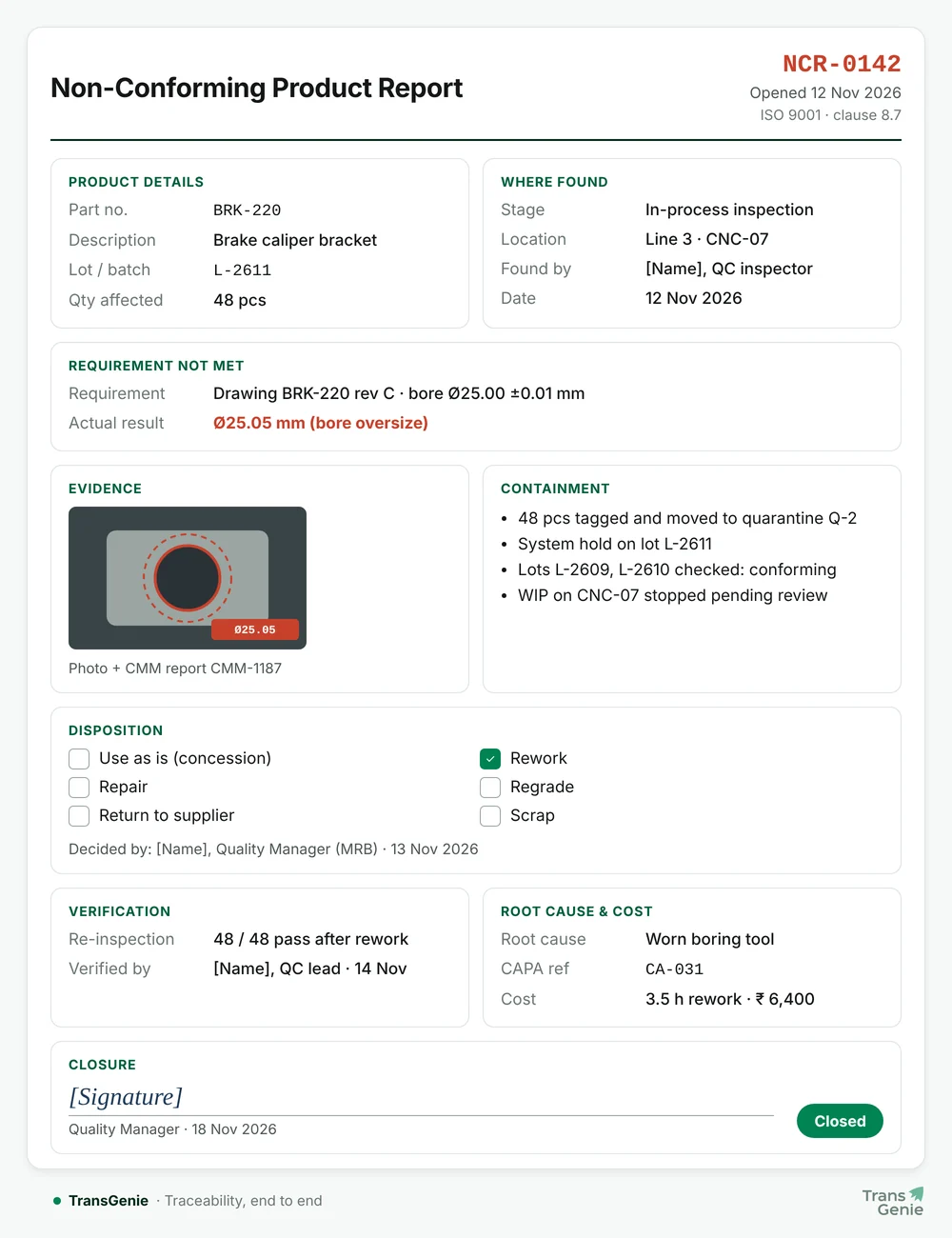
By following all these, keep the report factual and specific so that anyone reviewing it can understand the issue, decisions, and the actual outcome without having the need to investigate the same details again.
Maintaining the Non Conforming Product Log
An NCR tells you what went wrong in one instance. The non conforming product log helps you see whether the same problems keep coming back. Do keep all NCRs in one updated register, with the newest entries at the top.
| NCR no | Date | Part / Lot | Qty | Found At | Issue | Disposition | Approved by | CAPA ref | Status |
|---|---|---|---|---|---|---|---|---|---|
| NCR-0142 | [date] | BRK-220 / L-2611 | 48 | In-process | Bore oversize | Rework | [name] | CA-031 | Open |
| NCR-0141 | [date] | PKG-08 / L-2598 | 1,200 | Incoming | Seal strength below spec | Return to supplier | [name] | SCAR-012 | Closed |
Set aside 30 minutes each month to review the log. Look for patterns by supplier, production line, and inspection stage. For example, the repeated defects at final inspection may point to gaps in earlier checks, while recurring supplier issues need a formal corrective action request.
Also, track how long the NCR stays open and the cost of each issue. This helps your internal team spot recurring problems and understand their impact on production.
ISO 9001 Requirements for Non-Conforming Products
ISO 9001 non conforming product requirements mainly fall under two clauses: 8.7 (Control of Nonconforming Outputs) and 10.2 (Nonconformity and Corrective Action). These clauses cover both products and services.
Control
The organization must identify nonconforming products and ensure that they aren’t accidentally used or delivered. This can involve correcting the issue, keeping affected items separate, stopping supply, informing customers, or getting approval to use the product under a concession. The corrected products must be checked again before the release.
Records
Keep the records of what went wrong, how it was handled, any concessions, and who authorised the decision.
Corrective Action
When a problem occurs, investigate what caused it, decide whether corrective action is needed, implement the necessary changes, and check whether they have worked.
People may be confused about the written procedure, whether it's mandatory or not.
ISO 9001 (both the 2015 and 2026 editions) requires records under clause 8.7.2, but it doesn’t require a separate written procedure. Meanwhile, many manufacturers use one to keep everyone following the same approach.
ISO 9001 Updates & Sector-Specific Requirements
Based on Advisera’s comparison, clause 8.7 remains unchanged, while clause 10.2 has only minor editorial changes.
Also, some industries have additional requirements:
Requires customer approval for concessions and tighter controls over suspect, reworked, and repaired products.
Sets additional requirements for scrap, concessions, and MRB decisions.
Covers how non-conforming medical devices must be handled before and after delivery.
Track Non-Conforming Products With TransGenie’s Traceability Software
Manual tracking may work for smaller operations, but managing non conforming products becomes much harder as production grows. Due to this, the records might get duplicated, statuses may not reflect the latest updates, and linking an NCR to affected lots becomes difficult.
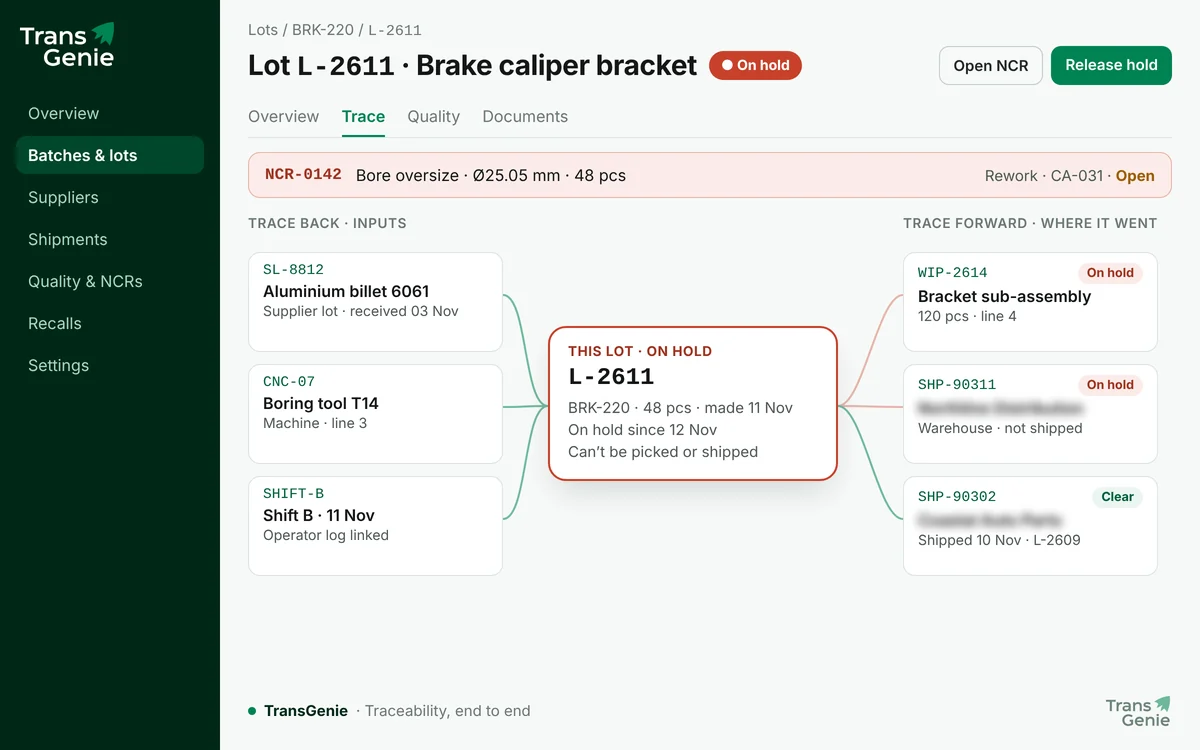
In such cases, traceability software manages these issues through:
Backward Traceability
Trace the defective lot back to its suppliers, machines, operators, and production settings.
Forward Traceability
Identify every batch, pallet, and shipment connected to a suspect input.
System Holds
Prevent flagged lots from being picked, used in production, or shipped.
Linked Records
Keep the NCRs, disposition decisions, concessions, and corrective actions connected to the relevant lot for easier audits.
TransGenie’s manufacturing traceability software includes all four of these features. It tracks batches and lots from raw materials to customers. Along with the above features, it also supports QR, RFID, NFC tagging, supplier collaboration, and audit-ready records, while integrating with existing ERP and inventory systems.
Track Every Lot With TransGenie
Trace affected products from their source to the customer and identify the impacted lots faster.
Common Mistakes While Handling Non Conforming Products
Even with the defined procedure, tiny mistakes can allow defective products to move through production or reach customers. You can watch out for these common issues:
Keeping Tagged Products Beside Good Stock
Use a designated quarantine area and apply a system hold to prevent accidental use.
Holding Only Defective Items
Trace the issue in both directions and identify all lots that may share similar problems.
Allowing Unauthorized Decisions
Clearly identify who has the authority to approve each action.
Skipping Customer Approval
Check the contract and quality agreement before using any product under concession.
Releasing Reworked Products Without Inspection
Re-inspect reworked products against the original requirements and record the results before release.
Closing NCRs Too Early
Keep it open until the root cause has been addressed and the corrective action is verified.
Reviewing Records Only Before Audits
Review nonconformity trends regularly, such as every month.
Handling Supplier Issues Through Email Only
Raise a formal supplier NCR and set a deadline for the required response.
Aside from these procedures, creating a blame-free reporting culture is equally important. The operators should feel comfortable stopping production and tagging suspect products without fear of punishment. When employees hesitate to report problems, defective products are more likely to reach customers.
Wrapping Things Up
A non conforming product doesn’t have to damage your business. What matters is how quickly you respond, who takes the responsibility, and whether every decision is properly recorded. A robust process helps your team contain issues, resolve them, and prevent them from happening again while meeting the ISO 9001 requirements.
The biggest challenge is often tracing affected lots. Try tracking one lot forward and backward. If it takes more than an hour, then it’s time to improve your traceability process.

Yokesh Sankar