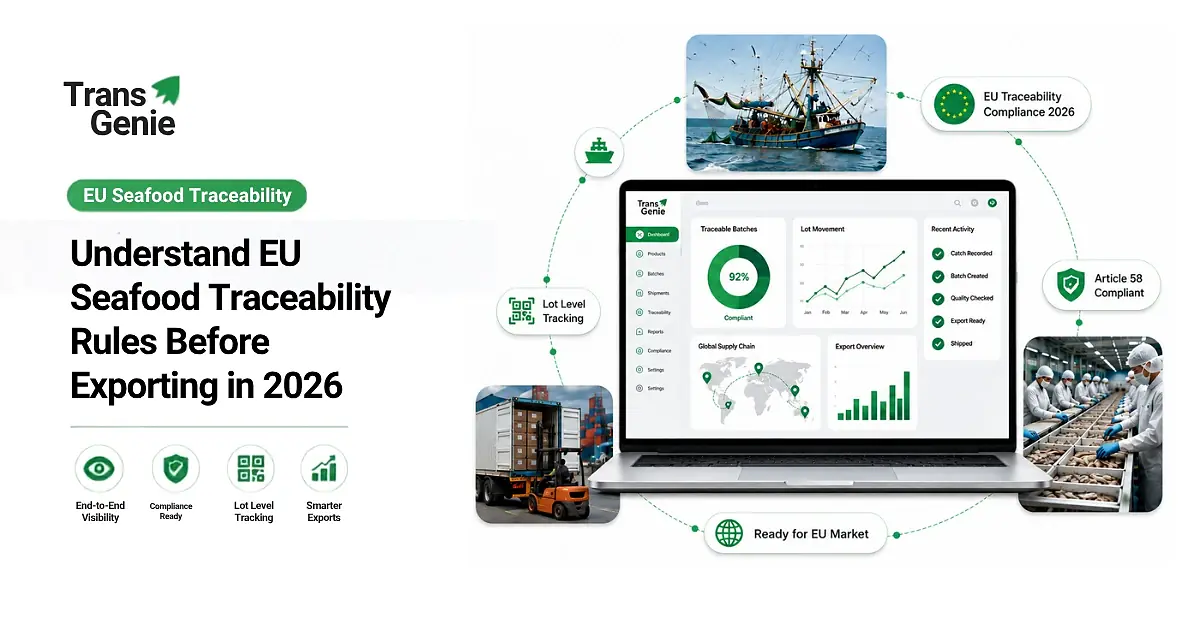
If you are exporting seafood to the European Union, it is to note that the EU seafood traceability requirements changed on 10 January 2026. The new rules affect how exporters manage catch certificates, lot-level records, and other fisheries-control data. However, EU seafood traceability covers different requirements. For most businesses, what needs to be followed depends on the type of seafood you export and how it moves through the supply chain.
In 2026, exporters need to understand three key areas:
CATCH and IUU catch certification is required for covered wild-capture fishery products entering the EU.
Article 58 lot traceability is needed for relevant fishery and aquaculture products. This includes products with specific digital traceability information.
Vessel and first-sale controls that mainly apply to fishing operations and operators under the EU fisheries-control system.
The practical question is therefore not simply "Do I need seafood traceability?" Rather, it is about “Which EU traceability and fisheries-control obligations apply to my products & can I produce the required data when the EU importer or authority needs it?”
What Changed for EU Seafood Traceability in 2026?
In 2026, seafood traceability is becoming more digital, connected, and easier to verify. i.e., instead of keeping traceability information across separate documents and systems, businesses increasingly need records that can be connected and retrieved throughout the supply chain.
Thus, traceability data should be:
- Precise at the time it is recorded
- Linked to the relevant lot, shipment, or source
- Consistent across certificates and other documents
- Available digitally when information needs to be shared
- Easy to retrieve when an importer or authority requests it
Thus, for exporters, this makes data management very important just as documentation. A catch certificate may include all the necessary information, but your team also needs to know where that information came from, which lot it belongs to, and how it connects to the final shipment.
From Documents to Connected Records
Earlier, seafood traceability could involve separate records for catch, processing, storage, and shipping. The 2026 framework puts more emphasis on connecting these records so that the history of a seafood product can be followed through the supply chain.
For example:
If a question arises about a shipment, you should be able to move back through this chain without manually searching across multiple files or systems.
Why This Matters for Exporters?
This shift means that having the right documents is no longer enough on its own. Your traceability process should also make it easy to:
- Verify all the data before exporting
- Match lot & shipment records
- Identify the source of a product
- Share supporting information with EU importers
- Retrieve records when requested
This is where a structured digital seafood traceability process can make compliance easier and help minimize manual reconciliation.
The Three EU Seafood Traceability Regimes - Which One Applies to You?
One of the easiest ways to misunderstand EU seafood traceability requirements is to treat CATCH, Article 58, and vessel controls as the same requirement. The fact is, they aren't the same.
Getting to know the seafood traceability requirements for EU imports starts with knowing which rules apply to your product and role
| Your situation | Main requirement to understand | Who is primarily responsible? |
|---|---|---|
| You export wild-capture seafood covered by the EU IUU scheme | Catch certificate + CATCH | EU importer, with exporter/flag-State data inputs |
| You supply fishery or aquaculture products entering the EU market | Article 58 lot traceability | Operators throughout the supply chain |
| You operate or buy from vessels subject to EU fisheries controls | Vessel, landing & first-sale controls | Fishing operators, vessels and relevant EU operators |
| You export aquaculture products | Article 58 traceability; CATCH may not apply as an IUU catch certificate | Supply-chain operators |
| You export processed seafood | Check the CN code & applicable IUU/traceability rules | Exporter + EU importer + relevant authorities |
Here, the important point is that CATCH is not a replacement for Article 58 traceability. They address different parts of the compliance chain.
Regime 1: CATCH and the IUU Catch Certificate
CATCH is the EU's digital system that helps manage catch certificates under the IUU Regulation. Since 10 January 2026, EU importers must use CATCH for covered fishery-product imports. The CACHE system is integrated into TRACES. The catch certificate ensures that the fish were caught legally and in line with applicable rules.
For non-EU exporters, the practical point is simple: Your EU importer may be responsible for submitting the information. However, you need to provide accurate data.
This can include:
- Fishing vessel details
- Species
- Catch quantity
- Catch area
- Fishing trip details
- Processing information
- Transport details
- Supporting documents
Non-EU exporters and authorities can also use CATCH voluntarily, while EU operators and authorities must use it for the applicable import process.
Regime 2: Article 58 Lot Traceability
It is worth noting that Article 58 is different from CATCH. i.e., it covers relevant fishery and aquaculture products that are required to be tracked by lots and remain traceable through the supply chain.
For products classified under Chapter 3 of the EU Combined Nomenclature (CN), the required traceability information must be recorded and made available digitally to the next operator and, when requested, to competent authorities. This implies that seafood supply chain traceability goes beyond managing catch certificates.
For example, a farmed shrimp shipment and a wild-caught tuna shipment may have different traceability records. In both cases, the business needs to maintain reliable lot information and keep it linked to the product’s source.
Regime 3: Vessel and First-Sale Controls
The third area includes fisheries operations and controls. This includes:
- Electronic fishing logbooks
- Vessel position information
- Landing declarations
- Sales notes
- Take-over declarations
- Transport documents
- Catch reporting
All of the above requirements primarily apply to vessels and operators covered by the EU fisheries control system. They should not automatically be treated as requirements for every non-EU seafood exporter.
For example, EU rules require certain fishing activity and catch information to be recorded electronically and made available for checks.
What Changed on 10 January 2026?
In the EU's fisheries control reforms, 10th January 2026 is marked as one of the major implementation dates. For seafood businesses, the biggest change was moving toward more digital, connected compliance records.
However, these changes do not apply to every exporter in the same way. The requirements vary and depend on whether you deal with wild-capture seafood, aquaculture products, EU fishing operations, or imports covered by the EU IUU rules.
| Change from 10 January 2026 | What it means for seafood businesses |
|---|---|
| CATCH becomes mandatory for EU importers | EU importers must submit applicable catch certificates & related documents through CATCH |
| Digital lot traceability applies | Covered fishery & aquaculture products need the required traceability information available digitally through the supply chain |
| More detailed source information | Traceability records need to connect products with information. This includes species, quantity, area & the relevant vessel or aquaculture production unit |
| More electronic fisheries reporting | Several control requirements move further toward electronic recording & reporting for the fishing operations covered by them |
| More connected compliance data | Exporters need reliable source records that their EU importers & other supply-chain partners can use for compliance |
From Paper Records to Digital Traceability
The 2026 reforms transform the EU seafood supply chain further away from the disconnected paper records and towards digital traceability.
For those covered fishery and aquaculture products, the required fish or tuna traceability data must be available digitally to the next operator and to authorities when requested. The rules apply to relevant products entering the EU market, including imports.
This does not mean that every seafood exporter must replace every document with a single software system.
It means the underlying information needs to be structured, accessible, and connected well enough to follow the product through the supply chain.
Thus making seafood supply chain traceability increasingly important for the exporters. Also, your EU buyer may need information from your vessel, farm, processing facility or shipment records to complete its own compliance process.
CATCH Becomes Mandatory for EU Importers
Besides the above, a separate yet closely related change took effect on the same date.
It states that from 10 January 2026, EU importers must use CATCH to submit applicable catch certificates and related documents for fishery-product imports. CATCH is part of TRACES and replaces the previous paper-based workflow for the EU catch-certification process.
This distinction matters for exporters:
CATCH is not the same thing as Article 58 lot traceability.
- i.e., CATCH is used to handle the EU's IUU catch-certification process, whereas Article 58 establishes broader lot-level traceability requirements for covered fishery and aquaculture products.
Non-EU exporters generally do not need to use CATCH themselves, although they can use it voluntarily. Their main role is to offer accurate information and supporting documents to the EU importer.
What New Traceability Information Needs to Be Connected?
The 2026 rules make the source and identity of seafood more important at lot level.
For covered products, the traceability record can include information such as:
- Lot identification
- Species and FAO species code
- Catch or harvest date
- Quantity
- Relevant geographical area
- Fishing gear category for applicable fishery products
- Vessel identifier and catch-certificate information for applicable imported wild-capture products
- Aquaculture production-unit information for applicable farmed products
The exact information required varies based on the product and its place in the supply chain.
For an exporter, the practical takeaway is just simple:
"Your shipment should not be a collection of separate documents. Its key information should tell one consistent story from source to EU market."
That means your fish traceability records should be capable of connecting the product to its source, lot, processing history, and shipment without relying on any manual reconstruction.
More Electronic Reporting for Fisheries Operations
The 2026 reforms also increased the use of electronic reporting for fishing operations covered by the EU fisheries control rules. These include electronic catch records, other fisheries data, along with stronger vessel-monitoring and reporting requirements.
These rules mainly apply to fishing operations and operators covered by the relevant EU fisheries-control system. They do not mean that every non-EU seafood exporter needs to use an EU vessel-monitoring or electronic logbook system.
For exporters, the key point is whether the fishing data they receive is complete and reliable enough to support EU traceability and documentation requirements.
What This Means for Exporters
The practical change is more than just moving from paper to software. EU buyers increasingly need connected, consistent, and retrievable seafood data.
Just before shipping, exporters should be able to track:
Source→Species→Area→Catch/Harvest→Quantity→Lot→Processing→Shipment
If that information is held across separate spreadsheets, emails, and paper documents, preparing EU documentation becomes harder as shipment volumes increase.
Having a seafood traceability platform can help bring all this information together. But first, businesses need a clear data structure and a process for managing the records.
In short, 10 January 2026 did not introduce one single "EU seafood traceability rule." It actually brought several important digital fisheries-control and traceability changes into effect. So exporters can get a clear view of which rules apply to their products and make sure the underlying data is accurate, connected, and ready for digital exchange.
Article 58: The Minimum Seafood Lot Traceability Data
Article 58 of the EU Fisheries Control Regulation is central to EU seafood traceability. It requires fishery and aquaculture products to be traceable throughout production, processing, and distribution. i.e., from catching or harvesting through to retail. Operators must also have systems and procedures that help find where a lot came from and where it was supplied.
For products covered by Chapter 3 of the Combined Nomenclature (CN), Article 58 sets out a minimum set of data that must accompany the lot and is made available digitally.
What Information Must Each Lot Contain?
The exact information depends on whether the product is imported or non-imported, and whether it is a fishery or aquaculture product.
| Required information | What it identifies |
|---|---|
| Lot identification number | The specific lot |
| Fishing trip/day ID or producer/production-unit details | The source for non-imported products |
| Vessel identifier and catch-certificate number, where applicable | The source & documentation for imported wild-capture products |
| Aquaculture production-unit details, where applicable | The source of imported farmed products |
| FAO alpha-3 species code and scientific name | The exact species |
| Relevant geographical area | Where the product was caught or produced |
| Fishing gear category, where applicable | How the fishery product was caught |
| Catch or harvest date | When the product was obtained |
| Quantity | Net weight or number of individuals, as applicable |
| Information on undersized fish, where applicable | Separate quantities for fish below the applicable minimum conservation reference size |
For products covered by Chapter 3 of the EU Combined Nomenclature (CN), each lot must carry a minimum set of traceability information. The exact data depends on whether the product is wild-caught or farmed and whether it is imported into the EU.
What is a "Lot" Under EU Rules?
A lot is a defined batch of fishery or aquaculture products that can be traced as a unit.
For Chapter 3 products, lots usually cover products that meet specific conditions.
For fishery products, this can mean the same:
- Species
- Product presentation
- Relevant geographical area
- Fishing vessel or group of vessels
For aquaculture products, the lot generally needs to come from the same:
- Species
- Product presentation
- Aquaculture production unit
There are specific exceptions for certain small quantities and products below the minimum conservation reference size.
What Happens When a Lot is Split or Merged?
Traceability cannot be stopped when a lot is repacked, divided, or combined with another lot.
Whenever two lots are merged, or one lot is split into multiple new lots, the new lot or lots must retain the required Article 58 traceability information.
The operator must also be able to show which original lots the new lot was formed from, along with how much product came from each one.
For example, imagine you are receiving one 1,000 kg seafood lot, and later it is divided into three shipments:
- Original lot → Lot A + Lot B + Lot C
You should be able to define the original lot behind each shipment and the quantity transferred into each new lot.
The same works in reverse:
- Lot A + Lot B → New consolidated lot
Even in this case, you should be able to find out both original lots and the quantity contributed by each. This calculation plays an important part in effective seafood supply chain traceability.
What Does "Made Available Digitally" Mean?
When it comes to covered Chapter 3 products, operators must hold the required Article 58 information on record and make it available digitally to the next operator in the supply chain. The same data must also be available to competent authorities when requested.
This does not mean that every exporter must use one specific software system. The regulation supports identification tools such as codes, barcodes, electronic chips or similar systems to help offer access to the traceability information.
In practice, exporters should therefore maintain structured digital records that can be connected to the physical lot.
For example:
- Lot ID→Species→Vessel/Farm→Catch/Harvest→Area→Date→Quantity→Processing→Shipment
The easier it is to trace that chain, the easier it is to support EU requirements, answer customer requests, and handle traceability investigations.
How Long Should You Keep the Records?
As per Article 58, it is mandatory to keep the information on record. However, it does not set a fixed three-year retention period for all Article 58 information.
So, instead of using a blanket three-year rule, exporters shall follow the EU, national, and other record-keeping requirements that apply to their business.
In practice, your traceability records should stay accessible for as long as you may need them for:
- Regulatory checks
- Customer requests
- Supplier investigations
- Recall investigations
- Shipment queries
- Internal audits
The simple test is:
Whenever an EU buyer or authority asks about a lot, can you quickly show where it came from, what happened to it, and where it went?
If you can provide this information without searching the spreadsheets, emails, and paper files, your digital seafood traceability process is working well.
CATCH Explained: What Seafood Exporters Need to Know
CATCH is nothing but a digital component of the EU catch-certification system that is integrated into TRACES. It is worth noting that it is not a standalone seafood traceability platform that replaces every other traceability system. Its role is specifically connected to the EU IUU catch-certification process.
From 10 January 2026, EU importers must use CATCH for the electronic submission of the required catch certificates and related information. Thus, CATCH is now an important part of the seafood export documentation that EU exporters need to manage when shipping covered fishery products to the EU.
Who Enters the Information?
| Party | Main role |
|---|---|
| Non-EU exporter | Provides accurate catch, product and supporting information |
| Flag State authority | Validates or endorses catch certificates where required |
| Processing-country authority | Handles applicable processing-related documentation |
| EU importer | Submits the applicable documents through CATCH |
| EU Member State authority | Receives and checks the submitted documentation |
Thus, exporters should not wait for the EU importer to discover missing information.
A stronger process is to validate the information before the shipment.
What Happens When Documents Are Still on Paper?
Paper documents have not immediately disappeared from every supply chain.
The current CATCH guidance also covers situations where EU importers receive paper catch certificates or related documents. If these documents have not already been registered in CATCH, then the EU importer must enter the required data into the system accurately.
That eventually creates a practical risk. i.e., every manual handoff is another opportunity for transcription errors. Thus, digital capture at the source becomes increasingly valuable.
What We Learned From the First Six Months of CATCH
The first six months of CATCH showed that moving to a digital system does not remove the need for good data. The European Commission introduced CATCH to make import checks more consistent and reduce paperwork. But the rollout also brought practical challenges for seafood businesses. This covers port delays, manual data entry, system issues, and incomplete information.
In July 2026, reported CATCH-related documentation problems led to temporary flexibility for certain countries through 30 November 2026.
For exporters, this highlights an important point:
A digital compliance system is only as reliable as the data going into it. If vessel, catch, species, quantity, and shipment details are available across different files, preparing EU import documentation becomes harder.
So, it is better to check and organise your traceability data before the shipment reaches the EU border.
CATCH manages the digital certification process. Your traceability process needs to make sure the data behind it is accurate, complete, and ready to use.
The EU Seafood Traceability Dates Exporters Should Watch
The EU seafood traceability changes did not end on 10 January 2026. More changes will take effect through 2027, 2028, and 2029. It is worth noting that not every date works for every exporter. So, check the product, role, origin, and applicable requirements.
Key EU Seafood Traceability Dates:
What These Dates Mean for Exporters
: Temporary CATCH flexibilities for certain countries and arrangements end. Do not depend on these measures long-term.
: More parts of the revised fisheries-control rules come into effect. So, exporters should check that their vessel, catch, and traceability records are ready.
: Covered EU fishing vessels move to more frequent position reporting, including 30-minute reporting. This mainly affects vessels, but exporters working with EU fleets should be aware of the change.
: CATCH moves toward closer integration with EU customs systems, while some older catch-certificate templates reach the end of their transition period. Keeping your catch and shipment data organised will become even more important.
: Traceability expands to certain prepared and preserved fishery and aquaculture products under CN headings 1604 and 1605, along with certain algae products. Businesses handling these products should check whether their current traceability system can support the wider scope.
What Should Exporters Do Now?
Finding how seafood exporters can comply with EU regulations is simple: keep the right data accurate, connected, and easy to find. You can start improving your process now instead of waiting for each deadline.
It's time to build a traceability process that can:
Identify the product→track its source→maintain the lot→record processing→reconcile quantities→prepare documentation→retrieve the complete history.
This ensures a stronger foundation for current EU seafood traceability requirements and future changes.
7 Seafood Traceability Problems EU Exporters Need to Fix
Knowing the EU requirements is only the first step. Applying them across your seafood supply chain can be more challenging.
Exporters often get data from vessels, farms, processors, warehouses, freight partners, and customers. When this data is kept in different places, small gaps can quickly turn into compliance problems.
Here are seven common seafood traceability challenges to fix.
1. Species Names Are Not Consistent
Species information can appear differently across supplier records, invoices, packing lists, and traceability systems.
For example, one record may have a common name while another uses the scientific name or species code.
This can make records harder to match. Using consistent species information, including the required FAO alpha-3 code and scientific name, helps identify the product correctly.
2. Catch Areas Are Too Broad or Inconsistent
Seafood origin needs to be recorded with the geographical information required for the product.
A broad area description may not be enough for every compliance requirement. It is better to record the correct catch or production area at the source instead of trying to fill in the details later.
3. Lot Identity Gets Lost During Processing
Traceability becomes harder as seafood moves through different stages. i.e., a single lot may go through:
- Received → Processed → Repacked → Split → Stored → Shipped
If the link between the original and new lots is lost, it becomes complex to trace the product's full history.
EU rules also require relevant data to be maintained when lots are split or merged, including information about the lots and quantities involved.
4. Quantities Do Not Match
Quantity differences can appear at different stages:
- Catch → Landing → Processing → Lot → Shipment
Some differences are normal, especially during processing. The problem is when your records cannot explain them.
A good traceability process should show where the quantity came from and how it changed in each stage.
5. Vessel and Farm Records Are Kept Separately
Wild-capture and aquaculture products have different source information.
For imported wild-capture products, the required information can include the catching vessel's IMO number or another unique vessel identifier, along with relevant catch-certificate information.
For imported aquaculture products, the records can include information about the aquaculture production unit.
If these records are kept separately from your lot and shipment data, it takes longer to build the complete product history.
6. Records Take Too Long to Find
Traceability is not just about storing information. You also need to find it when someone asks for it.
An EU customer, authority, or internal team may need to know:
- Where did this lot come from?
- Which vessel or farm supplied it?
- When was it caught or harvested?
- How much product was involved?
- Which processing batch was used?
- Where was the final product shipped?
If answering all these questions means searching through spreadsheets, emails, and folders, then your process needs improvement.
7. Documentation Work Grows With Shipment Volume
A manual process may work when you handle a small number of shipments. As volumes increase, the same process creates more:
- Data entry
- Document preparation
- Cross-checking
- Email exchanges
- Corrections
- Approval steps
The goal of digital seafood traceability is not simply to store more information.
It is to capture information once and connect it across the supply chain, so the same data can support traceability, documentation, and compliance.
The Common Thread
These problems may look different, but they often have the same root cause:
The data exists, but it is not connected.
A stronger seafood supply chain traceability process connects the product's journey:
- Vessel/Farm → Catch/Harvest → Lot → Processing → Storage → Shipment → EU Customer
When these records are connected, it becomes easier to maintain accurate information, respond to requests, and prepare for future EU requirements.
What Good EU Seafood Traceability Looks Like
Meeting EU seafood traceability requirements is not just about keeping more documents.
A good process should make it easy to trace a product from its source through processing and shipping, and quickly find the information you need.
For covered products, EU rules require operators to keep track of where lots came from and where they were supplied. The required information must also be available digitally where applicable.
For exporters, the traceability journey should be easy to follow:
- Vessel or Farm → Catch or Harvest → Lot → Processing → Storage → Shipment → EU Customer
1. Capture Data at the Source
It's better not to wait until you prepare export documents to collect traceability information. Record the relevant details when the product enters your supply chain.
When it comes to wild-caught seafood, it's vital to track information from the vessel and catch records. For aquaculture products, it can include information from the farm or aquaculture production unit. Recording data early helps minimize the need to search for or recreate it later.
2. Check the Data Before Moving Forward
Check important information before the product moves to the next stage. This includes:
- Lot numbers
- Species and species codes
- Vessel or production-unit details
- Catch or harvest dates
- Catch or production area
- Quantities
- Certificate references, where applicable
This can help prevent errors when the same information is later used for export documents or CATCH.
3. Keep the Lot History Connected
Each stage of the supply chain should connect to the next.
- Source → Lot → Processing → New Lot → Shipment
This is highly important when the lots are split or merged. The resulting lots should still be traceable back to the original lots, with the relevant information about their composition retained.
4. Connect Traceability With Your Existing Operations
Your traceability process should work with the systems your team already uses for inventory, processing, quality, and shipments.
Instead of maintaining separate records for each activity, connect the important information across each stage.
For example:
- Receiving → Processing → Inventory → Lot Management → Shipment
When these records stay connected, your team spends less time entering the same data in different places and gets a clearer view of the product journey.
This also makes it easier to use the same underlying data for seafood traceability, customer requirements, and EU compliance.
5. Keep Your Digital Records Connected
Digital seafood traceability is not simply about putting documents into one folder. It is all about keeping the important details connected so it can be found and shared when needed.
The EU framework allows tools such as codes, barcodes, and electronic chips to help provide access to traceability information.
For exporters, this could mean connecting:
- Lot ID + Source Data + Processing Records + Shipment Data + Supporting Documents
in one traceability workflow.
6. Build One Traceability Process for Different Needs
Your traceability data should not be collected only for one EU form. The same information may also be useful for:
- EU lot traceability
- CATCH documentation
- Customer requests
- Recall investigations
- Supplier checks
- Internal quality checks
- Other market requirements
This is where a seafood traceability platform can help bring certificates, lot records, processing data, and shipment information into one connected process.
7. The Five-Minute Traceability Test
Choose one recently shipped seafood lot and try to trace its full journey. Check if you can go from:
- EU Shipment → Lot → Processing → Source → Vessel/Farm → Catch/Harvest
and back again:
Source → Lot → Processing → Shipment → Customer?
If you can do this quickly and the information matches across your records, then your seafood supply chain traceability process is in a good position.
On the other hand, if you cannot track back and forth, then the answer may not be more paperwork. You may need better-connected data.
What Should Exporters Aim For?
The goal of modern fish traceability is simple:
This gives exporters a stronger way to manage today's EU requirements and prepare for future traceability changes.
Final Takeaway - Build Traceability Ready for the EU Market
EU seafood traceability is becoming more digital and connected. For exporters, the main challenge is not just moving away from paper. It is keeping the right information connected across the supply chain.
For applicable imports, CATCH adds digital catch certification to this process, while Article 58 covers lot-level traceability for relevant fishery and aquaculture products. Other fisheries-control requirements are being introduced in stages through 2027, 2028 and 2029.
The best time to strengthen your traceability process is before a shipment is held up, a customer requests its origin records, or an audit exposes a data gap.
Want to simplify seafood traceability for your business?
Book a Live Demo

Yokesh Sankar