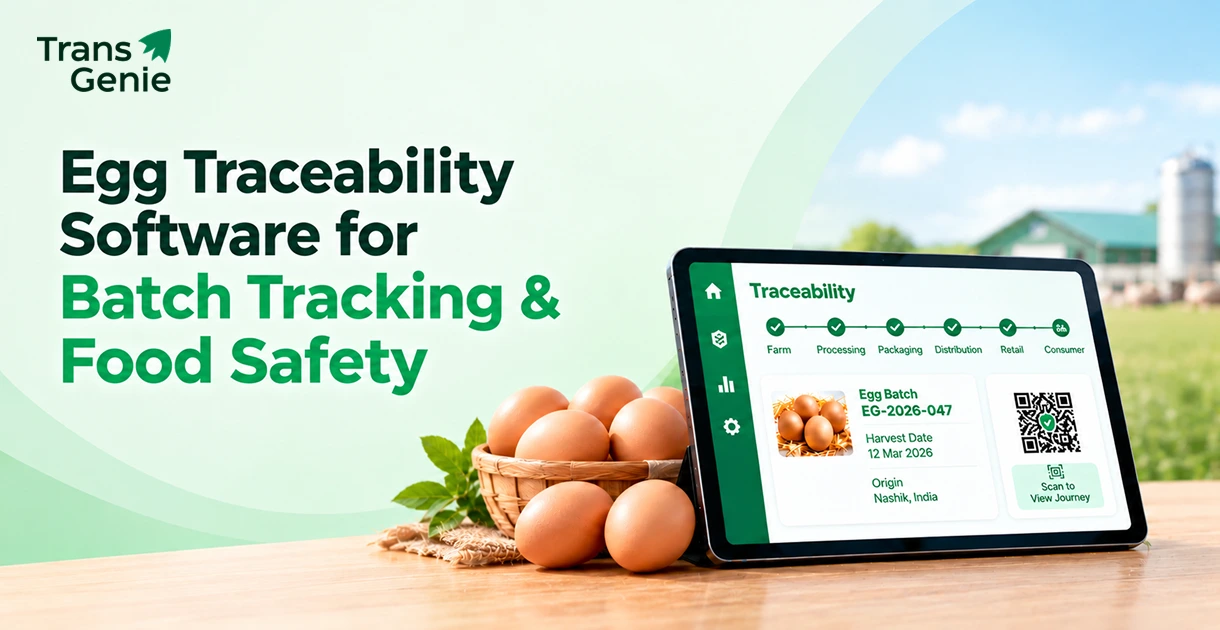
Tracking an egg batch across farms, packing facilities, distributors, and retailers can quickly become difficult when the records are scattered across disconnected systems. If a food safety issue occurs, finding where a batch came from, where it went, and who received it can delay recall and increase costs.
To bridge this gap, businesses can use egg traceability software and connect these records in real time. This gives them clear supply-chain visibility while supporting food safety, regulatory compliance, and efficient inventory management.
This informative guide explains how batch tracking software improves traceability, strengthens food safety, supports regulatory compliance, and makes inventory management more efficient.
Understanding Egg Traceability for Modern Supply Chains
Egg traceability is nothing but the ability to track eggs through every stage of the supply chain, from farm collection to retail. It links each batch to its origin, processing history, and final destination. As a result, it becomes easier to identify where a food safety issue started and which products might be affected.
Egg traceability software digitizes this process by assigning unique lot IDs and linking production, processing, transport, and shipment records in a unified system. Businesses can trace a batch backward to its source or forward to the customers who received it.
How Eggs Move Through Your Complete Supply Chain
Understanding how eggs move through the supply chain makes it even easier to see where traceability data comes from.
The journey typically follows this path:
At each stage, the batch tracking system captures information that builds a complete record of the product’s journey. The lot numbers identify eggs that are processed together, while batch records capture production dates, facility details, and other processing information.
Quality and production records show when the checks were performed and their results, while shipment records document what was shipped, when it shipped, and who received it. Altogether, these records support both forward and backward traceability.
This shows where a batch moved after leaving your facility and which customers received it at each stage.
It works in the opposite direction, helping identify the farms and earlier supply-chain stages connected to a specific batch.
The Anatomy of an Egg’s Journey
To clearly understand what egg batch tracking actually follows, look at the journey an egg takes before reaching the consumer. At each stage, new information is added to the product’s traceable history.
- Stage 1: Flock & House The journey starts with a flock ID and house number, linking the batch to details like the bird’s age, feed program, and health records.
- Stage 2: Collection & Receiving Once the eggs are collected, the date and time are recorded. This creates the first critical tracking event for that specific batch.
- Stage 3: Washing & Sanitizing The eggs further move through washing and sanitizing lines under specific temperature and chemical-concentration requirements.
- Stage 4: Grading & Candling The eggs are inspected for quality and size under USDA standards, with the resulting grade added to the batch record.
- Stage 5: Packing & Lot Coding During packing, the cartons receive a Julian date and a plant code. This creates the lot information printed on the carton and connects the finished products to their processing facility.
- Stage 6: Cold Storage The pallets are kept in temperature-monitored coolers, with their storage location and time in storage recorded as a part of the traceability history.
- Stage 7: Shipping & Distribution When eggs leave the facility, the shipment records connect each lot to the distributor and the delivery date. This keeps the final movement of the product visible.
With multiple stages involved, keeping each record connected can be quite difficult when information is spread across separate logs. Only egg traceability software can bring these records together, creating one continuous history from the flock to the customer.
Why Egg Traceability Software Matters in Your Supply Chain
Traceability helps egg businesses respond to food safety issues faster, maintain accurate records, and more. Here are a few aspects showing why it matters in your supply chain.
Faster Batch Identification
Whenever a food safety issue occurs, food supply chain traceability tools can identify affected batches in minutes. This helps in narrowing the recalls, minimizing inventory holds, and limiting the financial losses.
Better Supply Visibility
With real-time tracking, you always know where each batch is across the supply chain. Farms, packers, distributors, and retailers can work from connected records and easily spot the movement gaps and delays.
Accurate Production Records
Fully digital systems can reduce the errors caused by manual record-keeping and keep the production and quality data consistent. These records are also much easier to retrieve during audits or regulatory reviews.
Stronger Supply Accountability
Tracking the supplier and distributor activities will create a clear record of who handled each batch and when. This improves coordination and makes food supply-chain issues easier to investigate.
Lower Operational Risks
Batch traceability software helps food businesses detect and respond to contamination, inventory mismatches, and compliance issues faster. With faster and better coordinated responses, you can reduce the impact of these issues.
Three Critical Moments Where Traceability Decides Your Fate
A traceability system provides its value when you need reliable information quickly. These three situations put that capability to the test.
Moment 1: The Safety Crisis
The retailer reports a potential safety problem and needs answers quickly.
Without Traceability Software: In the absence of proper records, teams may spend more than 8 hours checking the farm records, spreadsheets, and shipment logs.
With Batch Tracking Software: They can identify the relevant farm, packing details, affected lots, and customer destinations in one place.
Moment 2: The Regulatory Inspection
An inspector may eventually ask for the complete history of a specific lot.
Without Traceability: Manually gathering the records can leave gaps or inconsistencies, and the investigation starts right from there.
With the Right System: A digital system can bring together the required records and provide clear, time-stamped history for review.
Moment 3: The Customer Queries
Your customers might want to know where their eggs came from or whether specific sourcing requirements were met.
Without Traceability: A general certification claim isn’t enough. Without batch-level proof, customers may question your sourcing.
With Batch Tracking: Traceability lets businesses connect those questions to the relevant farm and make it easier to provide specific answers.
From flock to shelf, see exactly how TransGenie tracks eggs your team can trust
Contact UsHow Egg Traceability Software Improves Food Safety & Quality
Food safety depends on knowing more than where an egg batch came from. Businesses also need to connect each lot with its handling conditions and quality results throughout processing and distribution.
Trace Eggs to Farms
When a safety concern is reported, egg tracking software can connect the affected lot to its supply farms. This helps businesses investigate the source without unnecessarily involving unrelated inventory.
Isolate Affected Lots
Lot-level tracking makes it easier to determine exactly which eggs might be affected by a safety issue. This allows the business to focus corrective actions on the relevant lots.
Capture Quality Checks
Temperature checks, visual inspections, and lab results can be recorded against specific lots. This keeps the quality information connected to the products it applies to.
Track Handling Conditions
Traceability records can show how eggs were handled and processed, including when and where the key events occurred. This helps businesses investigate issues such as temperature deviations.
Compliance Without the Headache
Compliance becomes hard when teams have to gather records from different systems. Food traceability software captures the required data as part of daily operations and keeps the records organized.
FSMA 204
Captures the Key Data Elements (KDEs) at each Critical Tracking Event and assigns Traceability Lot Codes, keeping the records ready for a 24-hour request.
USDA Records
Keeps the grading, washing, and sanitizing records linked to each lot to support 7 CFR Parts 56 and 57 requirements for those who handle shell eggs.
Retailer Requirements
Helps businesses provide shipment-level traceability data required by major retailers, regardless of the federal enforcement timelines.
Audit Readiness
Organizes exportable records for GFSI-benchmarked audits, including SQF and BRCGS, reducing the time teams spend assembling the documentation.
What Good Batch Tracking Software Actually Does
Not all platforms that are marketed as “traceability software” provide the same level of tracking abilities. A capable egg tracking software should connect production, inventory, and shipment data without simply replacing paper records with a digital spreadsheet.
A unique lot code follows eggs from the flock through processing and shipment, linking each carton or case to its production history.
Barcode or QR scans capture the product movement at each handoff, reducing manual data entry and making transactions faster.
Search by lot, flock, or date range to quickly identify the affected cartons and shipments when a recall is required.
Real-time inventory records show how much stock is available and where each lot is stored, giving a clearer view of on-hand products.
Temperature records from coolers and transport vehicles can be linked directly to the relevant batch to identify temperature-related issues.
The system can organize and export records needed for regulatory requirements, including FSMA 204 Key Data Elements.
Feed, health, housing, and other flock information can be connected to the relevant batches, supporting investigations that need to trace products back to the source.
Integration with existing ERP, accounting, or manufacturing traceability system tools allows businesses to connect traceability data without replacing their entire technology setup.
Stop chasing the lot data across five files and give every team the same source of truth.
Compare Your Current SetupManual vs Digital Egg Traceability: Know the Differences
Egg businesses must understand the difference between manual records and digital traceability when they need to find a batch, respond to a recall, or prepare records for an audit.
| Capability | Manual Tracking | Digital Traceability |
|---|---|---|
| Batch Search | Searching spreadsheets or paper records | Search by lot, date, or other filters |
| Inventory Visibility | The updates may be delayed or inconsistent | Real-time or near-real-time visibility |
| Recall Response | Can take days or even longer to identify the affected products | Quickly identifies the affected lots and shipments |
| Data Consistency | Prone to manual errors and duplicate entries | Standardized data with automated updates |
| Regulatory Response | Compiled manually and can take significant time | Records organized for quicker reporting |
| Scaling Operations | More volume often means more manual work | Handles growing data with less administrative effort |
| Audit Response | The documents may be spread across multiple sources | Centralized records with a traceable history |
How to Choose the Right Egg Traceability Software
The right egg traceability system must fit your actual production and distribution workflow. Before choosing a platform, check for:
- Egg-Specific Workflows: Must support flock, washing, grading, and packing processes instead of forcing your operation to a generic one.
- Barcode & QR Scanning: Look for scanning that works directly on the production floor, making it easy for workers to record product movement.
- FSMA 204 Support: Ensure it captures the required KDEs and CTEs, and can provide the necessary records within a 24-hour request.
- System Integration: The software should connect with your existing ERP, accounting, or warehouse systems so teams don’t have to enter data twice.
- Lot-Level Inventory: Choose one that shows the current inventory by lot and location, giving a clear view of what is available and where it is stored.
- Mock Recall Testing: A mock recall feature lets your team test the traceability process and see how quickly affected lots and shipments can be identified.
- Future Scalability: The system should have enough flexibility to support new products, facilities, or production lines as business expands.
Common Egg Traceability Myths Businesses Should Know
There are several misconceptions about egg traceability software, especially around cost, complexity, and when businesses need it. Here are some common ones worth cleaning up.
Reality: Smaller egg operations may qualify for certain USDA recordkeeping exemptions, including those based on the 3,000-hen threshold. Here, size isn’t the only factor. Retailer requirements & other regulations can still make traceability important for small businesses.
Reality: Spreadsheets can store your records, but they don’t automatically connect them. If a lot number is spread across several files, locating its full history can take much longer when you need the information all of a sudden.
Reality: Digital scanning can actually make the recordkeeping easier. A quick barcode or QR scan at each handoff can replace manual entries and reduce the time workers spend maintaining logs.
Reality: The federal timeline isn’t the only deadline to consider. Retailers and supply-chain partners may already ask for traceability data, so businesses may need to prepare well before the federal enforcement date.
Where TransGenie Fits In
TransGenie gives egg businesses a single place to manage the traceability information that they already generate during daily operations. Instead of treating it as a separate task, it brings that information into a structured digital system that teams can search and use whenever needed.
TransGenie is a part of a broader food traceability software platform designed for various kinds of food and manufacturing operations. You can also explore its resources on traceability codes, Julian dates, lot numbers, and traceability software to understand the wider traceability process.
Wrapping Up
To conclude, egg traceability software is no longer just a compliance tool. It’s an important part of running a modern food business, helping you to track batches, build customer trust, and respond quickly when food safety issues arise.
The right batch tracking system gives you a clear picture across your operations and helps reduce the cost and confusion of a recall. Instead of waiting for a crisis to expose gaps in records, put a reliable traceability process in place now.
See how TransGenie captures KDEs and CTEs automatically, so a records request never catches you unprepared.
Check FSMA 204 Readiness
Yokesh Sankar