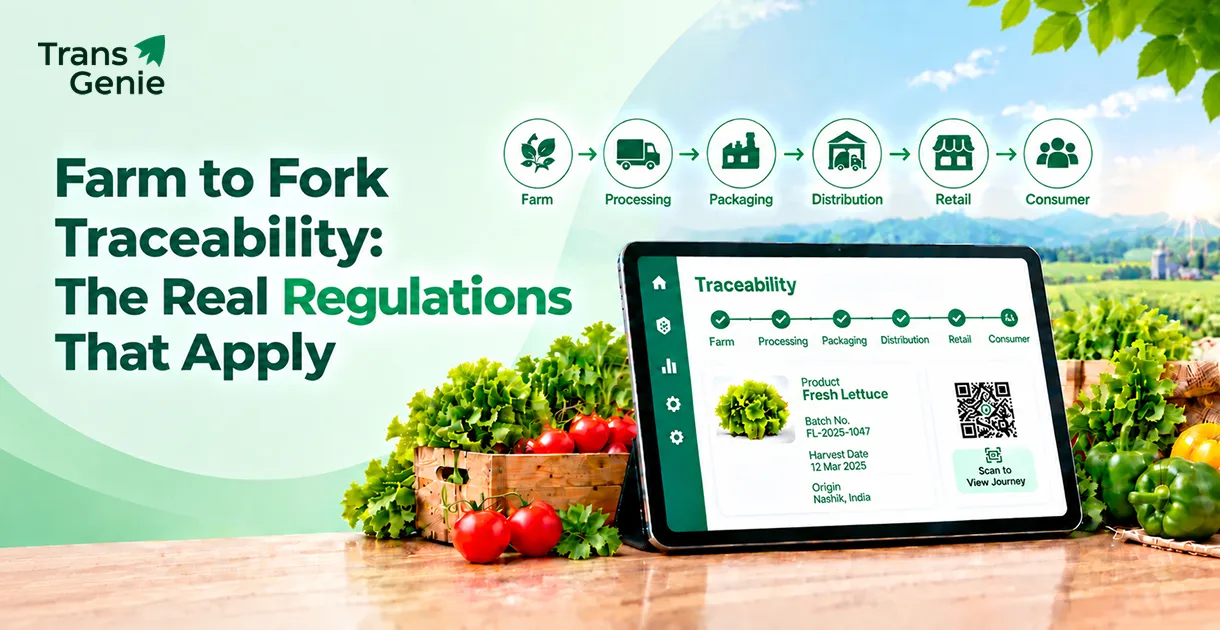
In 2026, many businesses ask the same question: “Are we farm to fork compliant? Which regulation do we need to follow? The truth is, there’s no single farm to fork food safety law or certification. It’s actually a concept, not a universal legal requirement.
This blog covers what actually binds you at each stage of the farm-to-fork journey, which regulations matter, and how to build traceability around them.
What Actually Is Farm to Fork Traceability
Farm to fork traceability is a concept for tracking food through the supply chain. It gained attention through the EU’s Farm to Fork Strategy (2020), but the strategy itself did not create one set of binding traceability rules for businesses. Its proposed initiatives also never became a unified legal framework.
What actually binds you are separate food safety from farm to fork and traceability regulations that can vary by country, product, and stage of the supply chain. The challenge is understanding which requirements apply to your business and connecting them into a single workable system.
EU Farm to Fork Traceability Requirements
Farm to fork concept isn’t a single EU law. These are the specific traceability and record-keeping requirements that actually apply across the food supply chain.
Article 18 is the Real Rule in the EU
Forget the EU farm to fork food safety strategy headlines. Your actual traceability obligation comes from Article 18 of Regulation (EC) 178/2002. This is the actual binding rule that applies across the food chain, from the farmer producing food to the retailer selling it. This has been in place since 2002, so this isn’t a new requirement created by the farm to fork strategy.
Here’s what Article 18 requires:
Every food business operator must be able to identify exactly who supplied them. This means knowing the specific person or business, what they supplied, and when they supplied it.
You must also identify the businesses you supplied. If you sell tomatoes to other businesses, you need records showing who received them.
The products must be adequately labeled or identified so they can be traced. This is where the lot codes, batch numbers, and other clear product identifiers become important.
Also, this applies to the farmers too. Based on Article 3(17), activities like growing crops, harvesting, milking, and keeping farmed animals before slaughter fall under primary production. A commercial farm is therefore considered a food business operator under EU food law, whether you grow lettuce, run a dairy farm, or produce vegetables on a large scale.
The second requirement comes from Regulation (EC) 852/2004, Annex I, Part A Section III, which requires primary producers to keep certain records. But these records serve a different purpose from traceability records. They document food safety risks and how they are managed, rather than tracking where they came from or where they actually went
Farm Record Requirements in the EU
The EU requirements also differ between animal and plant production, which affects what farmers need to document.
- Nature and origin of feed used.
- Veterinary medicinal products administered, including dates and withdrawal periods.
- Diseases that may affect the safety of products.
- Results of analyses carried out on samples.
- Relevant reports on checks performed.
- Plant production products and biocides used, including the products applied during growing, harvesting, and storage.
- Pests or diseases that may affect the product safety.
- Results of relevant analyses carried out on samples.
These records don’t give you the full traceability picture. They only show what happened during production, but not necessarily where a specific lot went.
For example, a spray diary shows what pesticide was used, but not which lot it affected or where the lot was sold. Only traceability records connect the lot to its source and destination. In simple terms, farm records show what happened on the farm, and traceability records show where the products came from and where they went.
The US Farm to Fork Traceability Requirements
The FDA Food Traceability Rule, commonly called FSMA 204 or 21 CFR Part 1 Subpart S, is more straightforward than the EU framework, but its enforcement timeline has been confusing.
Current Status: The original compliance date was January 20, 2026. The FDA has proposed July 20, 2028, but that change has not been finalized. Congress has also directed the FDA not to enforce the rule before July 2028. However, the customer contracts may still require compliance with the original date, so that business should start preparing rather than waiting.
The Three Critical Farm-Level Activities Under FSMA 204
| Activity | What Gets Recorded | Reference |
|---|---|---|
| Harvesting | Commodity, variety, quantity, farm/field, harvest date, and documents linking the harvest to the field | 21 CFR 1.1325(a) |
| Cooling | Cooling location and dates, including the harvest information received | 21 CFR 1.1325(b) |
| Initial Packing | Information received about the raw commodity and the packed food being created | 21 CFR 1.1330 |
The Lot Code is Assigned at Initial Packing
One of the most important points under FSMA 204 is that the traceability lot code is assigned by the initial packer, and not the grower.
The process is:
- Harvest Record the field, quantity, date, and required details
- Cooling Keep the harvest information connected to the cooling record
- Initial Packing The packer assigns the traceability lot code.
- Shipping The same lot code follows the products. Shipping does not create a new one.
The key is keeping the records connected. If produce is pooled without proper documentation, or field information is lost before packing, you may not be able to trace the lot back to the affected field while managing a food recall.
Beyond the Basic Rules: Additional Farm to Fork Traceability Requirements
Apart from the basic traceability rules, EU farms may also need to meet requirements for geolocation, certification, product identification, recall procedures, and supply chain control.
EUDR Geolocation Requirements for Farm Traceability
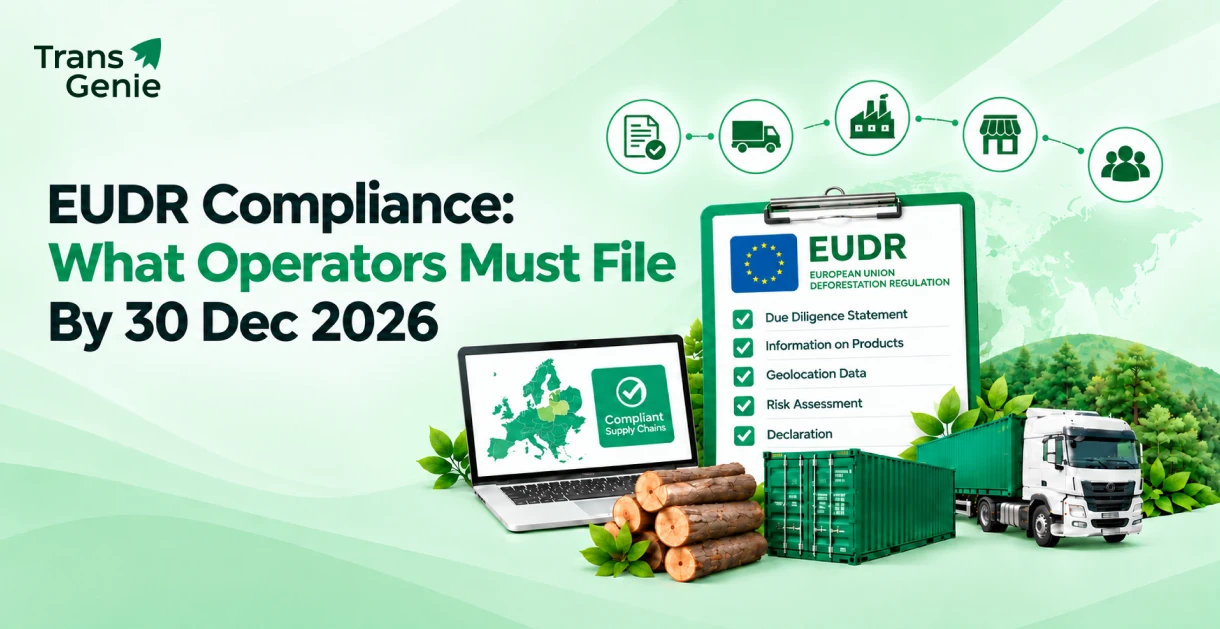
The EU Deforestation Regulation (EUDR) applies from December 30, 2026, for most operators and June 30, 2027, for micro and small operators. For covered commodities, businesses must provide precise information showing where the product was produced.
The key requirements include:
- Latitude & Longitude: Geolocation must be provided to at least six decimal places, giving roughly 11 cm of precision.
- Plots Over 4 Hectares: A polygon showing the full boundary of the plot is required, not just a single location point.
- Specific to Cattle: Geolocation applies to every establishment where the animal was kept during its lifetime. If cattle move between farms, each location must be recorded.
So, when EUDR applies, saying a product “came from our farm” isn’t enough. You need to identify the specific land parcel where it was produced.
Many EU farms already have much of this information through LPIS (Land Parcel Identification System), which supports the Common Agricultural Policy. EUDR due diligence and farm traceability can reuse existing parcel boundaries and coordinates instead of creating entirely new records.
Read our full guide on EUDR compliance to learn more about the regulations and requirements.
GLOBALG.A.P. Traceability & Certification Requirements
For many European retail supply chains, GLOBALG.A.P. Integrated Farm Assurance (IFA) is an important certification requirement. The current versions are IFA v6 Smart, which was introduced in January 2024, and IFA v6 GFS, introduced in January 2025.
The standard covers areas like product identification, traceability, recall procedures, segregation, and mass balance, where inputs must be accounted for against outputs. GLOBALG.A.P. also has a Chain of Custody standard for businesses further down the supply chain.
During the certification audits, farms need to demonstrate that their field records, traceability process, and recall procedures are properly connected and documented
Why Field-Level Records Matter More Than You Think
Field-level records can make a major difference when a foodborne outbreak occurs, helping businesses trace affected products faster and understand where contamination may have entered the supply chain.
Foodborne Outbreaks Show Why Traceability Speed Matters
Here’s the reality: the CDC says that outbreak detection can take 3-4 weeks from exposure to diagnosis and reporting. By then, the products from several weeks of production may already have reached different regions.
When the investigators finally ask where the contaminated product came from, the farm may have already harvested and shipped hundreds or even thousands of units. In the absence of detailed field records, narrowing down the affected products becomes difficult.
What the Data Says About Field-Level Traceability
The US Interagency Food Safety Analytics Collaboration’s 2023 annual report, published in March 2026, provides attribution estimates from outbreak investigations between 1998 and 2023:
67.9% of illnesses linked to farm contamination.
27.4% of illnesses from farm-level contamination.
15.9% of illnesses from farm-level contamination.
The above figures show why farm-level traceability matters the most. When a contamination is attributed to the farm or nearby stages, investigators need records that can connect the affected product back to a specific field, harvest, and lot.
This means the difference between recalling one identifiable lot and recalling everything produced during a wider period because the affected product cannot be narrowed down. Also, this isn’t just a concern in the US. In 2024, the European Food Safety Authority (EFSA) and ECDC reported 6,558 foodborne outbreaks across the EU. This is a 14.5% increase from 2023.
Field Records Are Your Safety Net
Think of field records as more than just a compliance requirement. When an actual outbreak occurs, they provide the evidence needed to trace the affected product back to its source. With investigations potentially starting weeks after the exposure, complete field records can help you identify the affected area and keep the recall focused.
Farm to Fork Traceability Requirements in the UK & India
Traceability rules vary by market. The UK and India use different systems for domestic operations, imports, and agricultural exports.
The United Kingdom
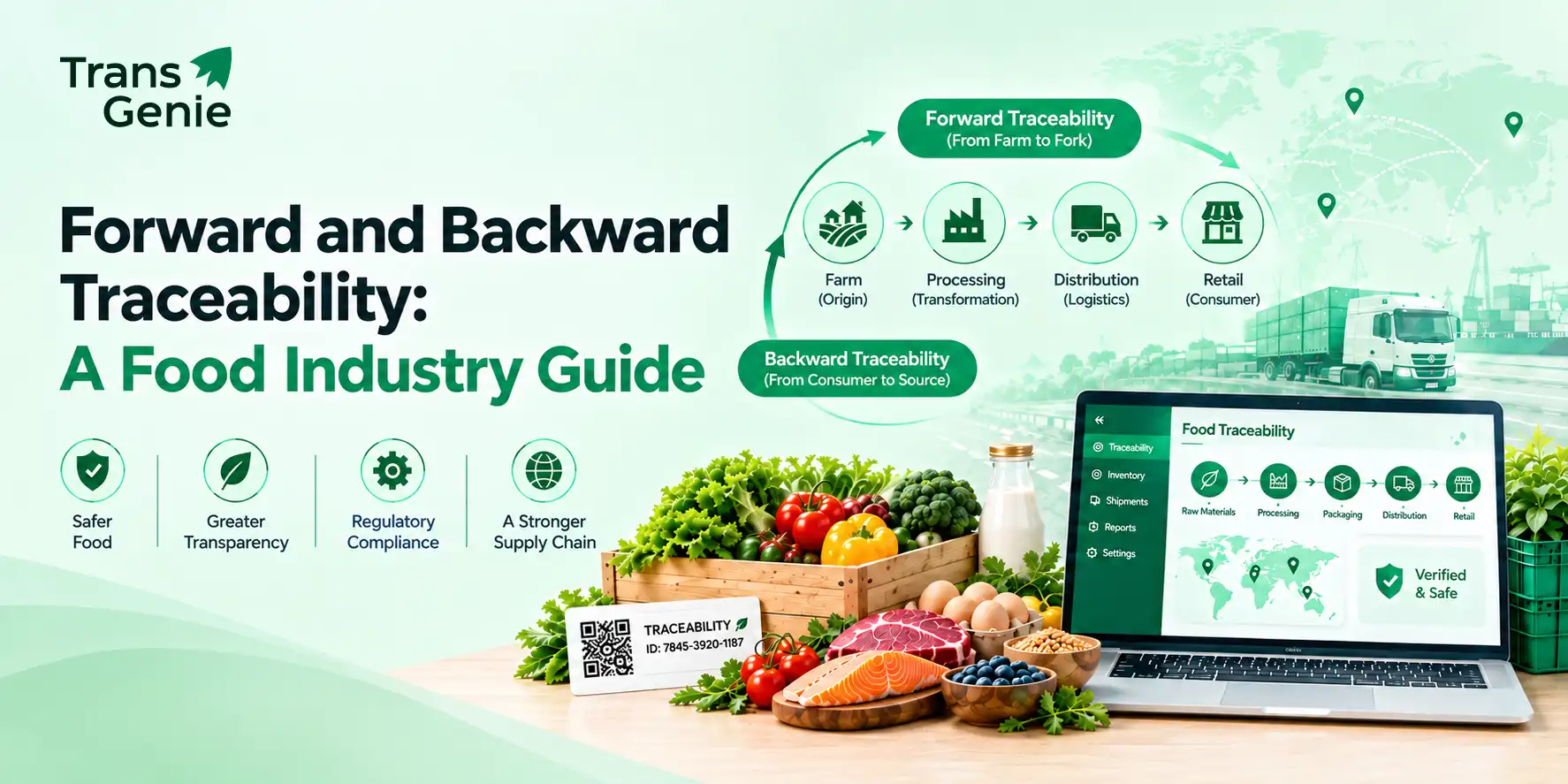
In Great Britain, Article 18 of Regulation (EC) 178/2002 continues as assimilated law, keeping the backward and forward traceability requirements. Northern Ireland follows the EU food law directly under the Windsor Framework.
UK import requirements are also evolving, so businesses importing produce into Great Britain must verify the current requirements with the relevant authority.
India
India’s requirements differ for exports and domestic operations. APEDA manages systems such as GrapeNet, which provides mandatory plot-level traceability for grapes exported to the EU, and HortiNet, covering several horticultural exports.
For domestic food businesses, traceability comes through specific regulations and licensing requirements rather than a single blanket rule. The Food Recall Procedure Regulations 2017 require recall planning and traceability, while FSSAI’s FoSCoS digital recall function, operationalized in March 2026, adds digital reporting for recalls and follow-up actions.
How to Build a Farm to Fork Traceability System for End-to-End Food Tracking
Build a connected system that links field, harvest, cooling, packing, lot codes, and customers across the food supply chain.
Define Fields
Give every field a stable identifier such as block, parcel, polygon, or GPS location. A farm name alone isn’t just enough, so use an ID your packer can also recognize.
Record Harvests
Capture the date, field, commodity, variety, and quantity during the harvest. Recording this in real time avoids gaps and unreliable details in the future.
Track pooling
When produce from different fields is pooled, record exactly what was combined. Losing field identity here can turn a targeted recall into a literal nightmare.
Assign Lot Codes
The initial packer assigns the traceability lot code, not the grower or shipping facility. Keep the same code through distribution without creating new ones.
Link Records
Connect harvest → cooling → packing → lot code → customer so that every step points to the previous one. This lets you trace a product back to its field and forward to its recipient.
TransGenie connects every stage of the process with farm traceability software, keeping the field records linked so each lot remains traceable back to its source
Explore Farm Traceability SoftwareCommon Mistakes That Cost You When an Audit Happens
Avoid the record-keeping and lot-tracking mistakes that can create problems during audits, investigations, and product recalls.
As said before, farm to fork is a concept, not a single legal requirement. Focus on the rules that actually apply to you, including EU Article 18, US FSMA 204, EUDR, GLOBALG.A.P., or India’s APEDA requirements.
A spray diary shows what was applied and when, while traceability shows which field produced the product and where it went. These serve different purposes, and you need both.
Under FSMA 204, the initial packer assigns the traceability lot code, not the grower. This creates another grower-level lot code that adds unnecessary mapping and confusion during calls.
The same traceability lot code should flow through the distribution line. Re-coding at shipping can eventually break the connection between the product, its packing record, and the original field.
A farm name alone isn’t enough when field-level identification is required. Record the specific field or growing area so that affected products can be traced and isolated much quicker.
Bottom Line!
Farm to fork traceability is only as strong as the records behind it. Incomplete, disconnected, or inconsistent records can turn a manageable issue into a huge recall and make the investigation more difficult.
The actual goal is not to collect as much paperwork as possible. It’s to have reliable records that are accurate, connected, and ready when they are needed. Build that foundation properly, and traceability becomes a part of how your business operates rather than another compliance task to deal with later.
Yokesh Sankar