
EU Deforestation Rules
The EUDR applies from December 30, 2026, for large and medium companies and from June 30, 2027, for micro and small companies under Regulation (EU) 2025/2650.
Sustainable supplier management gives complete visibility into supplier practices, certifications, and sourcing activities. TransGenie’s supply chain sustainability software brings the supplier data, certificates, and traceability under a single roof. This lets you verify product origin, track supplier compliance, and access the evidence you need to demonstrate your sustainability efforts.
 GS1 Compatible
·
 DPP Ready
·
 Blockchain Secured
·
 ERP Integration


Sustainable supplier management helps businesses collect, verify, and manage environmental, social, and ethical data across their supplier networks. This makes it easier to evaluate suppliers, identify potential risks, and ensure responsible sourcing practices.
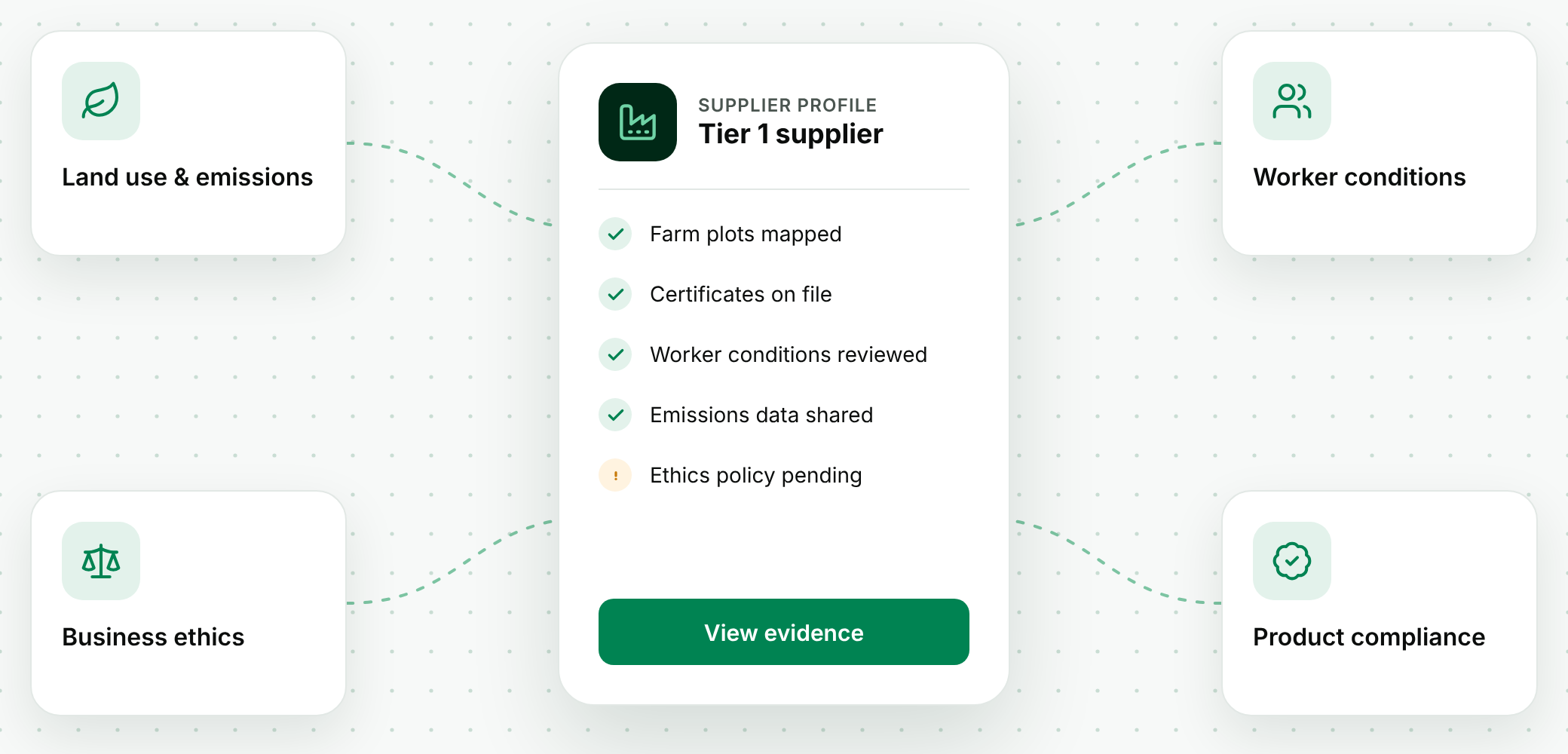
It covers key areas such as land use and emissions, worker conditions, business ethics, and product compliance requirements. TransGenie brings all the information together in one single platform, making the supplier data easier to access and manage without relying on scattered emails, spreadsheets, and PDFs.
Businesses face growing pressure to demonstrate responsible sourcing and maintain transparency across their supply chains. From regulatory requirements to customer expectations, having accurate and accessible supplier data is becoming essential.
The EUDR applies from December 30, 2026, for large and medium companies and from June 30, 2027, for micro and small companies under Regulation (EU) 2025/2650.

Importers into the US and EU need to demonstrate that their goods are free from forced labour. This requires visibility into supplier networks and the people involved in producing goods.

A significant share of a brand’s carbon footprint comes from its suppliers. Accurate Scope 3 reporting depends on reliable supplier data and emissions information.

Large retailers and brands increasingly expect suppliers to meet specific requirements as part of their purchasing agreements. Delayed information can put business contracts at stake.
Sustainable supplier management helps brands and importers make better sourcing decisions while building stronger supplier networks. Some of the key benefits include:

Identify environmental, social, and ethical risks before they affect business operations.

Set clear expectations and encourage suppliers to improve their sustainability practices.

Evaluate suppliers based on their practices, certifications, and compliance records.

Stay prepared for changing sustainability regulations and buyer requirements.

Demonstrate responsible sourcing practices and build trust with customers and business partners.

Reduce waste, avoid supply disruptions, and improve resource efficiency across supplier networks.
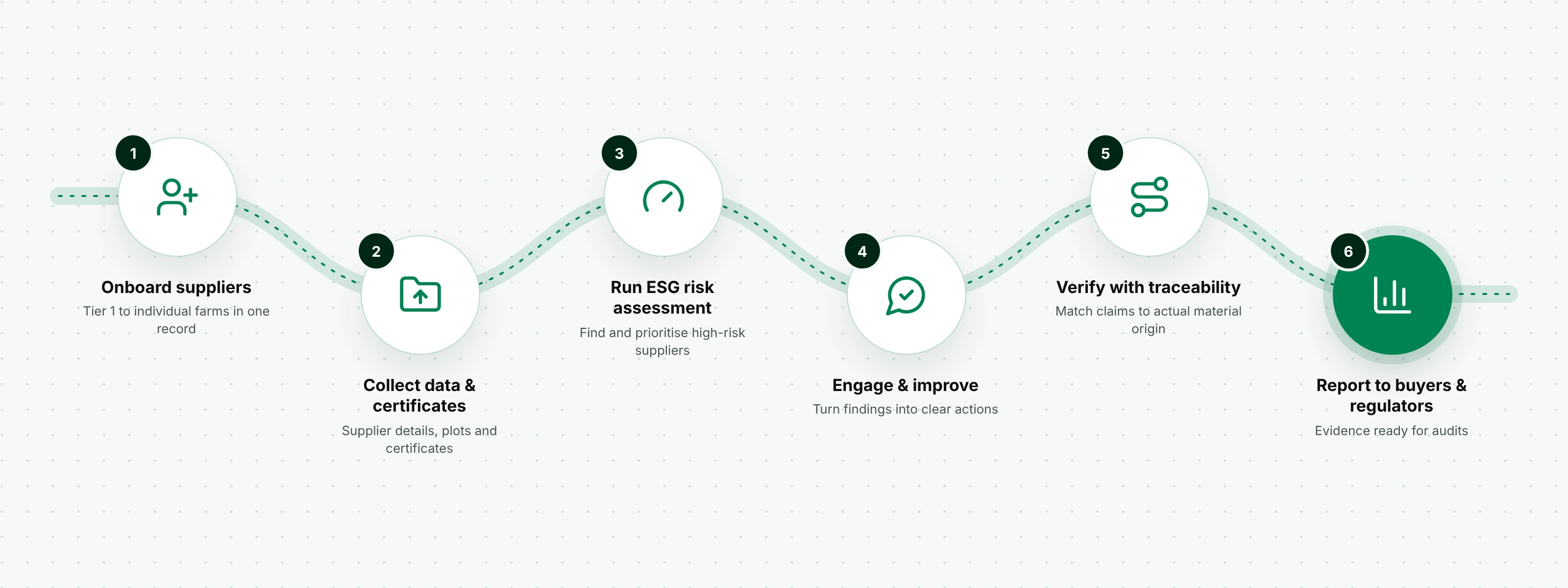
TransGenie simplifies sustainable supplier management with a structured six-step process that helps you manage supplier information and maintain verifiable records across your entire supply chain.
 Step 1
Bring your entire supplier network into one centralized record, from tier 1 suppliers to individual farms.
 Step 2
Gather the supplier details, plot information, and certificates that support their sustainability claims.
 Step 3
A supplier ESG risk assessment helps identify high-risk suppliers and prioritize areas that need attention.
 Step 4
A supplier engagement strategy turns the assessment findings into clear actions, with supporting evidence for both parties.
 Step 5
Verify supplier claims with end-to-end traceability by matching their declarations against the actual origin of materials.
 Step 6
Prepare evidence for buyers, auditors, and regulators without last-minute document collection.
Simplify how you manage supplier relationships and support your sustainability goals.
Supplier questionnaires can tell you what a supplier claims about their sourcing practices, but they don’t always prove where the materials come from. TransGenie connects the supplier information with traceability records. This helps you verify claims and make more informed sourcing decisions.
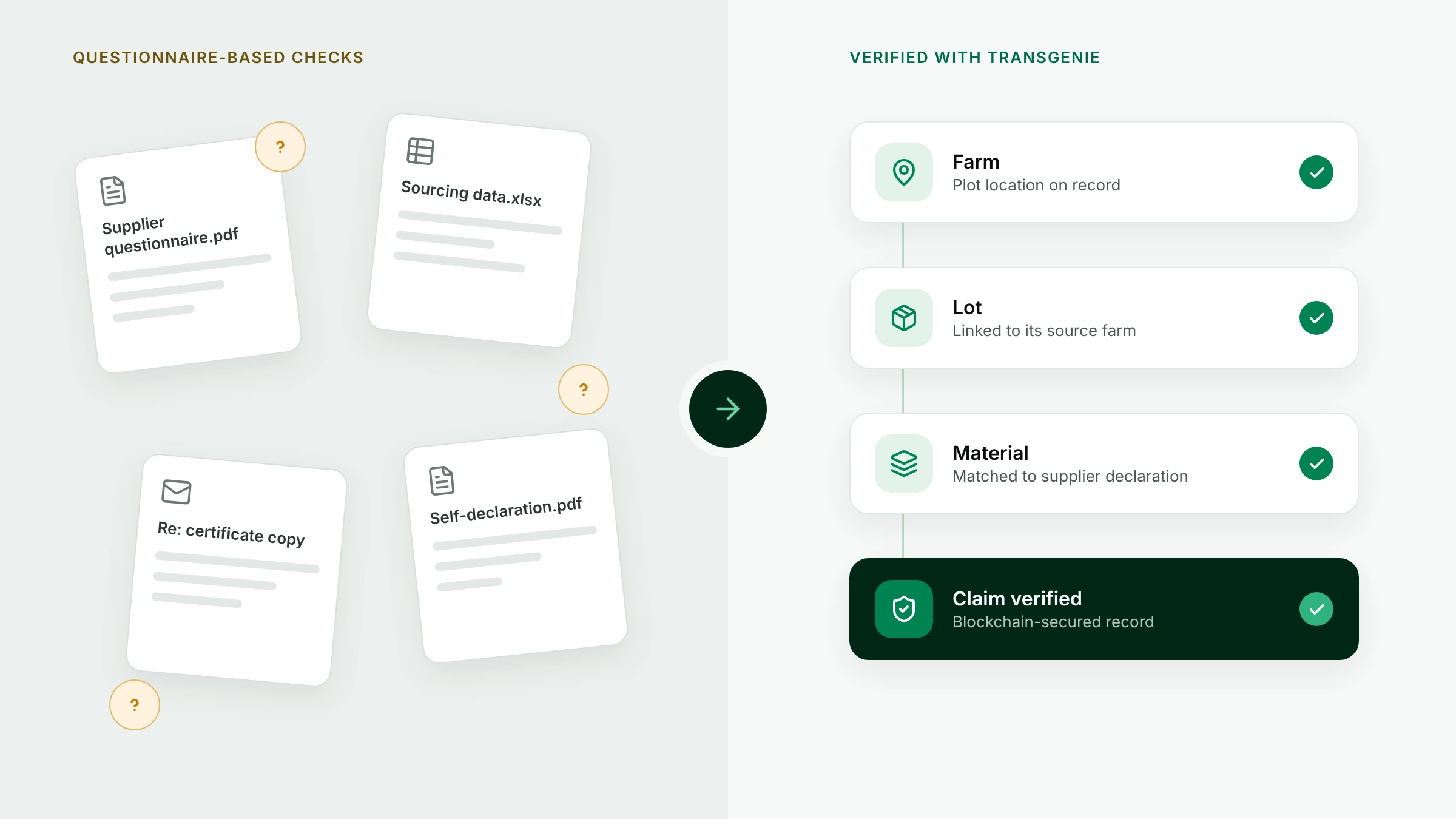
Relying only on supplier questionnaires means taking only their responses at face value. Without any supporting records, it’s difficult to confirm material origins, identify inconsistencies, or assess whether sustainability claims are accurate.
TransGenie, on the other hand, connects supplier responses with farm, lot, and material records. This gives you a clear picture of where the products come from and helps you identify unsupported claims before they become compliance issues.
Managing supplier sustainability comes with multiple challenges. TransGenie helps simplify these tasks with better data organization, traceability, and supplier risk management.

Challenge: Supplier certificates and sourcing details get lost across emails and spreadsheets.
Solution: Keep everything organized in one centralized system.

Challenge: Supplier questionnaires don’t always prove sustainability claims.
Solution: Cross-check information against farm, lot, and material records.

Challenge: Tracking only tier 1 suppliers leaves gaps in your supply chain.
Solution: Extend visibility across the network, down to individual farms.

Challenge: Suppliers often delay sharing information or fail to provide complete responses.
Solution: Set clear expectations and timelines through a structured supplier engagement strategy.

Challenge: Evaluating every supplier at once can overwhelm your team.
Solution: Use a supplier ESG risk assessment to prioritize high-risk suppliers.

Challenge: Keeping up with evolving compliance requirements can make supplier data management difficult.
Solution: Maintain updated and traceable records to stay prepared for EUDR reporting.
See how TransGenie makes sustainable supplier management easier with connected tools that bring greater visibility and control to your supply chain.

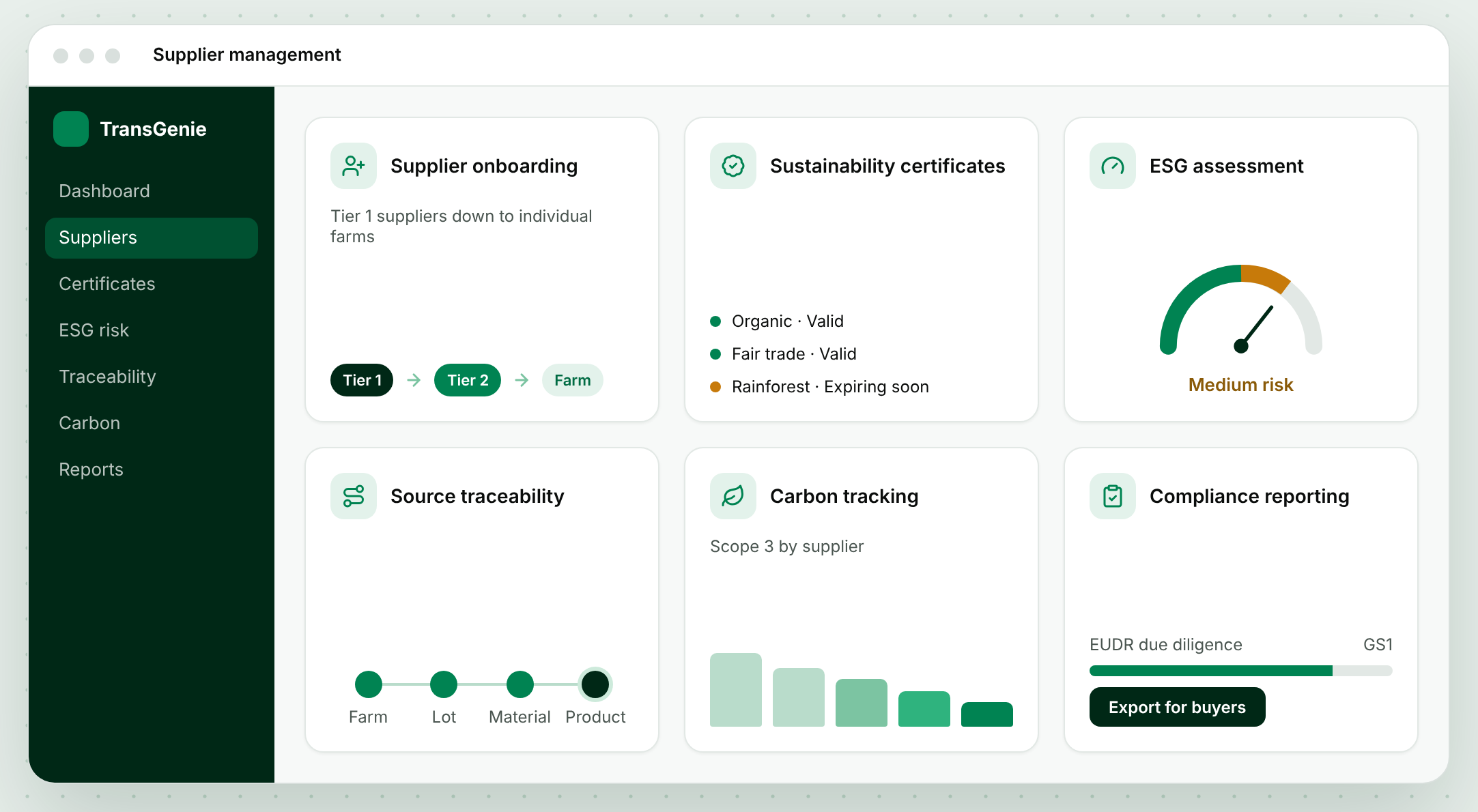
Bring the supplier and lot information together in one structured system. Standardized fields make it easier to compare supplier data and reduce the time spent chasing documents.

Store certificates alongside the suppliers and lots they apply to. So you can easily find the supporting documents without hassle.

TransGenie supports supplier ESG assessment through risk assessment and mitigation. Make supplier decisions based on the documented evidence rather than just assumptions.

Track the products back to their original farm, lot, or materials. Blockchain-secured records help protect traceability information from unauthorized changes.

Connect sustainability data with the same traceability records that are used to track materials across the supply chain. You can get in-depth info by surfing our carbon traceability guide.

Helps maintain organized, traceable records for digital passports using GS1-compatible data, making compliance documentation easier to manage and access.
Even though these two tools are often grouped together, they serve different purposes. Supply chain sustainability software verifies supplier practices and sourcing. ESG reporting software focuses on company-wide ESG performance.
| Aspects | Supply Chain Sustainability Software (TransGenie) | ESG Reporting Software |
|---|---|---|
| What It Tracks | Suppliers, certificate validity and risks, and material origins | Company-level ESG metrics and disclosures |
| Who Uses It | Sustainability, procurement, and compliance teams | Finance, investor relations, and ESG reporting teams |
| Data Source | Supplier evidence and traceability records | Internal company reporting data |
| Best For | Verifying supplier claims and sourcing practices | Preparing and publishing ESG disclosures |
Good sustainable procurement software helps purchasing teams understand which suppliers meet their requirements. TransGenie gives procurement teams visibility into supplier risks, certifications, and material origins before they commit to a supplier and throughout the relationship.
This helps businesses identify reliable suppliers, support improvements where needed, and make informed sourcing decisions. Whether you call it responsible sourcing or sustainable procurement, TransGenie connects the supplier data with supply chain traceability, keeping the procurement and compliance teams aligned.
TransGenie supports businesses across industries with tools to improve supply chain visibility, verify sourcing information, and maintain reliable product records.

Track products from farm plots to finished goods.

Trace every lot back to its catch or farm.

Track fibres and fabrics across multiple supplier tiers.

Maintain plot-level sourcing records, supporting deforestation compliance.

Keep material records ready for digital product passports.
Pick software that gives you clear supplier information, reliable evidence, and the tools to manage sustainability across the supply chain. Use the checklist below to see which capabilities your current system covers.
Select the capabilities your current software supports.
Are you missing a few? Don't worry. Ask for a demo, and TransGenie will show you how to fill those gaps.
Ask for a Demo →Discover why businesses choose TransGenie to simplify supplier management and support their sustainability goals. Get the tools and visibility you need to manage your supply chain with confidence.

Connect supplier responses with traceability records to verify the information they provide.

Manage supplier onboarding, certificates, ESG assessments, and traceability in a single platform.

Maintain GS1-compatible data for EUDR requirements and digital product passports.

Blockchain-secured data helps detect unauthorized changes and keeps the supplier records reliable.

Connect TransGenie with your existing ERP systems without disrupting your current workflows.
See how TransGenie can support your supplier management and responsible sourcing efforts.